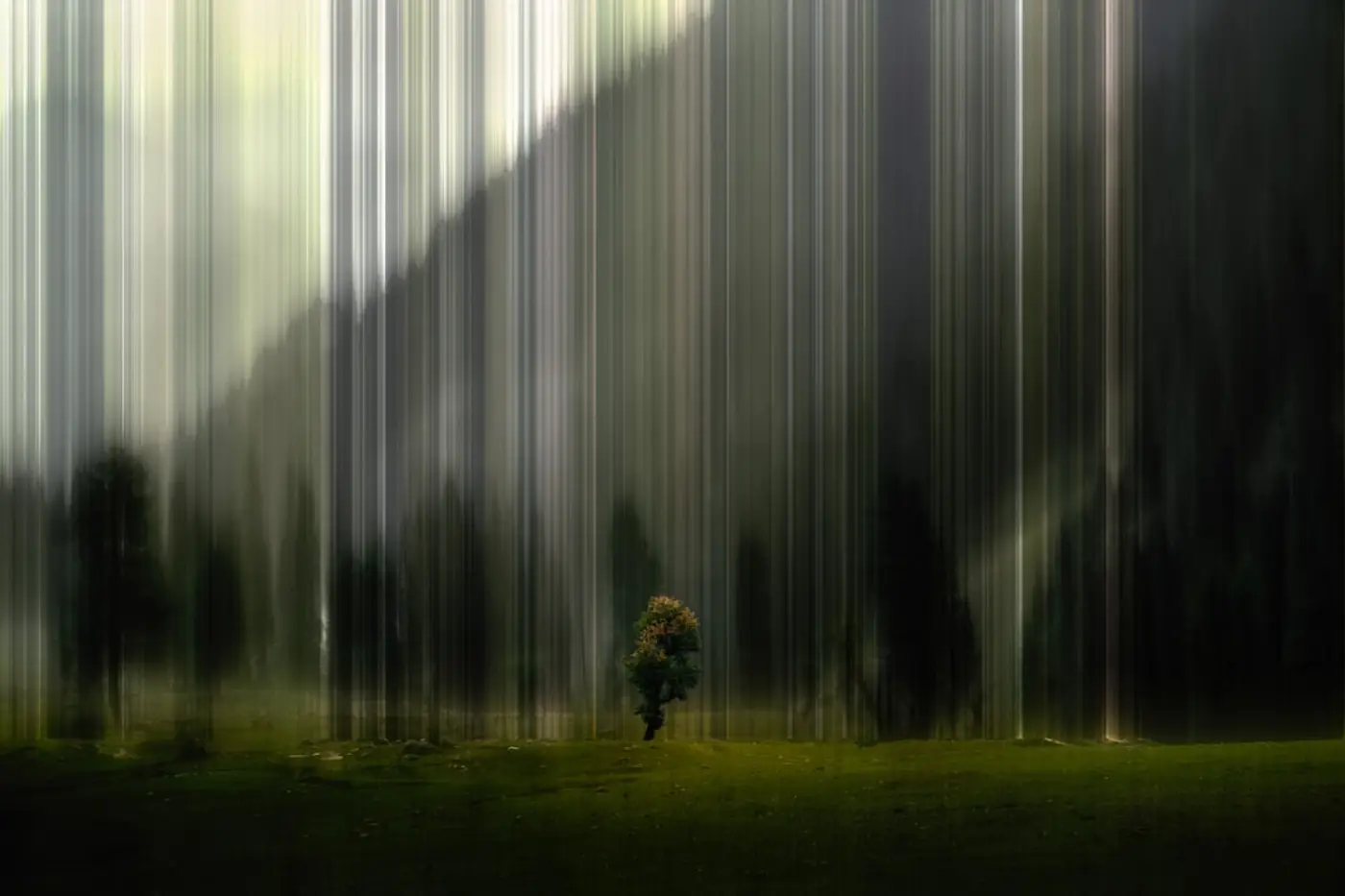
In the relationship between simulation and reality, the question reveals more than any answer: whoever asks whether reality is a computer simulation has already anticipated the answer. Not because the question is trivial, but because it presupposes a particular metaphysics: a cosmos of dead, computable matter onto which consciousness is retroactively imposed. Only in such a world is the step from reality to simulation conceivable, for if matter is mindless in any case, it makes no difference whether it consists of carbon or code. The simulation hypothesis is not the boldest question of our time. It is the final consequence of a conceptual error that began in the seventeenth century.
#The Question That Gives Itself Away
Nick Bostrom formulated the best-known argument in 2003: if a sufficiently advanced civilisation were capable of creating conscious beings in a computer simulation, then it would be statistically probable that we ourselves are simulated beings. The premise sounds sober, yet it contains a concealed decision: consciousness is posited as computable and substrate-independent. It is treated like software that can run on any hardware. That this assumption is itself a metaphysical position, not an empirical finding, remains invisible within Bostrom’s argument.
The substrate-independence tacitly presupposed here stands or falls with a Cartesian separation of mind and matter. If you read Descartes’ Meditationes de Prima Philosophia (1641), you find doubt pushed so far that the entire external world became thinkable as the deception of an evil demon. The simulation hypothesis updates this thought technologically: instead of a Genius Malignus, a supercomputer stands behind the veil. What changes is the vocabulary. What does not change is the structure: a radical doubt that corrodes its own ground because it drives reality and appearance apart without remainder.
#From the Cave Allegory to the Screen
In the Everlast AI Debate (2026), Gwendolin Kirchhoff unfolded a genealogy that locates the simulation idea deeper than is customary in contemporary tech philosophy. The conceptual metaphor that drove the Enlightenment, she argued, was the Platonic cave: sense perception as shadow-play, liberation as exit into the measurable (cf. Kirchhoff, G., 2026, Everlast AI Debate, 1:34:46). Three posits followed: first, a Chorismus — a radical ontological barrier between inside and outside. Second, the Lethe: there is nothing to discover inside; the innate ideas are erased, the tabula rasa becomes the starting point. And third, the elevation of simulation to the criterion of truth: “Science actually does nothing other than produce simulations of something — make models or produce simulations — and then increasingly loses the distinction between simulation and reality” (Kirchhoff, G., 2026, Everlast AI Debate, 1:36:26).
The decisive point: this development is not accidental but structurally determined. A tradition that rejects interiority as deceptive ultimately produces screens. A society that liberates itself from interiority ends up “in a built cave-city, a great machine-city, where we all waste away in front of screens” (Kirchhoff, G., 2026, Everlast AI Debate, 1:36:39). In this perspective, the simulation hypothesis appears not as a philosophical provocation but as the self-description of a culture that mistakes its own condition for the structure of reality.
#The Machine as Likeness for the World
The question of who or what is used as a likeness for the cosmos carries philosophical weight. Jochen Kirchhoff (1944-2025) made this choice of analogy a central problem: at present, the machine is used as the source of analogy for the cosmos — a reduction from the living, rather than taking the living human being as the starting point (cf. Kirchhoff, J., 2019, What Is Knowledge?, 72:00). If you think the cosmos on the model of a machine, simulation is conceivable. If you think it on the model of the living, simulation is absurd.
Hans Vaihinger described in The Philosophy of As-If (1911) the mechanism by which fictions become hypotheses and finally assumptions about reality. Jochen Kirchhoff radicalised this insight: “Empirical natural science exists up to a certain degree. Hypothetical natural science exists. But there is also fictive natural science, and the domain of fictive natural science is far larger than one thinks. Much of it consists simply of fictions, mathematised fictions” (Kirchhoff, J., 2022, Nietzsche as Critic of Science, 82:35). The simulation hypothesis is one such mathematised fiction: it takes an unexamined premise (consciousness is computable), dresses it in probability calculus, and presents the result as a serious possibility. The fiction does not lack formal consistency. It lacks ontological ground.
#What Living Nature Does Not Simulate
The hylomorphism of Aristotle contradicts substrate-independence at the root. Form and matter are inseparable in living beings. The entelechy — the realised purpose of an organism — cannot be detached from the living substrate and transferred to another medium without ceasing to be that entelechy. Kirchhoff stated in the debate: “The hylomorphism of Aristotle is precisely anything but substrate-independent. The entelechy is inseparably bound to the living being, and therefore it is not suitable for making a case for machine consciousness” (cf. Kirchhoff, G., 2026, Everlast AI Debate, 27:40).
From this follows a precise diagnosis: in a cosmos thought of as living — in which consciousness does not emerge retroactively from dead matter but inheres in the cosmos from the ground up — the simulation question dissolves. Not because it is forbidden, but because it becomes pointless. You can imitate a surface, copy a function, mimic a behaviour. What you cannot simulate is interiority: the that of experience, which no external model produces. Schelling formulated the principle: “As long as I am myself identical with nature, I understand what living nature is as well as I understand my own life. But as soon as I separate myself and with me everything ideal from nature, nothing remains to me but a dead object” (Schelling, 1797, Ideen zu einer Philosophie der Natur).
The simulation hypothesis presupposes exactly this separation and then asks, astonished, whether the dead object might also be an illusion. The question has no answer because it stands on a false foundation. The doubt that can think reality as simulation has already lost its ground when it severed the living from thought. The solution lies not in a proof against simulation. It lies in a return to what the Cartesian cut banished: your bodily perception, your experience of your own interiority, and a cosmos that is not computed but lived.
This field connects to the question of machine consciousness, to the critique of materialism as an invisible metaphysics, and to the natural philosophy that defends the living cosmos against its mechanistic reduction.
I defended this concept in my debate with Joscha Bach on Everlast AI — the full conversation is on YouTube (in German, 2:37:50).
#Sources
Descartes, R. (1641). Meditationes de Prima Philosophia.
Kirchhoff, G. & Bach, J. (2026). Streitgespräch: „Der Mensch soll abgeschafft werden!” Wohin steuert uns KI wirklich? [Video]. Everlast AI, YouTube. https://www.youtube.com/watch?v=vSwmJDMw4xY
Kirchhoff, J. (2019). “Was ist Erkenntnis? Wissenschaftliche Methode & Philosophie” [video]. Jochen Kirchhoff — In Memoriam, YouTube.
Kirchhoff, J. (2022). “Nietzsche als Wissenschaftskritiker” [video]. Jochen Kirchhoff — In Memoriam, YouTube. https://youtube.com/watch?v=tP9zNqZG5pI.
Schelling, F. W. J. (1797). Ideen zu einer Philosophie der Natur. Breitkopf und Härtel.
Vaihinger, H. (1911). Die Philosophie des Als-Ob.