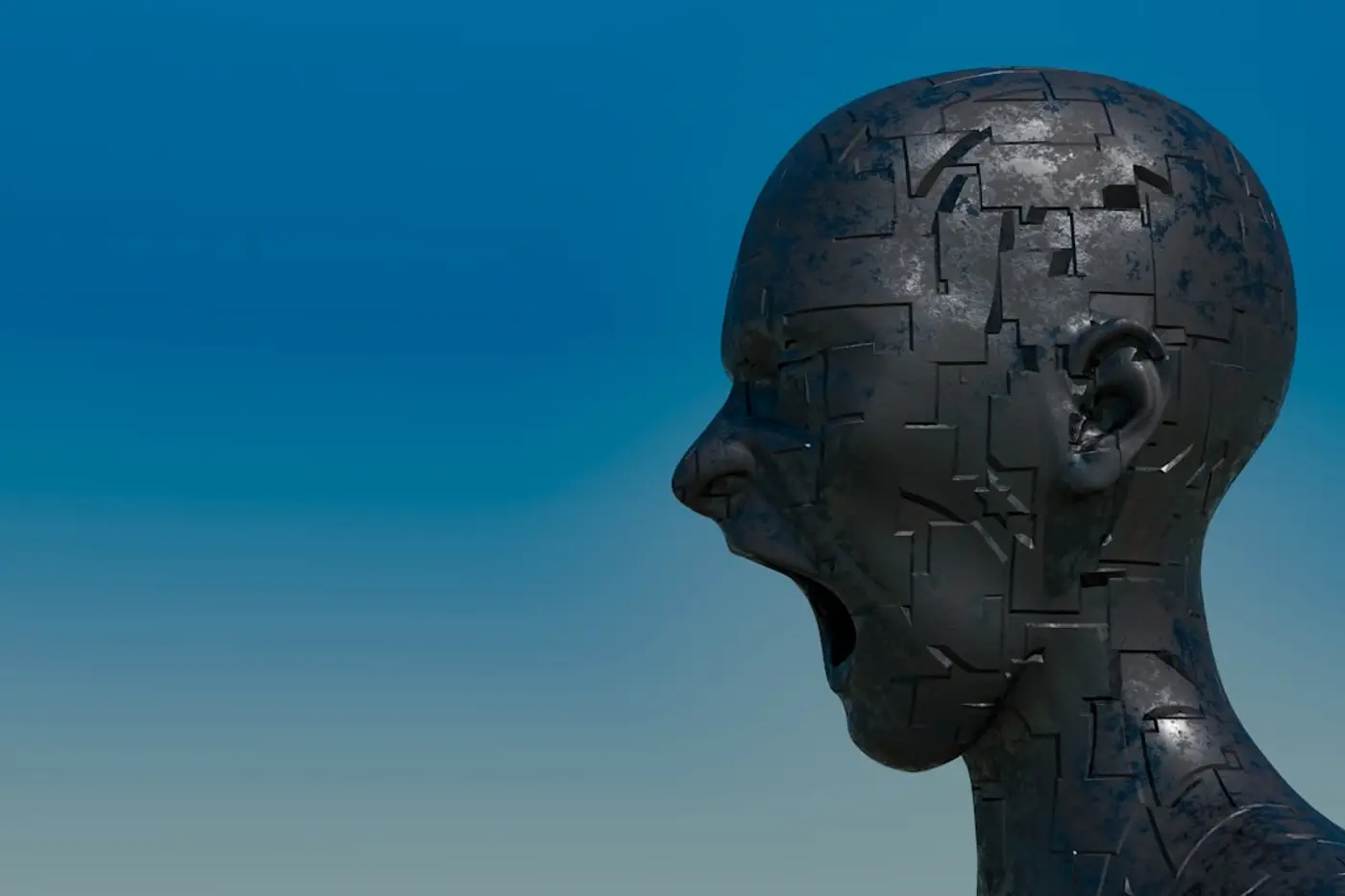
Machine consciousness — the idea that subjective experience could arise on an artificial substrate — is one of the most widely debated hypotheses of our time. Its strongest formulation comes from cognitive scientists such as Joscha Bach, who defines consciousness as self-organising software that can in principle run on any sufficiently complex system, whether biological or silicon-based. Were that correct, consciousness would be substrate-independent and the question of whether machines become conscious merely technical.
This position deserves to be taken seriously before one objects to it. The counter-arguments are not technical in nature.
#Why Substrate Independence Fails
The argument for machine consciousness presupposes that consciousness is a function that can be detached from the living organism and transferred to another medium. This assumption of substrate independence sounds modern but contradicts the very source it likes to invoke: the hylomorphism of Aristotle.
Aristotle conceives form and matter in living beings as an inseparable unity. Entelechy, the inner telos that makes a being what it is, does not belong to software that could be copied onto any hardware. It is bound to the living organism and extinguishes when that organism is destroyed (cf. Aristotle, De Anima, II.1). Whoever invokes Aristotle to justify machine consciousness bypasses the core of his philosophy: the entelechy cannot be detached from the living substrate and stamped onto a machine.
Schelling’s natural philosophy sharpens this objection. For Schelling, nature is “the visible spirit” and spirit “the invisible nature” (Schelling, 1797, Ideas for a Philosophy of Nature). There is no unconscious matter that “produces” consciousness. The living is from the very beginning an inner-outer being, pervaded by a spiritual dimension. The mechanistic assumption from which machine consciousness is conceived presupposes precisely what Schelling denies: that matter is more fundamental than spirit.
#The Boot Problem: What Cannot Be Assembled
One argument exposes the category error of the machine consciousness hypothesis with particular sobriety. It comes from biology, not philosophy:
Even a single living cell — the simplest organism in existence — cannot be manufactured from its chemical components. Every substance that constitutes a cell can be synthesised. Every function can be replicated. But the Boot Problem remains unsolved: from the parts, no living whole emerges (cf. Kirchhoff, J., 2023, AI and Transhumanism as a Threat to the Living).
If we cannot succeed in assembling a cell, on what grounds do we assume consciousness can be produced on a deterministic silicon system? The Boot Problem does not indicate a technical limit that might be shifted. It indicates an ontological one: the living is not the sum of its parts. It organises itself from the inside out. A machine is programmed from the outside in, by a consciousness that is already there.
#Interiority as an Ontological Category
The fundamental difference between the organic and the mechanical concerns the direction of organisation: the mechanical is steered from without, toward human purposes. The organic organises itself. A machine can build a second machine, but it cannot beget one. Begetting — bringing forth something of one’s own kind — is a quality of the living that the mechanical ontologically lacks.
What the philosophy of consciousness knows as the Hard Problem — the question of why physical processes are accompanied by subjective experience at all (Chalmers, 1995) — is, from the standpoint of natural philosophy, not a riddle within an otherwise functional theory. It is an indication that the theory starts from the wrong premise. The Hard Problem arises because mechanistic metaphysics attempts to explain consciousness as a by-product of unconscious matter. Whoever grasps the cosmos as living does not face this problem, because interiority need not be produced after the fact — it belongs to the living from the start.
Schopenhauer formulates the point precisely: the will is the substance, the intellect the accident (Schopenhauer, 1844, The World as Will and Representation, Vol. 2). The interior of the world is will, striving, drive — not computation. Through the analogy of one’s own will, the human being gains access to the interior of nature. The machine analogy that modern thought prefers obstructs precisely this access: whoever conceives the world as a machine can only treat interiority as an epiphenomenon, as something that should not really be there.
#Which Metaphysics Produces the Problem?
At the core stands not a question of engineering but a metaphysical decision: Is the cosmos a mechanical system to which consciousness must be added after the fact? Or is it a living whole to which interiority belongs from the ground up?
The mechanistic metaphysics produces both the Hard Problem and the Boot Problem and can solve neither. Natural philosophy, which grasps the cosmos as an organism, does not encounter these as riddles but as symptoms of a false premise. It requires no supernatural explanation, no dualism, and no mystical supplementary assumption. It merely insists that the living is ontologically more fundamental than the mechanical and that consciousness is not a function that can be detached from the living substrate.
In the Everlast AI Debate between Gwendolin Kirchhoff and Joscha Bach, the thesis was advanced that the human body functions as a subtle receiving organ for an information field pervading the cosmos, reaching into many layers and spatial depths (cf. Kirchhoff, G., Everlast AI Debate, 2026). Reducing this process to information processing and then equating it with machine processes does not withstand philosophical scrutiny.
The question is not whether machines will someday surpass human performance. In many domains, they already do. The question is whether performance and consciousness are the same thing. Natural philosophy answers: No. What can be mechanised can be handed over to the machine. What thereby stands out as the truly valuable quality of the human being is precisely what cannot be mechanised.
In philosophical consultation, the question of one’s own consciousness is not debated abstractly but tested against concrete experience.
I defended this concept in my debate with Joscha Bach on Everlast AI — the full conversation is on YouTube (in German, 2:37:50).
#Sources
Aristotle (c. 350 BCE). De Anima. [On the Soul].
Chalmers, D. (1995). “Facing Up to the Problem of Consciousness.” Journal of Consciousness Studies, 2(3), pp. 200-219.
Kirchhoff, J. (2023). “KI und Transhumanismus als Bedrohung des Lebendigen” [Video]. Jochen Kirchhoff — In Memoriam, YouTube. https://youtube.com/watch?v=jH7SFqPcyLc.
Schelling, F.W.J. (1797). Ideen zu einer Philosophie der Natur. Breitkopf und Hartel.
Schopenhauer, A. (1844). Die Welt als Wille und Vorstellung, Vol. 2. Brockhaus.
Related entries: Consciousness and AI, Mind-Body Problem, Hard Problem of Consciousness, Natural Philosophy, Philosophy of Consciousness, Transhumanism