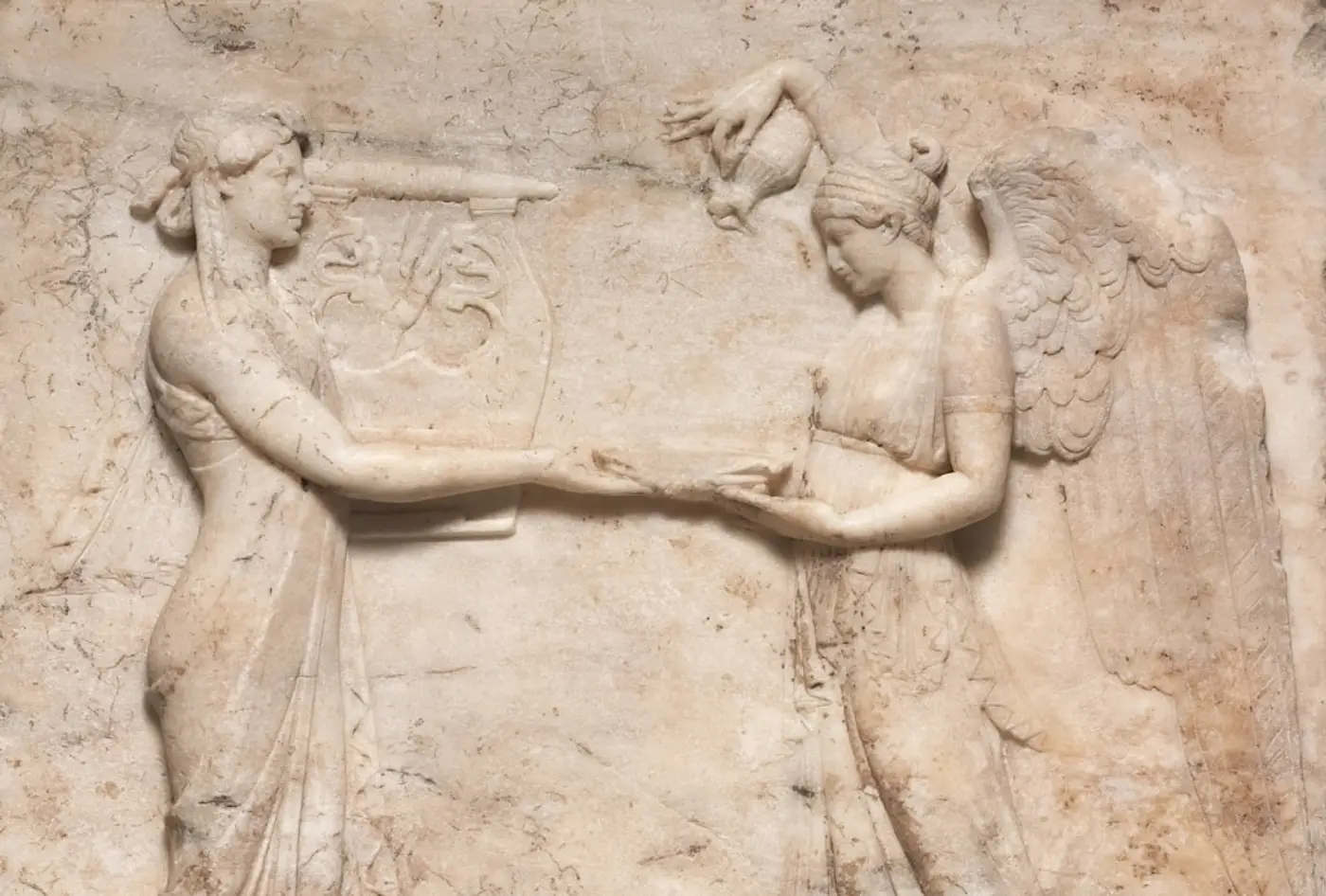
Chorismos — the Greek word chorismos means separation, severance, gulf. Aristotle used it as a technical term for a problem he identified in Plato’s theory of Forms: if the Forms exist in a world of their own, separated from sensible things, how can they still explain anything about those things? The Idea of the Good, severed from good action. The Idea of the Living, severed from the living organism. What was intended as knowledge became a split. This split — not as a historical episode but as a continuing movement in European thought — is what chorismos means.
#How a Separation Propagates
What begins in Plato as an epistemological problem becomes, with Descartes in the 17th century, an ontological decision. His distinction between res cogitans and res extensa divides reality into two substances that share nothing: thinking spirit on one side, extended matter on the other. Descartes consistently defined animals as mechanical automata. If a dog makes noises during vivisection, it squeaks like a mechanism (cf. Kirchhoff, G., 2026, Everlast AI Debate, 1:18:24). Matter becomes spiritless mass, spirit becomes a placeless spectator, and the pineal gland becomes the desperate attempt to join the two back together.
Jochen Kirchhoff (1944-2025) described in his conversation on Schelling how this split propagated from Descartes through Fichte into the present: a separation into a rationally-mathematically graspable world of spirit on one side and a mechanism of nature on the other that actually stand in no connection to each other (cf. Kirchhoff, J., 2021, Schelling: Genie der Naturphilosophie, 26:59).
Modern natural science inherited this chorismos as an invisible premise. It presupposes what it no longer examines: that nature is an object that can be fully disclosed through analysis, measurement, and mathematical modelling, without the measurer themselves being part of what is measured.
#Schelling’s Diagnosis
Friedrich Wilhelm Joseph Schelling (1775-1854) formulated in his Ideas for a Philosophy of Nature (1797) the sharpest diagnosis of chorismos in the entire philosophical tradition. Schelling describes the separation as the foundational condition of philosophizing itself: “Philosophy must presuppose that original separation, for without it we would have no need to philosophize” (Schelling, 1797, Ideas for a Philosophy of Nature). The task of philosophy, however, is to overcome this separation, not to perpetuate it.
This is precisely what the philosophy of reflection does. It makes the separation permanent instead of treating it as a means. Schelling called mere reflection a disease of the mind: “Mere reflection is a disease of the mind of the human being — moreover, where it sets itself up in dominion over the whole human being, that disease which kills his higher existence in the bud, his spiritual life, which proceeds only from identity, at its very root” (Schelling, 1797, Ideas for a Philosophy of Nature). This is not polemic but an ontological determination: thinking that cuts itself off from what is thought loses access to the living.
Against this chorismos Schelling set his famous identity thesis: “Nature is to be the visible spirit, spirit the invisible nature” (Schelling, 1797, Ideas for a Philosophy of Nature). In the absolute identity of spirit and nature, the question of how a nature outside us is possible dissolves. The question arises only through the separation, and it vanishes when the separation is overcome.
#What Is Lost When You Separate
Schelling formulated the consequence of chorismos with a clarity that has lost none of its sharpness across two centuries: “As long as I am myself identical with nature, I understand what living nature is as well as I understand my own life […] but as soon as I separate myself, and with me everything ideal, from nature, nothing remains for me but a dead object” (Schelling, 1797, Ideas for a Philosophy of Nature).
This is the heart of the problem. Whoever separates kills what they seek to know. The separated observer sees dead matter because the very act of separation renders invisible what is living in nature. The mathematical description of nature, as Schelling put it in a comparison in his lectures (1803), resembles the attempt to describe Homer’s works by counting the printed characters (cf. Schelling, 1803, Lectures on the Method of Academic Study). Of the inner movement one knows nothing at all.
In the contemporary debate on consciousness, chorismos repeats itself in a new guise. Whoever claims that consciousness is substrate-independent and transferable to machines operates with a Cartesian premise: that form and matter are separable. Hylomorphism contradicts this fundamentally. The entelechy that Aristotle conceived for living beings is inseparable from the living organism (cf. Kirchhoff, G., 2026, Everlast AI Debate, 27:40).
#Chorismos as Structure, Not Error
In the Everlast AI Debate (2026), Joscha Bach used the term chorismos to describe the structure of the Western Enlightenment: “If we posit the Enlightenment or posit modernism as a liberation from a cave, we posit a chorismos — we posit a radical ontological barrier between inner and outer” (Bach, 2026, Everlast AI Debate, 1:35:45). The liberation from Plato’s cave reproduces the very split it claims to overcome, and produces a culture that abandons its interiority in order to end up in self-built urban caves before screens.
Bach describes the finding; Gwendolin Kirchhoff names the resolution: bodily perception, the return to the perspective of interiority (cf. Kirchhoff, G., 2026, Everlast AI Debate, 1:37:06). Chorismos cannot be overcome through a better argument, only through a different kind of thinking — one that no longer presupposes the rift between thinking and life.
Natural philosophy is the systematic counter-programme to chorismos. It begins where the separation of spirit and nature is recognized as a philosophical disease, and works to reunite what was originally one. Schelling’s phrase about the endless estrangement of the philosophy of reflection was no rhetorical exaggeration but a description of a condition that applies to the present even more precisely than to his own time. Whoever asks why this split is so hard to think and harder still to overcome finds in the analogy model the epistemological explanation: the choice of analogy source determines what can be known, and a culture that chooses machines as its explanatory model can no longer systematically see the living.
#Sources
Kirchhoff, G. & Bach, J. (2026). Streitgespräch: „Der Mensch soll abgeschafft werden!” Wohin steuert uns KI wirklich? [Video]. Everlast AI, YouTube. https://www.youtube.com/watch?v=vSwmJDMw4xY
Kirchhoff, J. (2021). “Schelling: Genie der Naturphilosophie” [Video]. Jochen Kirchhoff — In Memoriam, YouTube. https://youtube.com/watch?v=Hw-jL1EER5Q.
Schelling, F. W. J. (1797). Ideen zu einer Philosophie der Natur. Breitkopf und Härtel, Leipzig.
Schelling, F. W. J. (1800). System des transzendentalen Idealismus. J.G. Cotta, Tübingen.
Schelling, F. W. J. (1802). Bruno, oder über das göttliche und natürliche Prinzip der Dinge. Unger, Berlin.
Schelling, F. W. J. (1803). Vorlesungen über die Methode des akademischen Studiums.