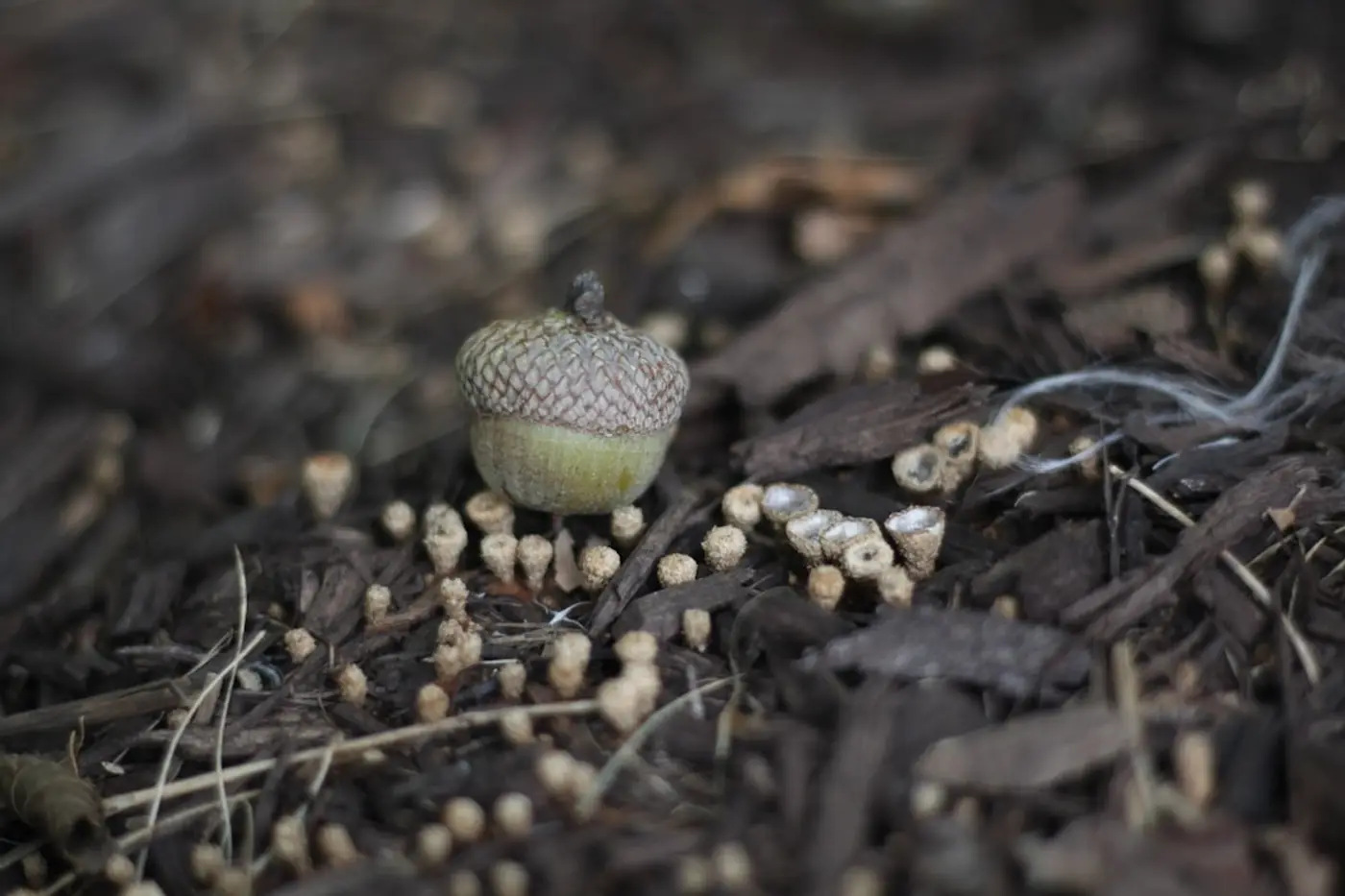
How does the acorn know it is meant to become an oak? Entelechy, Aristotle’s answer to this question, is one of the most consequential concepts in Western philosophy. What it describes is an inner directedness that inheres in the living being itself and requires no external designer. The term sounds ancient. The question it poses has never been more current.
#The Soul as Formative Power
Aristotle coins the term entelecheia in his treatise De Anima (Aristotle, c. 350 BCE, On the Soul). The Greek word is composed of en (in), telos (aim), and echein (to have, to hold) — literally: the having-of-one’s-aim-within-oneself. For Aristotle, the soul is the entelechy of the body. This does not mean that a soul inhabits the body the way a passenger sits in a ship. It means the soul is the actuality of the body: its realised form, its inner organising principle. An eye without sight would not be an eye but a piece of tissue. Seeing is the entelechy of the eye. A body without a soul is not an organism but a heap of matter.
Aristotle is thinking against the dualism that Plato had established before him. Soul and body are not two substances externally joined. They form a unity. In the language of hylomorphism, form (morphe) and matter (hyle) are separable only in abstract thought, never in reality.
#What Modernity Lost
Modern science, as it took shape from Galileo and Descartes onward, struck entelechy from its repertoire. It eliminated the so-called final cause — the question of what for — and retained only the efficient cause: the question of by what means. Francis Bacon formulated the programme: natural inquiry should confine itself to material and efficient causes and leave the question of purposes to metaphysics.
The price of this decision only became visible gradually. A science that asks only by what means something happens can explain which chemical processes take place in an acorn. It cannot explain why those processes are directed toward an oak and not a beech or toward nothing at all. The inner directedness of the organism that Aristotle named entelechy became the blind spot.
Jochen Kirchhoff identified this problem precisely in his critique of materialist natural science: what began as a methodological limitation — forgoing final causes in the laboratory — hardened into an ontological claim. Not only the method but reality itself was declared purposeless (cf. Kirchhoff, J., 2021, “Schelling: Genie der Naturphilosophie”). Nature has since been regarded as a dead mechanism set in motion from the outside, not as a living organism unfolding from within.
#From Inside Out
Gwendolin Kirchhoff works with a distinction that strikes at the heart of entelechy: the mechanical is governed from outside in — a consciousness or engineer prescribes the purposes. The organic organises itself from inside out (cf. interview with Gwendolin Kirchhoff, 2026 (unpublished)). A machine is built. It can build a second machine. But it cannot beget a machine. The organic is that which engenders itself, which brings forth and recombines new life from its own kind. It does not exist in dependence on the human intellect. The mechanical, by contrast, can only replicate what the intellect has abstracted from the processes of nature.
This distinction is not merely theoretical. It bears on the question of what it means to be alive. Schelling formulated the foundational principle of natural philosophy: the cosmos is an absolute organism, organic in its whole and in each of its parts. The principle of life is omnipresent, and to the organism belongs the organising principle of spirit (cf. Schelling, 1798, Von der Weltseele). This organising principle is not an external force acting on dead matter. It is entelechy itself — nature shaping itself from within.
#Goethe and Living Form
Goethe called the same principle by another name: metamorphosis. In his Metamorphosis of Plants, he describes how one and the same organ — the leaf — expands on the stem, contracts in the calyx, expands again in the petal, and contracts once more in the reproductive parts, “so as to expand for the last time as the fruit” (Goethe, 1790, Die Metamorphose der Pflanzen, sections 115-116). It is the same formative power realising itself in changing forms without losing its identity.
To understand the natural philosophy of the German tradition — from Schelling through Goethe to Jochen Kirchhoff — is to recognise in entelechy not an outdated Aristotelian technicality but the key to a different way of regarding nature: one that does not reduce the living to its measurable components but takes it seriously as a self-organising whole.
#Entelechy in the Consciousness Debate
In the philosophical dispute over machine consciousness, Aristotle’s entelechy returns as an argument. Gwendolin Kirchhoff formulates the objection against the thesis of substrate independence: “The entelechy that Aristotle conceives for living beings is inseparable from the living being, and therefore it is not suitable for making a case for machine consciousness that would, so to speak, copy entelechy from the living organism and stamp it onto a machine” (Kirchhoff, G., 2026, Everlast AI Debate, 27:48).
The point is philosophically precise: if consciousness is an entelechy — that is, the inner formative power of a living organism — then it cannot be detached from the organism and transferred to another substrate. It is not software that runs on arbitrary hardware. It is the actuality of this particular body, just as seeing is the actuality of this particular eye.
The organic organises itself from inside out, under its own power and by its own measure. The mechanical is constructed from outside, according to a foreign plan. Entelechy names the ground of this difference — and with it the reason why the question of the living cannot be answered by the means of a purely mechanistic science. In philosophical consultation, the question of entelechy becomes practical: what wants to be realised in a person, and what is preventing it?
#Sources
Aristotle (c. 350 BCE). De Anima (On the Soul).
Goethe, J. W. (1790). Die Metamorphose der Pflanzen.
Kirchhoff, G. & Bach, J. (2026). Streitgespräch: „Der Mensch soll abgeschafft werden!” Wohin steuert uns KI wirklich? [Video]. Everlast AI, YouTube. https://www.youtube.com/watch?v=vSwmJDMw4xY
Interview with Gwendolin Kirchhoff, 2026 (unpublished).
Kirchhoff, J. (2021). “Schelling: Genie der Naturphilosophie” [Video]. Jochen Kirchhoff — In Memoriam, YouTube. https://youtube.com/watch?v=Hw-jL1EER5Q.
Schelling, F. W. J. (1798). Von der Weltseele.