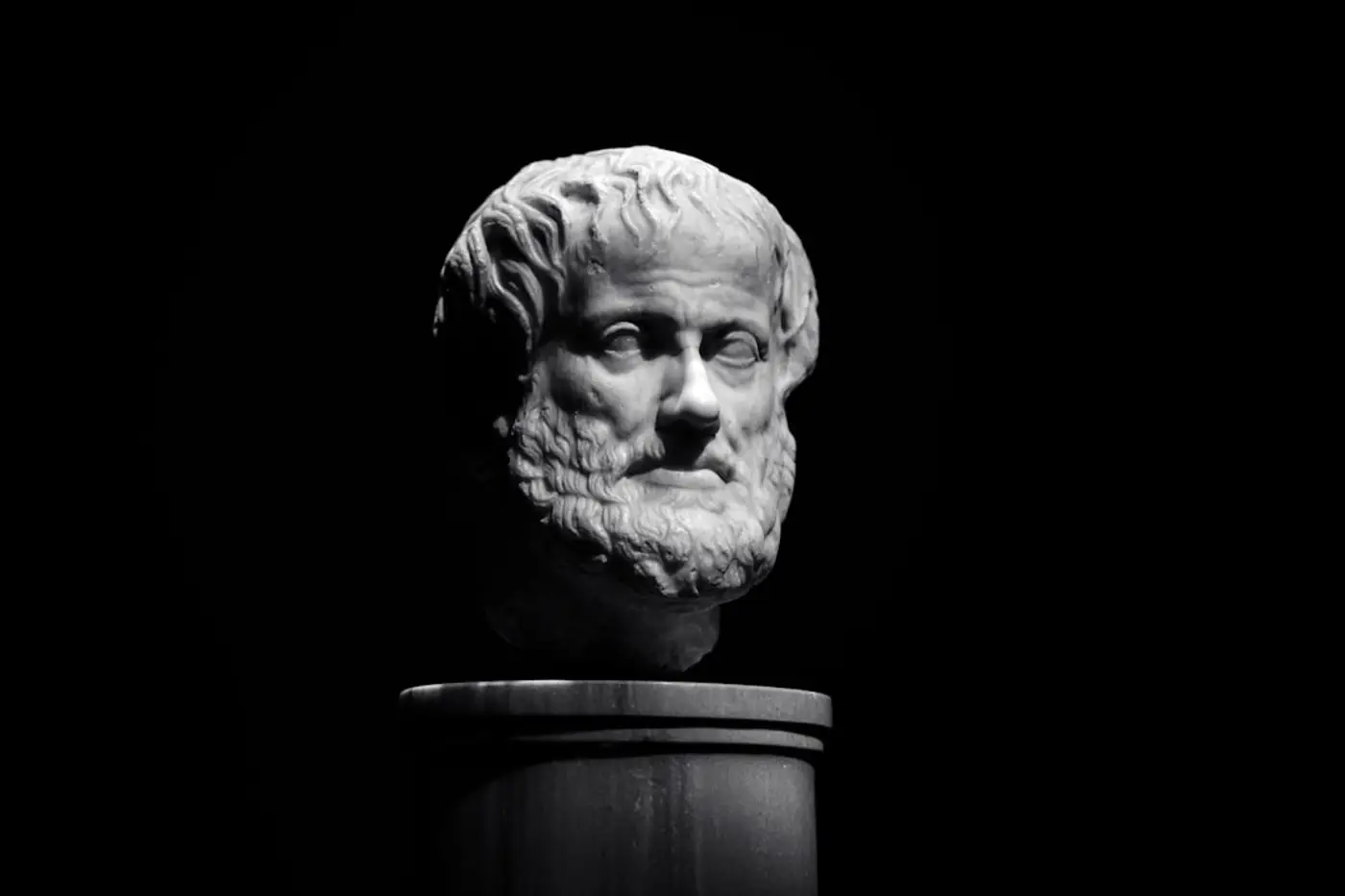
Two thinkers invoke Aristotle and mean opposite things. The cognitive scientist Joscha Bach calls Aristotle the forefather of modern science — an open rationalist whose psychology can be translated into a software model for the present day (cf. Bach, 2026, Everlast AI Debate, 36:23-36:55). Gwendolin Kirchhoff counters: Aristotle’s hylomorphism is precisely the opposite of substrate-independence, entelechy inseparable from the living being (cf. Kirchhoff, G., 2026, Everlast AI Debate, 27:40-27:48). Which of them is right? Or more precisely: which Aristotle is the real one?
#Ensouled Nature
Aristotle (384-322 BC) wrote in an era when the question of whether nature is alive or dead simply did not exist. All of ancient philosophy took the ensoulment of nature for granted. What Aristotle did was something different: he gave this ensoulment a conceptual order. In De Anima, he defined the soul as the entelechy of a natural body furnished with organs (cf. Aristotle, c. 350 BC, De Anima, II.1). That means the soul is not a thing inside the body, not a passenger in a ship. It is the actualised form of the body itself. Sight is the entelechy of the eye. Without sight, an eye is not an eye but a piece of tissue.
This thought has a precision contained in the word entelechy (en-telos-echein, having-one’s-end-within-oneself). Every living being carries its end within itself. The acorn becomes an oak not because someone inscribes a blueprint into it, but because its form is the becoming-an-oak. The living organises itself from within outward. The mechanical is constructed from without inward. This distinction, which Gwendolin Kirchhoff uses as a foundational distinction in her philosophical work, has its origin in Aristotle.
#The Four Causes and the Loss of the Question “What For?”
Aristotle’s Physics distinguishes four causes of every natural thing: the material cause (causa materialis), the formal cause (causa formalis), the efficient cause (causa efficiens), and the final cause (causa finalis). Modern natural science, as it took shape from Galileo and Bacon onward, retained only the efficient cause and discarded the other three as unscientific. Francis Bacon declared final causes barren like virgins: they produced nothing.
The consequences became visible only later. A science that asks only by what means something happens can describe chemical processes in an embryo. It cannot explain why these processes are oriented toward a human being rather than a random aggregate. The inner teleology of the living, which Aristotle named, became the blind spot of modernity. Jochen Kirchhoff (1944-2025) analysed this development in his Anti-Geschichte der Physik (1991) as one of the most consequential turning points in the intellectual history of Europe: nature was transformed from a living organism into a dead machine, set in motion only by external forces.
#Aristotle Against Plato: No Forms Without Things
Aristotle studied for twenty years at Plato’s Academy before going his own way. The break concerns a single but fundamental question: where do the forms exist? Plato had conceived the Ideas as self-subsisting realities, separate from the sensible things in which they are imperfectly mirrored. Aristotle recognised a problem he called chorismos — separation: if the Idea of the Good exists in a world of its own, separate from good action, how can it explain anything about that action? The forms are not elsewhere. They inhere in the things themselves.
This critique has far-reaching consequences. If, as hylomorphism teaches, form and matter are inseparable, then the soul cannot be detached from the body. There is no place the soul could go after the death of the body, and there is no substrate to which it could be transferred. The Cartesian separation of res cogitans and res extensa, which generated the entire mind-body problem of modernity, would have been, for Aristotle, a relapse into the Platonic chorismos he had already overcome.
#Two Readings in the Present
In the Everlast AI Debate (2026), the two readings of Aristotle emerged sharply. Bach interprets Aristotle’s doctrine of the soul as a three-layered control model: plants grow and nourish themselves, animals perceive and feel, humans additionally possess reason (cf. Bach, 2026, Everlast AI Debate, 36:24-36:46). In this reading, the soul is a causal pattern inscribed into the physical world, and the modern name for such a pattern is software (cf. Bach, 2026, Everlast AI Debate, 23:33). Gwendolin Kirchhoff objects: software is written by a human engineer and executed on deterministic hardware, while consciousness is already presupposed (cf. Kirchhoff, G., 2026, Everlast AI Debate, 26:52-27:02). The software analogy conceals exactly what it claims to explain.
The dispute is philosophically non-trivial. If you read Aristotle’s doctrine of the soul as a control model, you abstract the form from its matter and make it transferable in principle. If you read it as hylomorphism, you bind the form to its matter and rule out the transfer. Bach claims Aristotle for a project of substrate-independence. Gwendolin Kirchhoff shows that precisely this claim contradicts the core of Aristotelian thought.
#Why Aristotle Is Not a Closed Chapter
Aristotle did not invent the ensoulment of nature. He gave it conceptual form. The natural philosophy of the Kirchhoff tradition does not tie directly back to Aristotle but to Schelling, who translated the Aristotelian basic idea of a nature formed from within into the language of German Idealism. Yet the starting point is the same: nature is not dead matter onto which order is imposed from outside. It is a living whole that organises itself.
In the current debate around machine consciousness and artificial intelligence, Aristotle returns as a philosophical reference — not as a historical authority, but as a touchstone. Anyone who claims consciousness is a computer program that can run on any hardware presupposes the chorismos that Aristotle denied. Anyone who takes seriously the unity of form and matter faces an uncomfortable consequence: the living cannot be mechanised. Entelechy is not an algorithm. And the question of what Aristotle really thought is not an antiquarian exercise but a decision about how we understand nature and ourselves.
#Sources
Aristotle (c. 350 BC). De Anima (On the Soul).
Aristotle (c. 350 BC). Metaphysics.
Aristotle (c. 350 BC). Physics.
Kirchhoff, G. & Bach, J. (2026). Streitgespräch: „Der Mensch soll abgeschafft werden!” Wohin steuert uns KI wirklich? [Video]. Everlast AI, YouTube. https://www.youtube.com/watch?v=vSwmJDMw4xY
Kirchhoff, J. (1991). Anti-Geschichte der Physik. Grundlagenkritik und Alternativen.
Schelling, F. W. J. (1797). Ideen zu einer Philosophie der Natur. Breitkopf und Härtel, Leipzig.