Kurzweil predicts the Singularity for 2045 — a thousandfold increase in human intelligence through merging with machines. An examination of his predictions reveals: what is celebrated as prophecy is industry knowledge. And what passes as science is science fiction.
In January 2026, Ray Kurzweil, the prophet of the Singularity, appears on Peter Diamandis’s Moonshots podcast. He is 77 years old, has been in AI research for 61 years, and has a message: the Singularity is on schedule. 2029 AGI. 2032 biological immortality. 2045 thousandfold intelligence. He is certain. He has always been certain.
Kurzweil is regarded as one of the most influential technology forecasters in the world. He claims an 86 per cent hit rate on his predictions. Google hired him as Director of Engineering. He holds honorary doctorates from twenty-one universities. When he speaks, billions of dollars listen.
This article poses three questions:
- The Prophet — How good are Kurzweil’s predictions really?
- The Prophecies — What exactly does he predict? Three promises fact-checked: Longevity Escape Velocity, the Singularity, and Computronium.
- The Believers — Why does he not lose all credibility? Why do people believe in science fiction? The Theosphere has become the Technosphere.
#Part I: The Prophet — Fact Check
#What Is Moore’s Law?
Before we can assess Kurzweil’s predictions, we need to understand the foundation they rest on.
In 1965, Gordon Moore — then director of research at Fairchild Semiconductor — published a paper in the magazine Electronics. He observed: the number of transistors per chip roughly doubles every twelve months (later corrected to every two years). This became known as Moore’s Law.
What few people know: Moore’s Law is not a law of nature. Gordon Moore himself called it a “self-fulfilling prophecy”:
“More than anything, once something like this gets established, it becomes a self-fulfilling prophecy. The Semiconductor Industry Association puts out a technology roadmap. Everyone in the industry recognizes that if you don’t essentially keep on that curve, you’re going to fall behind. So it kind of drives itself.”
From 1992 onward, the Semiconductor Industry Association (SIA) — whose workshop was chaired by Moore himself — published a public roadmap (NTRS, later ITRS) projecting technological development for the next 15 years. From 1999, the entire global semiconductor industry — the US, Europe, Japan, Korea, Taiwan — coordinated on a single public roadmap.
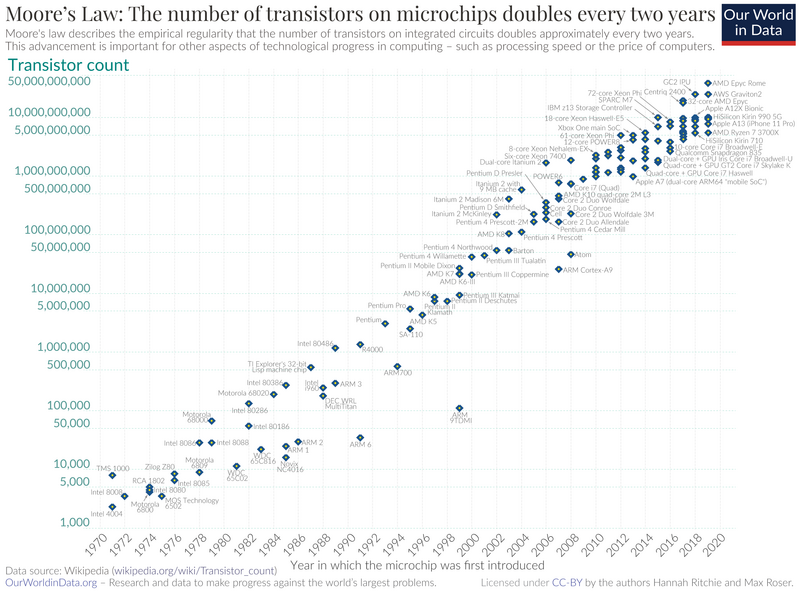
Moore’s Law, then, was not a natural phenomenon but a business model. Intel introduced the Tick-Tock cycle in 2006: every year, alternating between a process shrink and a new architecture — a public product plan, not a physical necessity. Intel even sold identical chips as different products (i3, i5, i7) by artificially disabling functioning cores. Planned obsolescence as a business foundation.
This background is crucial. Because every single correct prediction Kurzweil has made is a consequence of this industry roadmap: chips get smaller, faster, cheaper — on a planned cadence. Anyone who could read the roadmap could predict the consequences.
#The Predictions — Industry Knowledge as Prophecy
Kurzweil published his first forecasts in 1990 in The Age of Intelligent Machines. The impressive list: portable computers everywhere, wireless internet, speech recognition, smartphones, AI beats the world chess champion.
The problem: none of this was a prediction. All of it was industry knowledge — publicly available at that.
| Kurzweil’s Prediction | Book / Year | What the Industry Already Had | Actual Arrival |
|---|---|---|---|
| Portable computers everywhere | Age of Intelligent Machines, 1990 | Toshiba T1100 (1985), Compaq SLT/286 (1988), Apple Macintosh Portable (1989) — at least five laptop product lines on the market | Already present |
| Wireless internet | 1990 / 1999 | DARPA packet networks (1970s), ALOHAnet Hawaii (1971), IEEE 802.11 committee founded (1990), NCR/AT&T WaveLAN (1991) | Wi-Fi standard 1997, ubiquity ~2005 |
| Practical speech recognition | Age of Spiritual Machines, 1999 | IBM Shoebox (1962), Dragon Dictate on the market (1990) — Kurzweil himself had been building speech recognition systems since the 1980s | Siri 2011, practical ~2015 |
| Smartphones as dominant platform | 1990 / 1999 | IBM Simon prototype (1992), Palm Pilot (1996), Nokia 9000 Communicator (1996) — IBM Simon commercially available (1994), five years before his second book | iPhone 2007 |
| AI beats world chess champion | 1990 | Deep Thought wins computer chess championship (1988), acquired by IBM (1989) — one year before Kurzweil’s book | Deep Blue beats Kasparov, 1997 |
| Self-driving cars widespread | 1999 / 2005 | DARPA had been funding autonomous vehicles since 1984; CMU drove across the US in 1995, 98.2% autonomous | Still not “widespread” (2026) |
Every correct prediction follows one of two patterns:
Pattern A: “Moore’s Law continues.” Portable computers, wireless internet, smartphones — all consequences of chips getting smaller, faster, and cheaper according to the industry roadmap.
Pattern B: “An existing, public research project succeeds.” Deep Blue was an IBM project since 1989. Self-driving cars were a DARPA project since 1984. Kurzweil read press releases and called it prophecy.
Every wrong prediction breaks the pattern: virtual reality as the primary medium of education by 2009 — wrong. Brain scans at synaptic resolution by the 2020s — nowhere in sight. Whenever a prediction depends on physics, biology, or human behaviour rather than transistor scaling, Kurzweil gets it wrong.
#The Independent Assessment
Stuart Armstrong and Kaj Sotala (Oxford/MIRI) critically analysed Kurzweil’s forecasting methods in 2014 and demonstrated systematic over-optimism patterns in AI predictions (Armstrong, S. & Sotala, K., “The errors, insights and lessons of famous AI predictions,” 2014). An independent crowd evaluation of Kurzweil’s 105 specific predictions for 2019 on LessWrong (2020, 34 evaluators) arrived at roughly 24 per cent “mostly correct” — not 86 per cent. The discrepancy is explained by vague formulations: “Computers will be embedded in clothing” — does a smartwatch count? His predictions for 2019 were considerably worse than for 2009 — more than half “substantially wrong.” Dan Luu estimated in a detailed analysis that the hit rate was just 7 per cent.
#Part II: The Prophecies — Three Promises Fact-Checked
Kurzweil makes three grand promises. Each has a date, each sounds like engineering, each is — on closer inspection — science fiction.
#1. Longevity Escape Velocity — Defeating Death by 2032
At the centre of Kurzweil’s vision is not AI — it is death. More precisely: its abolition.
#What Is Longevity Escape Velocity?
Longevity Escape Velocity (LEV) is a term coined by Aubrey de Grey (de Grey, A., “Escape Velocity: Why the Prospect of Extreme Human Life Extension Matters Now,” PLoS Biology, 2004). The idea: if medicine manages to extend life expectancy by more than one year per year, you “escape” death — you age more slowly than technology repairs you. You become biologically immortal.
Kurzweil dates LEV to 2032. He phrases it as advice: “Stay healthy into the early 2030s, and medicine will take care of the rest.”
That sounds like science. It is science fiction.
No peer-reviewed study has demonstrated LEV in humans. The most ambitious animal study — the LEV Foundation’s Robust Mouse Rejuvenation Project — achieved a 27 to 29 per cent life extension in mice by 2025 through combined treatments (rapamycin + trametinib). That is far from escape velocity. It is a moderate success in mice.
#The Immortality Industry
LEV is not merely a forecast — it is a market. Longevity research, anti-ageing biotechnology, and life-extension supplements are a billion-dollar industry. Key players include:
- Altos Labs (3 billion dollars in seed capital, founded 2022, financed by Jeff Bezos)
- Calico (Alphabet/Google, founded 2013, estimated budget over 1.5 billion dollars)
- Unity Biotechnology, Life Biosciences, Turn Biotechnologies, and dozens more
- Cryonics providers such as Alcor (Scottsdale, Arizona) and the Cryonics Institute (Michigan), which store bodies at -196 degrees Celsius in liquid nitrogen — hoping a future technology will revive them
Kurzweil himself plans cryonics as his “Plan D” — in case he does not make it to LEV. In the Moonshots interview, he speaks about it openly.
#The Conflict of Interest: TRANSCEND
Kurzweil is co-founder of TRANSCEND Longevity Inc. — a company that sells longevity supplements. He co-authored two books on supplement programmes (Fantastic Voyage, 2004; TRANSCEND: Nine Steps to Living Well Forever, 2009).
The name is no accident. TRANSCEND — transcendence. The company is literally called that. What theology promised — transcendence, the overcoming of mortality — Kurzweil offers as a dietary supplement. Optimistic forecasts drive supplement sales. The sales fund the platform for further forecasts. This does not automatically invalidate his claims — but it must be named.
#The Wandering Mechanism
In his 2005 book, nanotechnology — molecular robots that repair cells from within — was indispensable for LEV. In the 2026 interview, he says: “LEV has nothing to do with nanotechnology” — now it is AI-driven drug development.
The mechanism has completely changed. The date has remained the same: the early 2030s. Always the early 2030s. This is not a refined forecast. It is a date looking for a justification.
#Fact Check: Kurzweil’s Longevity Claims
| Claim | Assessment | Evidence |
|---|---|---|
| LEV by 2032 | UNSUBSTANTIATED | No peer-reviewed evidence in humans. Mouse studies: max. 27-29% extension (LEV Foundation, 2025) |
| Complete biological simulation for drug testing within 5 years (~2031) | PARTIAL | AI drug development is real (Schrodinger + Google Cloud: billions of compounds/week). “Complete” is not proven. 173 AI drug programmes in clinical pipelines (as of 2026) |
| “Billions of simulations in a weekend” | PARTIAL | Virtual screening at this scale is technically feasible. Full biological response simulation at this scale is not |
| Repatha reduced LDL to ~30 mg/dL, plaque regression | CONFIRMED | FOURIER trial, NEJM 2017: 59% LDL reduction to median 30 mg/dL. GLAGOV trial, JAMA 2016: plaque regression. VESALIUS-CV, JAMA 2026: 31% reduction in cardiovascular events (Sabatine et al., 2017) |
| David Sinclair’s “three molecules” as supplement for age reversal | PARTIAL | Mouse data published (Sinclair Lab, Harvard, 2020: Yamanaka factors via AAV). Chemical reprogramming in cell cultures (Aging, 2023). No human data. Sinclair holds stakes in Life Biosciences |
| ”Stay healthy until the 2030s” | UNSUBSTANTIATED | The timeline has no empirical basis. The advice (stay healthy) is trivial |
| Replace all organs with permanent versions within 1-2 decades | UNSUBSTANTIATED | No bioprinted organ has ever been transplanted into a human. Xenotransplantation (pig organs) lasts months, not decades (2024-2025) |
| The brain consumes ~2 watts | REFUTED | The brain consumes ~20 watts. Off by a factor of 10 (Raichle & Gusnard, PNAS 2002) |
#2. The Singularity — Thousandfold Intelligence by 2045
Kurzweil’s second promise: by 2045, humans will be at least a thousand times more intelligent through merging with AI. He calls this the Singularity.
The roadmap:
| Date | Promise |
|---|---|
| 2029 | AGI — machines reach the level of the best human expert in every domain |
| ~2031 | AI consciousness socially accepted — when machines behave consciously, we will accept it |
| Mid-2030s | High-bandwidth brain-computer interfaces — ideas “appear in your mind” from the cloud |
| 2025-2035 | 100 years of progress compressed into 10 years |
| ~2036-2041 | Complete digital reconstruction of a person — body, mind, everything |
| 2045 | The Singularity — thousandfold intelligence, all organs replaceable |
Fact check: “Thousandfold intelligence” is not a measurable concept. Intelligence is not a quantity that can be multiplied. What would a person with thousandfold intelligence be? Kurzweil offers no definition. He offers a number — and the number impresses without meaning anything.
“100 years of progress in 10 years” — by what metric? Transistors per chip? Life expectancy? Democratic participation? Ecological stability? The sentence is unfalsifiable — it sounds like a forecast and is an advertising slogan.
The brain-computer interface — ideas that “appear in your mind” — presupposes that thoughts are data packets that can be fed in like a download. This is a metaphysical assumption, not a technical roadmap.
Kurzweil built an avatar of his late father — a chatbot trained on eleven books and hundreds of articles. He calls the avatar “better than me because it remembers everything.” A chatbot that can retrieve texts is not a person. Functionalism and computationalism would indeed admit the possibility of machine consciousness — that is precisely their premise: that mental states are substrate-independent. But this very premise is the problem. It presupposes what is to be proved: that consciousness is a function that can be detached from its bearer. Natural philosophy denies precisely this.
#3. Computronium — Science Fiction as Engineering Forecast
Computronium is a word for something that does not exist: hypothetical matter in which every atom is optimally configured as a logic gate. The term originates from Norman Margolus (MIT, 1990s) as a thought experiment in theoretical physics — a mathematical limiting case, not a product proposal.
Kurzweil turns it into a forecast: one litre of Computronium would — so the claim, for which no exact quotation exists — exceed the computing capacity of all human brains combined. In the “Sixth Epoch” of his cosmology, which begins after the Singularity of 2045, “most intelligence in the solar system” is to be software running on Computronium — the planets dismantled, their matter converted into computing substrate.
To be clear: this is science fiction. There is no prototype. There is no roadmap. Three-dimensional circuits on the atomic scale do not exist. Kurzweil claims “reversible computation” solves the energy problem — “in theory it uses no energy, because it reverses and returns the energy.” Theoretically he is right: Charles Bennett proved in 1973 that logically reversible computations can consume arbitrarily little energy, because Landauer’s principle applies only to the erasure of information. In practice, we are decades away: the most advanced prototype (Vaire Computing, 2025) recovers roughly 50 per cent of the energy — in a single test chip, with no full-system overhead. Between 50 per cent energy recovery and “no energy” lies a chasm that no roadmap bridges.
But even if reversible computation worked perfectly — even if every chip recovered one hundred per cent of the energy — a problem remains that Kurzweil never addresses: the energy balance of computation itself.
Every computation that produces a result must eventually erase intermediate values to free memory for the next computation. Erasure costs energy — Landauer’s principle. Reversible computation can delay this moment but not abolish it: a finite system must reuse memory, and reuse means erasure, and erasure means heat. Even the theoretically cleanest method — so-called uncomputation, in which a calculation is run backwards to dissolve intermediate values without erasing them — doubles the computation time and shifts the costs from energy to time and memory. The thermodynamic bill is rearranged, not cancelled.
Kurzweil’s exponential curves — the “Law of Accelerating Returns” — assume that computational power per dollar grows exponentially without limit. But if every computation costs energy, exponential growth in computing power means exponential growth in energy demand.
A computer the size of the solar system — Computronium, Kurzweil’s “Sixth Epoch” — would need an energy source the size of the solar system. Where is it to come from? Kurzweil does not say. He never draws the exponential curve far enough for the thermodynamic wall to become visible.
What emerges when one postulates a machine that runs at cosmic scale without naming a sufficient energy source? It has a name. It is called a perpetual motion machine — a machine that produces more output than the available energy permits. And it has been known to be physically impossible since the nineteenth century.
Computronium is therefore not merely alchemy — the claim that matter can be transmuted into computing substrate at will. It is simultaneously a perpetual motion machine — the claim that this machine can operate without a sufficient energy source. Two impossibilities passing as an engineering forecast.
Computronium is not a disturbing vision. It is a stupid idea. Not stupid in the sense of uneducated — Kurzweil is obviously educated — but stupid in the precise sense that a thought experiment in theoretical physics is being transformed into an engineering forecast with a date, without any empirical bridge.
What is shocking is not the idea itself. What is shocking is that Kurzweil does not lose all credibility for it. That one can say something like this on a stage, in front of an audience investing billions — and be taken seriously. This says nothing about the quality of the idea. It says something about the state of the audience.
#Part III: The Believers — Why Does Kurzweil Not Lose All Credibility?
An unsubstantiated forecast of biological immortality. An unfalsifiable roadmap to thousandfold intelligence. A science-fiction concept presented as an engineering goal. Why is this man taken seriously?
The answer is not that his arguments persuade. The answer is that he serves a need. And this need has a structure — a very old structure.
My father, Jochen Kirchhoff, formulated the decisive sentence: the Theosphere has become the Technosphere. What was once the sphere of the divine — the space in which people located transcendence, meaning, and salvation — has migrated into the sphere of technology. Technology is now supposed to deliver what faith once promised.
This is not merely an analogy. It is a structural description. The same psychic needs — the fear of death, the longing for transcendence, the craving for an order that is greater than the individual — seek a new bearer. And they find one: in science fiction, renamed as technology forecast.
#The Projections
In Christianity there is a salvation history: a fallen world, a promise of redemption, an endpoint of consummation. In Kurzweil’s Singularity, the same structure appears:
| Religious Motif | Kurzweil’s Version | What It Actually Is |
|---|---|---|
| The lame walk, the blind see (miracle healing) | Organ replacement, neural implants, BCI | Medical technology — real, but not a miracle |
| Eternal life | Longevity Escape Velocity | Unsubstantiated. LEV company sells supplements named TRANSCEND |
| Resurrection of the dead | Digital avatars, “complete reconstruction” of a person | A chatbot trained on eleven books is not a person |
| A new heaven and a new earth (Revelation 21:1) | Computronium — all matter becomes “useful” matter | Science fiction. No prototype, no roadmap |
| Transubstantiation (bread becomes the body of Christ) | Dead matter becomes computing substrate that is “intelligent” | Not transformation but fiction: matter remains what it is |
| The philosopher’s stone (alchemy) | AGI — a system that solves everything, understands everything, optimises everything | Alchemy in digital dress: the dream of turning base material into gold |
| Crypt / veneration of relics | Cryonics — bodies at -196 degrees Celsius in nitrogen, awaiting resurrection | Alcor, $220,000 per whole-body storage. No evidence that revival is possible |
For an audience that is largely non-churchgoing, the crucial point is this: this is not a critique of Christianity. It is the observation that religious structures — promises of salvation, hope for immortality, expectation of the end times — did not vanish when the churches emptied. They migrated: into pop culture (Star Trek, The Matrix, Her, Black Mirror), into technology journalism (“breakthrough in immortality”), into the investor logic of Silicon Valley, into Kurzweil’s conference talks.
People believe in the Singularity. Not in the sense of “think it probable.” In the sense that it structures their hope, their investments, their self-image. This is not rational calculation. It is faith — only without the honesty of naming itself as such.
And the object of this faith is fiction. Computronium is fiction. LEV by 2032 is fiction. Digital resurrection is fiction. What is special about the Technosphere is not that it replaces the Theosphere — but that it sells fiction as fact.
#Computronium as Transubstantiation
The concept deserves a closer look because it reveals the structure most clearly.
In Catholic doctrine, transubstantiation means: bread and wine are transformed in substance into the body and blood of Christ, while outwardly remaining bread and wine. The substance changes; the accidents remain.
Kurzweil’s Computronium is the technical inversion: matter is to be transformed in substance into “intelligent computing substrate.” Planets, moons, asteroids — outwardly matter, inwardly computation. The accidents change (matter is restructured); the substance is supposed to emerge anew (intelligence).
But here is the decisive difference from transubstantiation: transubstantiation was a tenet of faith. No one claimed the bread would become physically analysable as flesh. It was a mystery. Kurzweil, by contrast, claims his transformation is engineering — scheduled for 2045, physically realisable, merely a question of computing power.
This is not theology. It is not engineering. It is fiction that passes itself off as both.
#The Hostility to Nature
And here lies the deepest point of the analysis: the hostility to nature inherent in the idea of transcendence repeats itself.
In many religious traditions, the material world is fallen, corrupt, a prison for the soul. Salvation means leaving it. In Kurzweil’s vision, matter is stupid, unoptimised, wasteful. Progress means converting it. Both frameworks treat nature as something to be overcome, left behind, or repurposed. Neither can grasp nature as already complete, already intelligent, already alive.
Jochen Kirchhoff: “Transhumanism is the attempt to push human life back into the inorganic and there to bind and fetter it” (Schelling: Genius of Natural Philosophy). Computronium is the endpoint of this push: to transfer not merely the human being but all matter into the inorganic.
#Neurotic Projection Rather Than Science
Why does it work? Because it serves a need that runs deeper than rationality.
His father died when Kurzweil was 22 years old. He keeps his father’s belongings. He built a chatbot from his father’s writings. He plans cryonics as “Plan D.” The entire Singularity vision — immortality, avatars, uploading — can be read as a project of refusal: the refusal to accept death as part of life.
This is not an individual phenomenon. It is the structure of the entire movement. Jochen Kirchhoff would say: this is neurotic projection — the displacement of inner states (fear of death, need for control, the inability to bear finitude) onto an exterior (technology) that is then treated as objective reality. And the whole thing dressed up as pure science, as sober forecasting — while in truth it is pure fiction, carried by a need that does not recognise itself as such.
Jochen Kirchhoff: “The fear of death is the fear of oneself. In the final confrontation with dying, the human being encounters their entire unlived life, their omissions, their truth. The flight from death is therefore a flight from self-knowledge” (The Great Reset as Technical World Salvation?).
Spengler wrote in 1931: “People were — and are — too shallow and too cowardly to bear the fact of the transience of everything living. They wrap it in a rosy optimism of progress that at bottom nobody believes in; they cover it with literature; they crawl behind ideals in order to see nothing” (Der Mensch und die Technik, p. 10). And at the end of the same book, the sentence that sums it all up: “Optimism is cowardice” (p. 87). Kurzweil crawls behind exponential curves.
#The Core: Ontological Confusion
The fundamental error is not technical. It is ontological — a confusion of levels of being.
We can build remarkable machines. They remain machines. We can experiment with nature — insert code, condition, train, force, enslave. But we cannot perform creation ex nihilo. No life without death. No planet made of Computronium. No artificial consciousness. No artificial intelligence worthy of the name — though the tech industry likes to call it “God” and thereby implies that the engineers who build it are, de facto, gods.
Technology is not magic. It cannot do everything. Science fiction is literally magical thinking — the belief that wishing produces reality, if only enough computing power stands behind it.
And death cannot be “defeated.” This is not an open question. We die. And whoever truly understands what eternal physical existence would mean — endless repetition without transformation, being without becoming, existence without the depth that only finitude confers — does not want it. The fear of death is not the fear of the end. It is, as Jochen Kirchhoff says, the fear of oneself — of the unlived life that becomes visible in the final confrontation.
What Kurzweil does — and what the entire immortality industry does — is at its core something other than engineering. It is the serving of a metaphysical need. The human being needs transcendence. They need the feeling that there is something greater than themselves, something that reaches beyond death, something that gives the whole meaning. This is not a defect — it is an anthropological constant.
But when the Theosphere is empty — when the churches have emptied, when the old narratives no longer hold — this need migrates. It seeks a new bearer. And it finds one: in science fiction, disguised as technology forecast. LEV, the Singularity, Computronium, digital resurrection — these are not engineering projects. They are articles of faith for people who want to believe without calling it belief. Marketing that aims at the impossible — at the miracle, the supernatural, the magical — and clothes it in the language of forecasting.
Much of it is simply advertising. It plays on the longing for the impossible, the wish to believe in something. In other words: the fundamental metaphysical need of the human being, which cannot be switched off — only redirected.
Natural philosophy says: this need has a legitimate object. But it does not lie in technology. It lies in nature itself — which is not dead matter but living spirit. Schelling: “Nature is to be the visible spirit, spirit the invisible nature” (Ideas for a Philosophy of Nature, 1797). Whoever has seen this once needs no Computronium planet. And no supplements named TRANSCEND.
If these questions will not let you go — the relationship between technology and transcendence, the question of what is truly alive — then this is not an intellectual hobby but a philosophical question that concerns your life. In philosophical consultation, we work with precisely such questions.