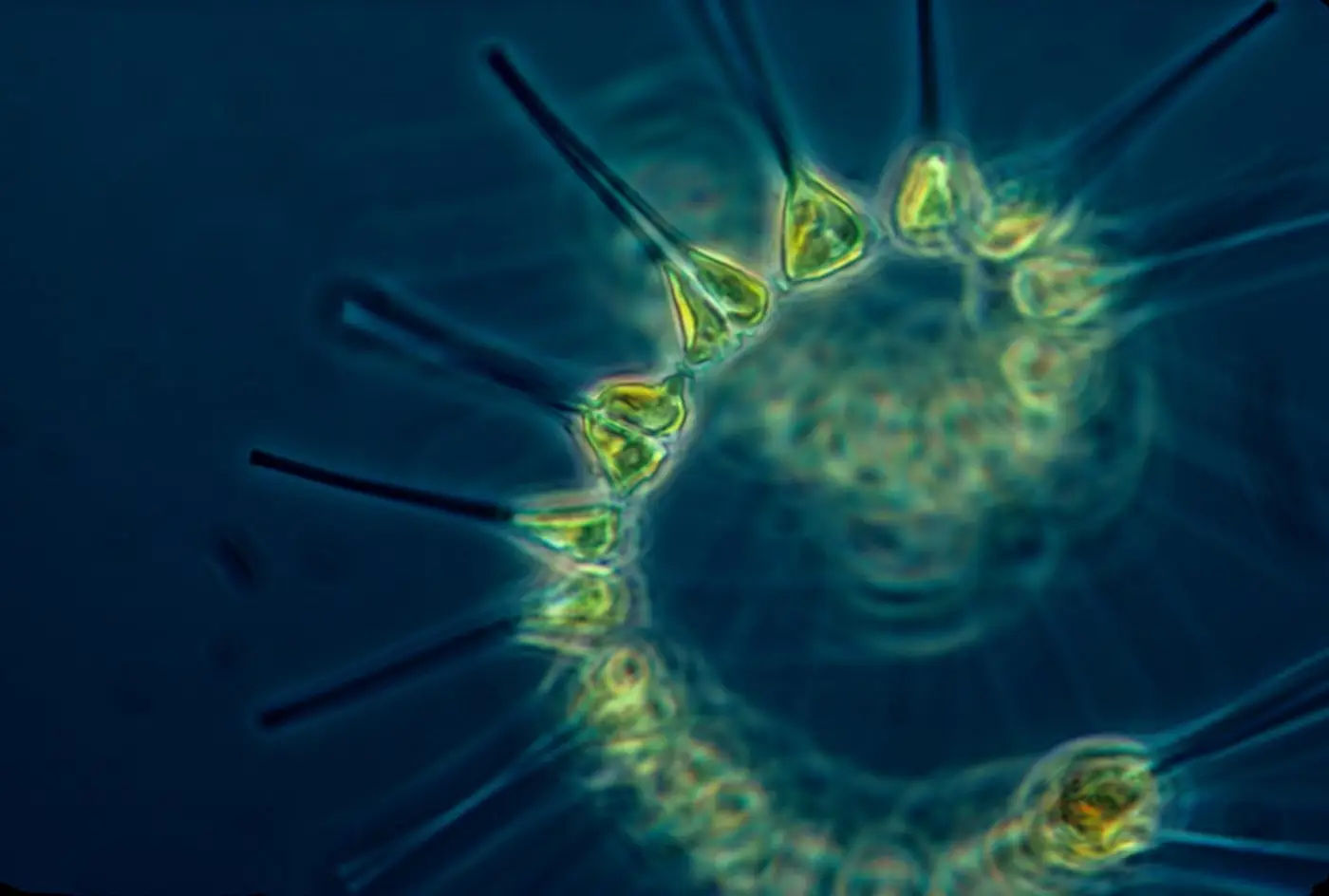
Every component of a living cell can be synthesised. Every chemical substance, every protein, every membrane structure can be manufactured in a laboratory. The composition is known, the functions are understood, each one can be replicated individually. And yet: no one has ever assembled a living cell from these components. The simplest organism that exists cannot be put together from its parts. This fact has a name: the boot problem. It concerns not only biology but every debate about consciousness, artificial intelligence, and the question of whether experience can be technically produced.
#More Fundamental Than the Hard Problem
In the philosophy of consciousness, David Chalmers formulated the hard problem in 1995: why is there subjective experience at all? Why does it feel like something to have a brain? The question presupposes that physical processes can in principle be described and traced, and then asks about the inexplicable remainder — the experience.
The boot problem intervenes one step earlier. It does not ask why the assembled parts produce experience. It shows that the assembly itself fails. Once you grasp this distinction, the implications become clear: the hard problem assumes assembly is in principle possible and then marvels at the experience. The boot problem contests the assembly itself. Biology can disassemble a cell into its components and analyse each one. But the reverse path — restoring the whole from the parts — does not exist. Life arises exclusively from life.
Gwendolin Kirchhoff introduced the term into the consciousness debate during the Everlast AI debate with Joscha Bach (2026), framing the argument as follows: we can replicate every function a simple living cell performs, but the boot problem remains unsolved. Not a single living cell has ever been manufactured from its chemical components. And the same holds for consciousness (cf. Gwendolin Kirchhoff, Everlast AI Debate, 2026, 04:34-04:45).
#What the Cell Reveals About Consciousness
The analogy to the cell is not merely a parable. It exposes an ontological structure: the living is not the sum of its parts. It organises itself from the inside outward, not from the outside in. A machine is built, programmed, set in motion. An organism unfolds. The cell is not a mechanism that happens to be alive but a living being that does things: it feeds, it divides, it perceives, it moves, it adapts.
Jochen Kirchhoff sharpened this point in his talk AI and Transhumanism as a Threat to the Living (2023): the claim that the living arose from the dead has never been observed. Never. No human being on this earth has ever witnessed how something truly living emerged from the dead (cf. Jochen Kirchhoff, AI and Transhumanism as a Threat to the Living, 2023, 53:00).
The argument strikes at the core of the strong AI thesis. Joscha Bach maintains the position that consciousness is an emergent control process which could in principle run on any sufficiently complex system. The communication between cells that leads to the self-organisation of a mind, he argues, can be replicated with today’s computers. The boot problem disagrees: if even the simplest organism cannot be assembled from parts, then the attempt to generate consciousness from non-conscious building blocks fails not because of insufficient computing power but because of a category error. The limit is not technical but ontological.
#Which Metaphysics Produces the Problem
In the debate, Kirchhoff made the decisive move: the question is not whether the boot problem is solvable, but which metaphysics produces it in the first place. Both the view that everything is a machine and the view that everything is an organism are metaphysical positions. But only one of them produces a boot problem and a hard problem: the mechanistic one. The natural philosophy that conceives of the cosmos as a living organism does not face these problems, because it need not derive consciousness retroactively from the non-conscious (cf. Gwendolin Kirchhoff, Everlast AI Debate, 2026, 1:15:43-1:15:53).
Schelling laid the ontological foundation for this argument. In a passage that Jochen Kirchhoff read aloud and commented on in his talk Schelling: Genius of Natural Philosophy (2021), Schelling writes: no origin of the organic from the inorganic may be conceived, which is not only, as Kant says, an adventure of reason but a monstrosity and an absurdity. The inorganic is merely the negated organic, the dead merely suppressed life (cf. Jochen Kirchhoff, Schelling: Genius of Natural Philosophy, 2021, 76:24).
The thought is radical: there is nothing absolutely dead. Everything is primal seed, or it is nothing. The supposedly inorganic is not the foundation from which the living emerges but the residue of a living reality that has been suppressed. If you ask yourself why this detail matters for the consciousness debate: the boot problem of biology confirms Schelling’s insight empirically. If the living cannot be assembled from the dead, then the dead was never the foundation — it was always the derivative.
#Against Emergence and Strong AI at Once
The boot problem refutes two popular positions in a single stroke. First, emergentism, which claims that qualitatively new properties arise from increasing complexity of unconscious matter. The emergence thesis says: beyond a certain level of organisation, consciousness appears. The boot problem replies: even at the simplest level of organisation — the cell — assembly from parts does not succeed. If the simplest thing cannot be put together, this is not an open technical problem that better laboratory equipment could solve. It is an indication that the framing of the question itself is wrong.
Second, the strong AI thesis, which claims consciousness is substrate-independent and can be instantiated on any sufficiently complex system. The boot problem shows that the idea of generating consciousness on a deterministic, silicon-based system repeats the error in intensified form. Here, there is not even an attempt to replicate the biological substrate. Here, it is presupposed that function can be detached from substrate and transferred to a categorially different medium. The boot problem of the cell shows that even within the biological substrate, assembly fails. The transfer to silicon multiplies the error rather than bypassing it. What we are dealing with is not a lack of engineering skill but a misunderstanding of what consciousness is: not a function that runs on substrates but a quality of the living that remains bound to being alive.
If you ask whether machines will ever be conscious, you face a decision that runs deeper than any technical argument: is the living assemblable from the dead, or has it always already been present? The boot problem gives a sober answer. It is not computing power that is missing, not data, not architecture, but the living, which conforms to no blueprint. Natural philosophy unfolds the consequences, consciousness philosophy names the terrain, and the entry on machine consciousness traces the debate in detail.
I defended this concept in my debate with Joscha Bach on Everlast AI — the full conversation is on YouTube (in German, 2:37:50).