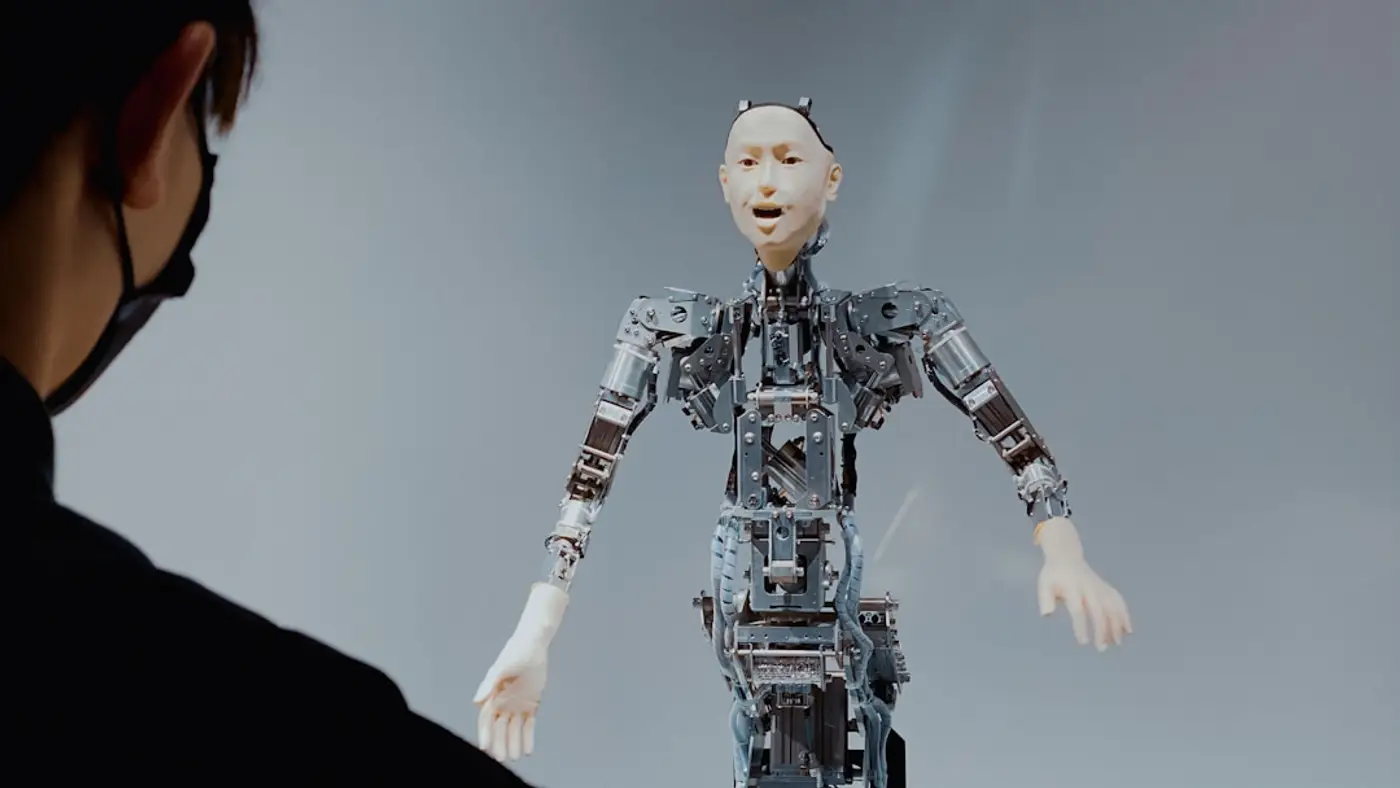
In 2005, Ray Kurzweil predicted that by 2045 human beings would merge with machines and overcome biological mortality (Kurzweil, 2005). Nick Bostrom drafted a philosophical programme that treats human nature as raw material in need of improvement (Bostrom, 2005). The transhumanist movement, drawing on such blueprints, promises enhancement, singularity, and the technological transcendence of the condition humaine. But behind the promise lies a premise that is seldom examined: an image of the human being as a creature of deficiency, whose embodiment, finitude, and interiority are defects to be corrected.
#The Deficient Image of the Human
What transhumanism takes to be its boldest thought — the overcoming of the biologically given — is, philosophically, its blindest spot. The entire argument presupposes that the human being in its present form is inadequate. The premise that technical augmentation is identical with human maturation is never justified; it is treated as self-evident. Jochen Kirchhoff (1944—2025) showed in his analyses that this fundamental trait is gnostic in character: the notion that the human being must liberate itself from dark, deficient matter and rise above its biological limitations through technology (Kirchhoff, 2007). What presents itself as a vision of the future repeats an ancient structure: hatred of the bodily, contempt for the finite, flight from the concreteness of existence.
Why should a merger of human beings with AI, as Kurzweil envisions it, constitute evolution? One could just as well speak of a pathogenesis — the emergence of disease disguised as progress. For what is lost in the merger is not an accessory of being human but its core: the indivisibility of the living organism, its gestalt-character, its I-ness. These qualities cannot be digitized, because they are not information but modes of being.
#Fichte, Mumford, and the Prehistory of Optimization
Transhumanism has an intellectual depth its proponents typically overlook. Friedrich Wilhelm Joseph Schelling (1775—1854) already criticized Johann Gottlieb Fichte (1762—1814) for treating nature exclusively as an object of human exploitation: its entire existence reduced to the purpose of being managed by human beings. Fichte stated the thought explicitly: nature must gradually enter a condition in which its steady course can be securely calculated and counted upon (Fichte, 1800). Schelling recognized in this a killing of the living: every subordination of nature to purely human ends destroys what is alive in it (Schelling, 1797).
Lewis Mumford (1895—1990) described the institutional side of this structure in The Myth of the Machine (1967) (Mumford, 1967). His megamachine — an invisible edifice made of living human parts reduced to fixed functions — was the first complex machine and the archetypal model for all subsequent forms of mechanized organization. The myth of the machine, the belief that it is inherently invincible and ultimately beneficent, holds rulers and ruled captive to this day. The transhumanist singularity repeats this myth in digital form: unlimited power, absolute control — not only over every domain of life, but over life itself.
#What Is at Stake
Transhumanism treats thinking as computational performance, consciousness as information processing, the body as hardware. In this equation lies its deepest confusion. For what thinking actually is — a bodily process that feels, gropes, encounters resistance — cannot be translated into algorithms. The essential character of the living, which shows itself phenomenologically in every organism — indivisibility, gestalt-character, I-ness — no machine can reproduce. Not because technology has not advanced far enough, but because the category does not apply. Artificial life never transforms into real life, just as Goethe’s Homunculus remains in his vial until he shatters against living nature (Goethe, 1832).
What stands behind the transhumanist promise is less boldness than embarrassment: the inability of a civilization to find meaning in human existence as embodied and finite. Where inner world once was, a pure outer world available to the interests of an elite is meant to take its place. The ceaseless drive to improve, the enhancement, the longing for the singularity — all point to a culture that experiences its own aliveness as a problem. Posthumanism, seen in this light, is not the surpassing of the human but its loss.
#The Counter-Image: The Human Being as Cosmic Being
Philosophical critique of transhumanism remains incomplete if it merely negates. It requires a counter-image that shows what the human being is when understood not as a creature of deficiency but as a cosmic being. The tradition of natural philosophy — from Schelling through Goethe to Kirchhoff — understands the human being as microcosm of the macrocosm: a being in which all layers of existence are laid down and which participates in the living rather than needing to overcome it. The Cosmic Anthropos describes this primordial form: the human being in its full power of consciousness, to which nothing need be added, because its task is not augmentation but realization. If the human being already carries the structure of the whole within itself as microcosm, then enhancement presupposes a lie: that something external could complete what is already fully endowed. Transhumanist optimization does not misjudge a possibility — it misjudges the constitution of the human being itself.
Oswald Spengler (1880—1936) articulated the reverse side: to the hubris of Prometheus, who reaches into the heavens to subject the divine powers to human will, belongs the fall (Spengler, 1931). Transience, arising and passing away, is the form of everything real. Whoever seeks to overcome it through technology has not shifted the boundary but lost the relationship to reality. Friedrich Nietzsche (1844—1900) named the same state of affairs in Twilight of the Idols as decadence (Nietzsche, 1889): the instincts in anarchy, clear-headedness as a substitute for lost certainty in living. What passes for progress is the attempt to replace the lost feeling for life with calculability — not wisdom, but a makeshift.
The critique of science that Kirchhoff developed following Schelling and Goethe (Kirchhoff, 1998) reveals the root of this structure: a metaphysics that treats the cosmos as a dead mechanism and then attempts to reconstruct the living that it had previously abolished. Transhumanism is the final consequence of this metaphysics. It does not try to improve the human being. It tries to replace the human being with something that fits into its reduced worldview. The Kogi, an indigenous people of the Sierra Nevada, express the connection with a clarity often absent from Western philosophy: whoever fells one tree has thereby killed all trees. The indivisibility of the living is not a sentimental objection but the fundamental ontological fact that transhumanism fails to recognize.
#Sources
- Bostrom, N. (2005). A History of Transhumanist Thought. Journal of Evolution and Technology, 14(1), 1–25.
- Fichte, J. G. (1800). The Vocation of Man [Die Bestimmung des Menschen]. Berlin: Voss.
- Goethe, J. W. von (1832). Faust, Part Two [Faust. Der Tragödie zweiter Teil]. Stuttgart: Cotta.
- Kirchhoff, J. (1998). Was die Erde will. Bergisch Gladbach: Gustav Lübbe Verlag.
- Kirchhoff, J. (2007). Räume, Dimensionen, Weltmodelle. Klein Jasedow: Drachen Verlag.
- Kurzweil, R. (2005). The Singularity Is Near. New York: Viking.
- Mumford, L. (1967). The Myth of the Machine: Technics and Human Development. New York: Harcourt, Brace & World.
- Nietzsche, F. (1889). Twilight of the Idols [Götzen-Dämmerung]. Leipzig: Naumann.
- Schelling, F. W. J. (1797). Ideas for a Philosophy of Nature [Ideen zu einer Philosophie der Natur]. Leipzig: Breitkopf und Härtel.
- Spengler, O. (1931). Man and Technics [Der Mensch und die Technik]. Munich: C. H. Beck.