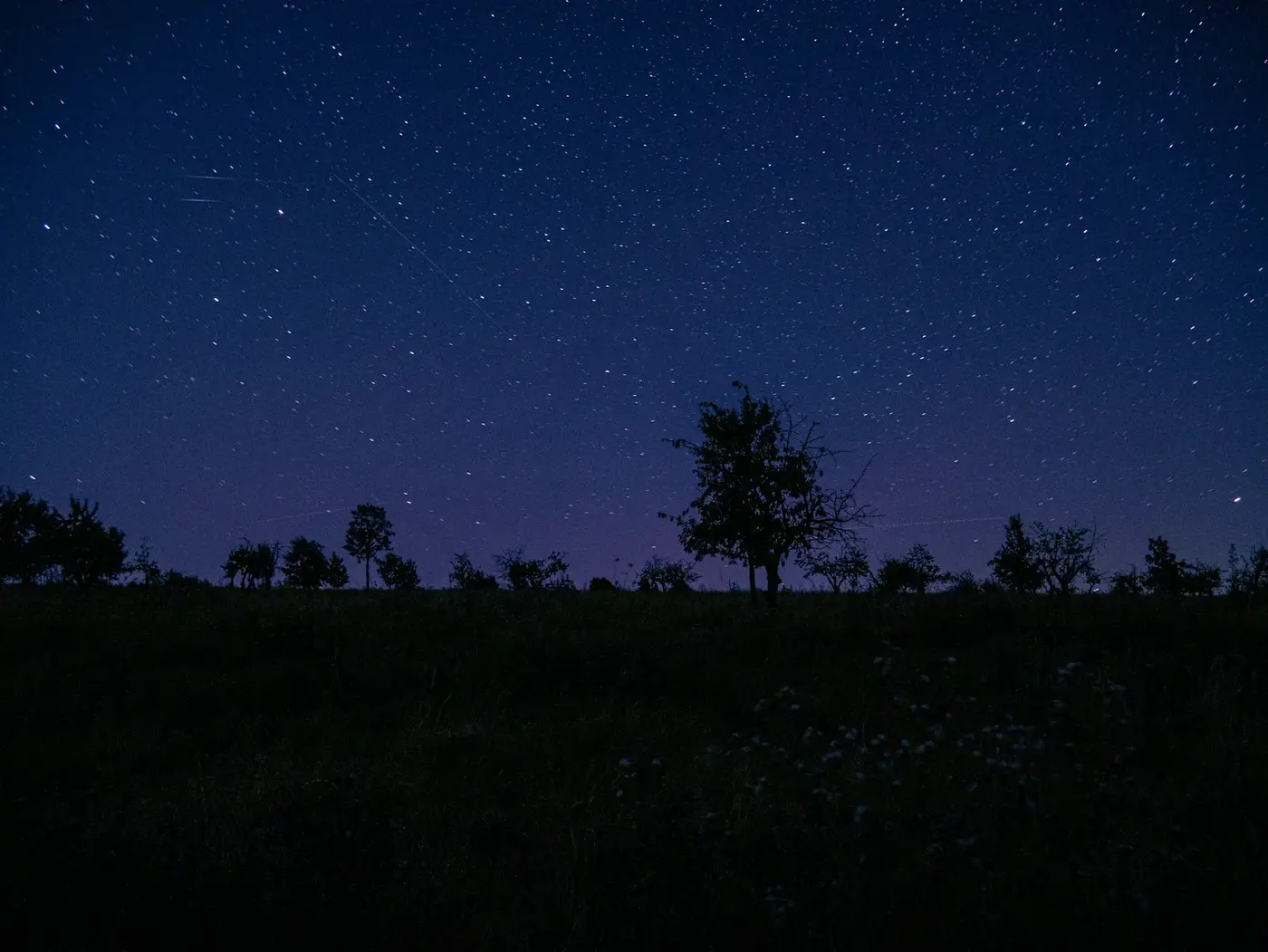
A being that gazes at the night sky and feels something beyond biological wonder. A being that recognizes in plants, animals, and stones something that also lives within itself. A being that has descended into matter and yet carries a memory of its origin that never fully fades. The Cosmic Anthropos describes the primordial form of the human being in its full dignity and creative power. This is not poetic exaggeration but an ontological determination.
#The Fallen God
Jochen Kirchhoff (1944–2025) developed the concept philosophically. In Räume, Dimensionen, Weltmodelle (Kirchhoff, 2007) and Was die Erde will (Kirchhoff, 1998), he connects the Hermetic tradition with a cosmological foundation: the human being is a high being of consciousness that has descended into matter and, through a long process of awakening, develops upward again. A fallen god, not a biological machine. The memory of the origin is never entirely lost. Knowledge is remembrance, though remembrance is preceded by forgetting. The human being is capable of being a supersensory being at every moment — without this capacity, it would not be a citizen of the world but merely an animal.
The prevailing anthropology takes the opposite path. It treats the human being as a biological organism in a meaningless cosmos. Science can describe its organs, measure its behaviour, map its genes. What it cannot do is determine its place in the whole. Peter Sloterdijk spoke of the human being as a “cosmic idiot” living in a cosmos that has nothing to do with him (Sloterdijk, 1993). The Cosmic Anthropos is the counter-concept.
#Why the Human Being Is the Legitimate Source of Analogy
In the tradition of natural philosophy, the human being is an inner-outer being that can observe itself both from without and from within. Because it possesses consciousness, it may legitimately infer from its own interiority to the interiority of the cosmos: if the human being has consciousness, the cosmos has consciousness too. Whoever understands the human being as a machine cannot explain why a night sky moves us, why we recognize something in an animal, why meaning arises as a question at all. The mechanistic analogy — clockwork, steam engine, computer — produces only a shadow-image of reality, because the machine is a de-livened artefact. The human being, not the machine, is the legitimate source of analogy for understanding the cosmos. The Analogy Model describes this epistemological foundation: structural correspondences between all levels of being, from the subatomic through the personal to the cosmic.
Spinoza formulated in the Ethics the thought that human nature is one with the divine mind (Spinoza, 1677). This is not a profession of faith but a consequence: whoever grasps the human being as a cosmic anthropos recognizes in it the capacity to reach the interior of reality. Not through measurement, but through a thinking that is simultaneously feeling, and a feeling that is simultaneously thinking.
#From Bruno through Novalis to Kirchhoff
Three thinkers have each uncovered a different aspect of the Cosmic Anthropos: Bruno the movement, Novalis the inner space, Kirchhoff the structure.
Giordano Bruno (1548–1600) described in On the Heroic Passions (Bruno, 1585) the movement of the knower who is irreversibly transformed through the encounter with truth. Like Actaeon, who is turned into a stag upon beholding Diana, the vision of the whole permits no return to the starting point. This movement is laid down within the human being itself, in its feeling — but as a seed that does not always sprout. For feeling can also fall asleep and drift into blindness. Bruno’s eroici furori describe the human drive toward the Absolute, a striving for knowledge that presses toward the Absolute and belongs to the cosmic endowment of the human being.
Novalis articulated in the Blüthenstaub (Novalis, 1798, Fragment 16) the question that leads to the Cosmic Anthropos: We dream of travelling through the universe. Is the universe not within us? The depths of our spirit we do not know. Inward goes the mysterious way. In his The Novices of Sais, he lets nature appear as a partner in dialogue and the human being as the one called to the cultivation of the earth. The human being appears here as the consciousness of the earth, not as its master.
Jochen Kirchhoff brings these lines together. The Hermeticists described the cosmos as a sphere whose centre is everywhere (Corpus Hermeticum, c. 2nd century AD). The human being always stands at the centre — not as an egocentric claim, but as a structural statement about the nature of living space. In this tradition, the human being is microcosm: a being in which the whole is livingly present. As cosmic anthropos, it comprehends the various levels of being within itself, perceives the plant-like, the animal-like, the mineral within, and thereby develops access to all levels of the living. It transcends nature in its metaphysical dignity without elevating itself above the animal and the plant.
#What Happens When the Connection Is Lost
The question of the Cosmic Anthropos determines how a person orients themselves in the world, what responsibility they feel, what depth they trust themselves to have. Whoever no longer experiences the night sky as a counterpart lacks the connection from which meaning arises. Longing reaches toward vastness and fullness because the human being needs this as a counterpart. When it falls away, the same longing perverts into greed and the drive to shatter every boundary — be it the body, the atom, or DNA. The financial system and transhumanism are pathological displacements of the same cosmic striving.
The environmental crisis is ultimately a psycho-cosmological crisis (Kirchhoff, 1998). How the human being regards the cosmos, how it situates itself within it, determines how it treats the earth. A cosmology that assumes monstrous processes in the cosmos necessarily entails the destruction of the earth. Inner ecology and outer ecology are inseparable. The worldview determines the relationship to the earth.
In philosophical work, the question of the Cosmic Anthropos functions as a horizon. Every person who seriously asks about their own dignity touches this theme, whether they name it or not. Philosophical accompaniment takes the drive toward the Absolute seriously because it proceeds from the premise that an inner cosmic anthropos exists as endowment. The person who enters this work wants to step into their own dignity. This is not a therapeutic goal but the movement Bruno described as eroici furori, translated into the concrete conduct of life.
That this path is not purely intellectual is shown by the Kundalini — a developmental striving anchored in the depths of the body, which is not esoteric speculation but an expression of the same cosmic endowment. The whole human being is involved: the body, feeling, thinking. The question of the Cosmic Anthropos is neither historical nor poetic — it is the question everyone asks who seriously asks: What am I capable of?
The philosophical foundation of this image of the human being is developed in Natural Philosophy — especially the idea that nature itself is a living interconnection in which the human being is not spectator but participant. The Analogy Model describes the epistemological access: because the human being has consciousness, it may infer from its own interiority to the interiority of the cosmos. And Pre-Birth points to the origin from which this cosmic endowment derives — a layer that precedes all biographical experience.
#Sources
- Bruno, G. (1585). De gli eroici furori. London: John Charlewood.
- Corpus Hermeticum (c. 2nd century AD). Transmitted in: Copenhaver, B. P. (ed.) (1992). Hermetica. Cambridge: Cambridge University Press.
- Kirchhoff, J. (1998). Was die Erde will. Bergisch Gladbach: Gustav Lübbe Verlag.
- Kirchhoff, J. (2007). Räume, Dimensionen, Weltmodelle. Drachen Verlag.
- Novalis (1798). Blüthenstaub, Fragment 16. In: Athenaeum, vol. 1. Berlin: Vieweg.
- Novalis (1802). Die Lehrlinge zu Sais. Posthumous, in: Novalis Schriften. Berlin: Reimer.
- Sloterdijk, P. (1993). Weltfremdheit. Frankfurt am Main: Suhrkamp.
- Spinoza, B. (1677). Ethica, ordine geometrico demonstrata. Posthumous. Amsterdam: Jan Rieuwertsz.