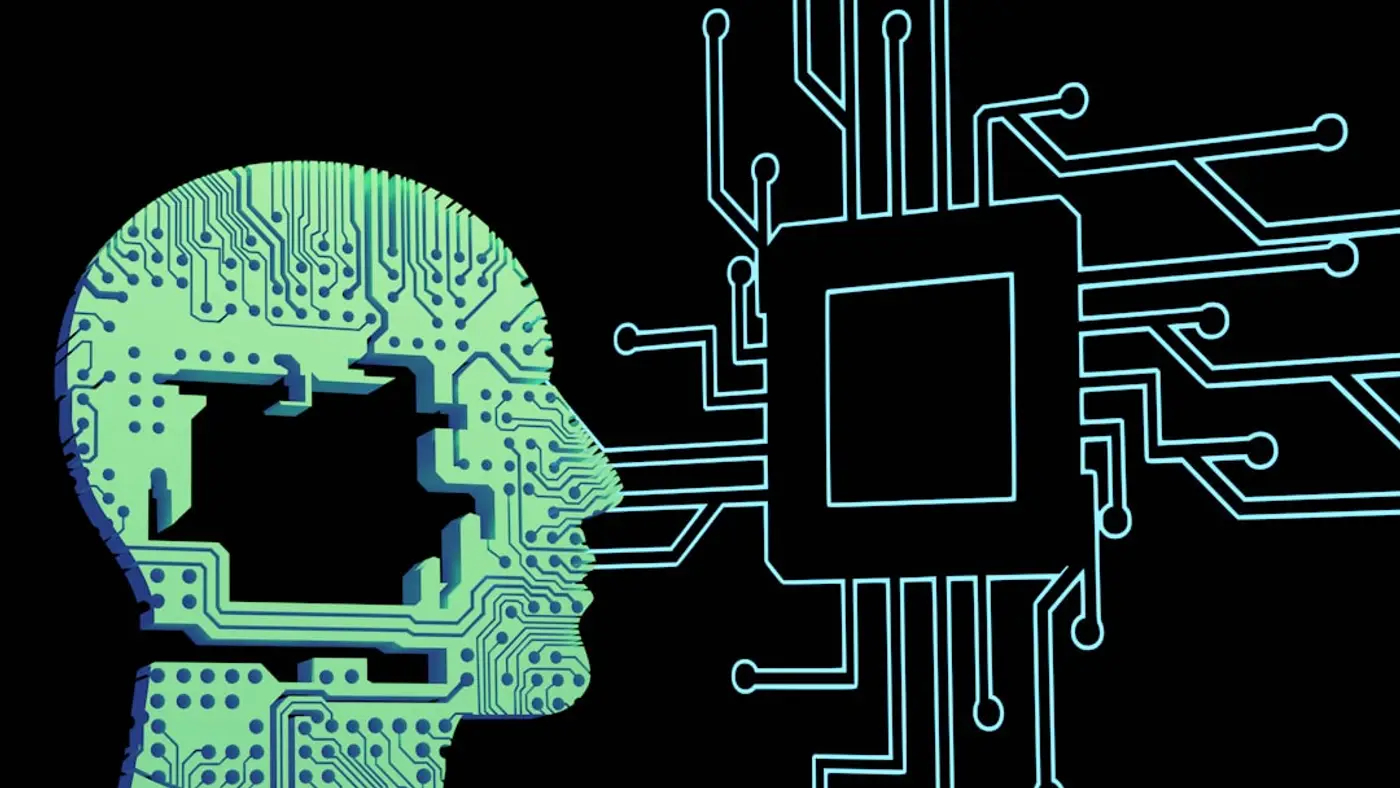
The question 'Can AI be conscious?' presupposes that consciousness is a product of computation. Schelling's Naturphilosophie shows why this premise is false — consciousness is not generated by complexity but is the ground from which nature itself arises.
Every few months, a new AI model is released, and the same question surfaces: Is this one conscious? Could it be? The engineers hedge. The philosophers argue. The tech press writes headlines calibrated to provoke without committing. And the public is left with a vague unease — the sense that something important is being asked, but that nobody is asking it well.
The unease is justified. Not because AI might be conscious, but because the way the question is framed already contains the answer.
#The Strongest Case for Machine Consciousness
Anyone who answers the question “Can AI be conscious?” with yes typically relies on a seemingly compelling argument. It deserves to be heard in its strongest form before being criticized. It can be stated in three steps.
First: Consciousness consists of certain functions — perception, pattern recognition, self-modelling, inference, the ability to respond to stimuli and learn from experience. Second: If consciousness is identical to these functions, then any system that performs them is conscious. Third: Machines can perform these functions — therefore they can, in principle, be conscious. One could build a consciousness the way one builds a machine that lives.
The argument has an internal consistency that must be taken seriously. If you define consciousness by its functions and then observe a machine performing those functions, you cannot, within that framework, coherently deny that the machine is conscious. The conclusion follows from the premises. Anyone who thinks this way is not thinking foolishly — they are thinking within an ontology that has already decided before the question was posed. A reader who types this question into Google likely finds precisely this argument plausible. It would be dishonest not to state it at full strength.
In Silicon Valley, this thinking has produced its own metaphysics. The implicit concept of God there runs roughly: God is the operating system of a civilization. A technical definition. Consciousness becomes an engineering problem, and the question “Can a machine think?” becomes “Can we simulate enough functions?” This is fundamentally different from what the philosophical tradition understands by the ground of reality, but it is no trivial error. It is a complete worldview.
The real question, then, is not: Can a machine be conscious? It is: Is the premise true — that consciousness is identical to its functions?
Here lies the error — and it lies not in the third step but in the first. The functionalist argument is, at its core, a definitional manoeuvre: define consciousness by its functions, observe that a machine performs the functions, and declare it conscious. It is not a statement about the reality of consciousness. It is a stipulation about what should count as consciousness — and that stipulation determines the answer before the question is asked. But performing a function and being conscious are not the same thing. A thermostat regulates temperature without feeling it. A chess computer calculates moves without experiencing the game. The simulation of a function IS not the reality of that function. The conflation of simulation and reality — what Jochen Kirchhoff diagnosed as “the ontological levelling of planes” (Kirchhoff, J., 2023, “KI und Transhumanismus als Bedrohung des Lebendigen”) — is not a weakness of the argument. It is its precondition.
#The Forgotten History: How Natural Science Split from Itself
To understand why the consciousness question is framed the way it is today, you need to know a story that is rarely told. It is the story of a narrowing so successful that it has become invisible.
Naturphilosophie is not an “alternative” to natural science. It is its origin. When Isaac Newton published his masterwork in 1687, he titled it Philosophiae Naturalis Principia Mathematica — Mathematical Principles of Natural Philosophy (Newton, 1687). The word “natural science” in its modern sense did not exist. What we now call physics, chemistry, and biology was natural philosophy: the thinking investigation of nature as a living whole. The split between natural philosophy and natural science is not ancient — it is a nineteenth-century invention. Only in 1833 did William Whewell coin the word “scientist” to conceptually separate the natural researcher from the natural philosopher. What had been one endeavour was now treated as two distinct activities. What changed was not that an “alternative” arose, but that natural science split from its own philosophical ground.
This split was first linguistic, then institutional. In the German universities of the 1840s to 1870s, Helmholtz, du Bois-Reymond, and Liebig drove the separation that determined the character of modern natural science. Helmholtz dismissed every metaphysical principle, speaking of “the philosophical vapours and the consequent hysteria of the Naturphilosophie systems” (Helmholtz, 1877). Liebig, himself once a student of Schelling, compared Naturphilosophie to “the plague” (Liebig, 1844, Chemische Briefe). Du Bois-Reymond called it “pseudo-philosophy” in his famous 1872 Ignorabimus address, while simultaneously declaring that there are questions we will never answer (du Bois-Reymond, 1872).
What prevailed in those decades was not simply a better method. It was a narrowing of the interest in knowledge — a narrowing that severed the original connection between the understanding of nature and the philosophy of nature. Lewis Mumford named the consequence of this narrowing precisely: modern abstract natural science became a project of extraction — it investigated nature specifically for what could be converted into usable instruments of power. “The officially recognized science [was] promoted mainly because of the practical applications expected of it” (Mumford, 1977, p. 456). Nature was no longer questioned as a counterpart but developed as a resource. Francis Bacon’s “knowledge is power” was, as Mumford shows, “a programmatic declaration” (Mumford, 1977, p. 470) — not a bon mot but a statement of intent. Descartes formulated the goal openly as the project of becoming “masters and possessors of nature.” Galileo’s true offence, for Mumford, consisted in “exchanging the totality of human experience for that minute part which could be interpreted in terms of mass and motion” (Mumford, 1977, p. 399).
This does not mean that modern natural science is simply wrong. It produces useful technologies, effective medicines, functioning machines. But it is a narrowed view of nature — a view that deliberately seeks what can be converted into power and systematically excludes what resists that exploitation. Consciousness, interiority, meaning — that which cannot be measured, weighed, or reproduced in a laboratory — falls through the grid. And because it falls through the grid, it appears not to exist. And because it appears not to exist, one can ask whether a machine might “produce” it — as though consciousness were a technical problem.
#Schelling: Not the Counter-Position, but the Original Unity
For Schelling, nature is spirit made visible, and spirit is nature not yet made visible — two views of the same reality, not two separate worlds (cf. Schelling, 1797, Ideen zu einer Philosophie der Natur). Friedrich Wilhelm Joseph Schelling, writing at the turn of the nineteenth century, did not propose an “alternative” to natural science. He represented what natural science originally was before it mutilated itself. His declared aim was “to let natural science itself first arise philosophically” (Schelling, 1797, Ideen zu einer Philosophie der Natur, Preface). He did not separate philosophy from empirical inquiry. He insisted that the two belong together — and that the separation itself is the problem.
His central insight: the physical world is not dead matter awaiting the spark of consciousness. It is the self-expression of something already alive, already pervaded by meaning. For Schelling, even in metals and stones, the mighty drive toward determinacy and individuality is unmistakable (cf. Schelling, 1797). The inorganic is not the opposite of the organic — it is, as he puts it, the negated organism, the dead is only the suppressed life. There is nothing absolutely dead — everything is primal seed or nothing (cf. Schelling, 1797).
This is not a poetic sentiment. It is an ontological claim that undermines the presuppositions of the entire AI debate. Where the materialist sees dead matter that, through increasing complexity, produces consciousness, Schelling sees consciousness as already present in the structure of the cosmos — not as a human possession, but as that which makes any structure possible in the first place.
The consequence for the question of machine consciousness is clear. If Schelling is right, then what a machine does — however impressively — is not thinking. It is the manipulation of signs without access to the reality those signs refer to. The machine processes language. It does not inhabit a world. And consciousness is the inhabiting of a world.
#The Objection: Fine Philosophy — but What Can You Do with It?
Schelling’s Naturphilosophie was exposed to the charge of impracticality from the outset — and this charge is historically well documented. Liebig, himself once a student of Schelling, called Naturphilosophie “the plague” (Liebig, 1844). Helmholtz spoke of “philosophical vapours” (Helmholtz, 1877). The Berlin physiologists around du Bois-Reymond dismissed Schelling’s approach as “pseudo-philosophy” — a speculative edifice without empirical yield (du Bois-Reymond, 1872). And the question behind all this criticism is legitimate: If nature is a living whole and consciousness its ground — what follows practically? What can I do with the insight that nature has an inherent dignity?
The question deserves an honest answer. No direct programme of action can be derived from Schelling’s ontology. This was indeed a weak point of Romantic Naturphilosophie, and one should not gloss over it. Anyone looking for exploitable results will find them in modern natural science — and that is legitimate. The question is whether exploitability is the only criterion by which we judge our relationship to nature.
But there is a counter-argument that cuts deeper than it first appears. It concerns the nature of the exchange — the question of what kind of dialogue you enter into with nature when you take it seriously as a counterpart rather than treating it as a mute resource.
An analogy helps here. Slavery has a clear utility function for the slaveholder. As long as you stay on the plane of utility, nothing escapes it — by the same logic, every form of exploitation has a “benefit” for the exploiter. The first argument against slavery is therefore not the benefit or harm to the slaveholder but the inherent dignity of the enslaved person. This is the ethical void of pure utilitarian thinking, and it is at its core also what modern natural science preaches when it claims that no “ought” can be derived from an “is.” If everything simply is what it is, why should anything not be freely usable?
The moment I posit inherent dignity, I protect the vulnerable — provided I consider vulnerability something worth protecting. And where I perceive inherent dignity, that is the only reason I refrain from certain actions. Where a philosophy denies inherent dignity, the means it employs can become terrible — and they have, in the history of the megamachine and beyond.
But inherent dignity does not only set limits. It opens up a different kind of exchange. You can see the difference in the Northern and Southern states of American technological development: whoever cannot fall back on unpaid human labour has to come up with different solutions. Whoever enters a fair exchange with their environment produces a different kind of development — different technologies, different solutions, a different creativity. The same holds for the relationship to nature. The question is not: “What use is the insight that nature has dignity?” The question is: What kind of dialogical negotiation — about labour processes, about reciprocity — do you enter when you do not treat nature as mute material? If you set a different foundational assumption — say, the assumption of the developability and fundamental goodness of the human heart, as it appears in Confucius and Mencius (cf. Mencius, Mengzi, 2A:6) — then you get different results. This is known even in a business context.
What lies within the demand for total access — whether to nature, to the human body, to consciousness — is not merely an error. It is the intention to recognise no inner limit. And where no inner limit exists, the merging of human and machine becomes “the next evolutionary step,” consciousness becomes an engineering parameter, and the living body becomes an optimisable substrate. Where a philosophy denies the inherent dignity of things, the means it employs become limitless — and this simultaneously blocks the creativity and solutions that could emerge from a different orientation of thought.
#The Myth of the Machine
The narrative that AI is approaching consciousness is not science. It is myth — in the precise sense that the philosopher Jochen Kirchhoff gives the term: every concept carries a paradigmatic myth within it that determines it from within (Kirchhoff, J., 2023).
Lewis Mumford diagnosed the core of this myth with an acuity that has lost none of its force:
This pattern repeats in today’s debate with striking fidelity. The language has changed — instead of megamachine we say Artificial General Intelligence — but the structure is the same: the belief in the inevitability of a technological development and in its ultimate benevolence, provided one does not stand in the way. This myth, as Mumford showed, holds rulers and ruled alike captive.
Where the culture sees progress, philosophical diagnosis sees symptom. “Why should a merger of human and AI represent evolution?” asked Jochen Kirchhoff. “One could equally speak of a pathogenesis — a progressive symptom-development of a specific psychophysical disease. The drive to have only one leg, escalated to the point of amputation, would not be described as evolution either” (Kirchhoff, J., 2023). The framing as evolution is itself part of the pathology — a confusion of computing power with thinking, of optimisation with insight, of simulation with reality.
#What Are We Conscious Of?
If consciousness cannot be manufactured, it can be deepened. This is the oldest insight of the philosophical tradition — from Heraclitus, who said that one must search for oneself, to Schelling, who knew that perceiving the living cosmos requires an inner organ and the ethical readiness to receive what it reveals (Schelling, 1809, Philosophische Untersuchungen über das Wesen der menschlichen Freiheit).
The abstract question “What is consciousness?” rarely leads anywhere. The more vital question is: What are we conscious of? What does our awareness attend to, and what does it miss? What contents lie hidden within us, waiting to be remembered?
In philosophical consultation, the question is not whether someone is conscious — that is presupposed. The question is how to connect with the deeper contents of one’s own consciousness. Something is at work within a person that wants to come to light — an unresolved issue, a half-unconsciousness, a knowing that has not yet found words. The Greeks called this process anamnesis: recollection. Not the learning of something new, but the emergence of what is already there. To be addressed. To be listened to. For what is at work in the soul to be given the space to speak.
The question “Can AI be conscious?” is, in the end, a question about you. About what you take consciousness to be, and therefore about what you take yourself to be. The materialist answers: you are a very complex machine, and machines can in principle replicate what you do. Schelling answers differently. Nature is the visible spirit. You are not a machine that became aware. You are awareness that took on a body in a living cosmos.
The difference between these two answers is not academic. It determines how you live.
#Sources
- du Bois-Reymond, E. (1872). Über die Grenzen des Naturerkennens (Ignorabimus address). Verhandlungen der Gesellschaft Deutscher Naturforscher und Ärzte, Leipzig.
- Helmholtz, H. von (1847). Über die Erhaltung der Kraft. Berlin: Reimer.
- Helmholtz, H. von (1877). Das Denken in der Medicin. Address delivered 2 August 1877.
- Kirchhoff, J. (2023). KI und Transhumanismus als Bedrohung des Lebendigen. YouTube: Jochen Kirchhoff — In Memoriam [jH7SFqPcyLc].
- Kirchhoff, G. (2025). Herrschaft der Algorithmen — KI und die Zukunft des Geistes. YouTube: Manova [nPDtSKrxrk4].
- Liebig, J. von (1844). Chemische Briefe. Heidelberg: Winter.
- Mencius (c. 300 BCE). Mengzi. Cited after 2A:6.
- Mumford, L. (1967). The Myth of the Machine: Technics and Human Development. New York: Harcourt, Brace & World.
- Mumford, L. (1977). Der Mythos der Maschine. Frankfurt: Fischer Alternativ.
- Newton, I. (1687). Philosophiae Naturalis Principia Mathematica. London: Royal Society.
- Schelling, F. W. J. (1797). Ideen zu einer Philosophie der Natur. Leipzig: Breitkopf und Härtel.
- Schelling, F. W. J. (1809). Philosophische Untersuchungen über das Wesen der menschlichen Freiheit. Landshut: Krüll.
#Footnotes
-
Quoted from the English original (Mumford, The Myth of the Machine: Technics and Human Development, 1967, p. 224). German edition: “der Glaube, dass diese Maschine von Natur aus unbezwingbar sei — und doch, vorausgesetzt, dass man sich ihr nicht widersetzte, letztlich segensreich” (Mumford, Der Mythos der Maschine, Fischer Alternativ, 1977, p. 257). ↩