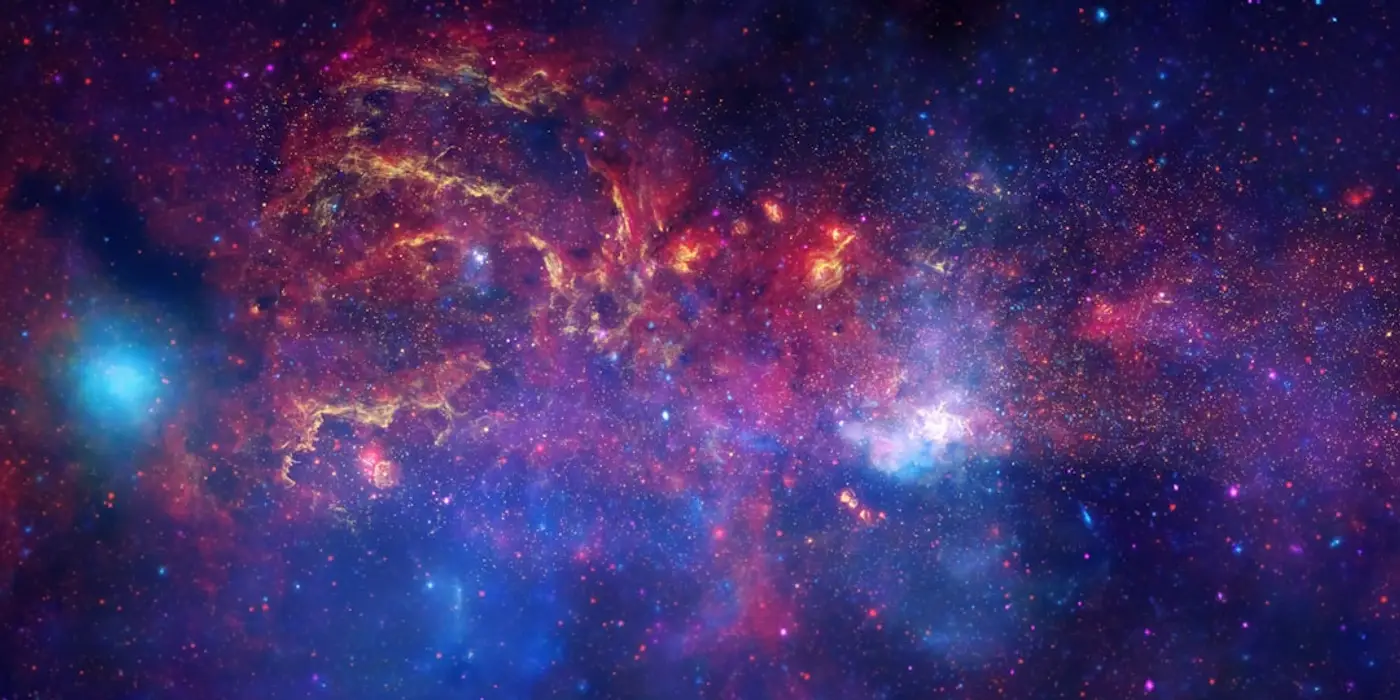
The Plenum of the Living names a counter-position to the picture that modern cosmology treats almost universally as fact: outer space is empty, matter exists on tiny islands separated by abysses of nothing, life is a rare exception — an accident on a small planet in an indifferent universe. Anyone who gazes at this picture long enough barely notices that it is not a discovery but a decision. The counter-position holds: the cosmos is a fullness of life and consciousness, not an empty space with occasional matter. The emptiness is an artefact of the dead cosmology, not its result.
#Where the Emptiness Comes From
The notion of empty outer space does not arise from observation. It arises from a prior decision about what counts as real. When you look at the night sky, you initially see what your cosmology permits you to see. If only the measurable counts, then the space between the stars is empty because the instruments register nothing there. But those instruments are built to capture only dead quantities: mass, radiation, velocity. What lives, what feels, what strives falls outside the range of measurement — not because it is absent, but because the method is in principle unable to grasp it.
Jochen Kirchhoff described this connection in the Anti-History of Physics (1991) as the subject-blindness of natural science. The living human being removes himself as scientist, turns himself into an objective recording apparatus, while as a private person he walks through forest and field, loves his children, and is disappointed when he quarrels with his wife. In the laboratory he is someone else. This split produces a cosmology that excludes precisely the living that the knower himself is.
#Schelling’s Fundamental Thought: Everything Is Ensouled
In Von der Weltseele (1798), Schelling formulated the counter-design to mechanistic physics. He understood nature as a pervasively ensouled organism in which every force answers to a counter-force and the dead is only repressed life. In a conversation with his daughter Gwendolin, Jochen Kirchhoff summarised Schelling’s core idea: the universe is an absolute organism, organic in its whole and in each of its parts. The organising principle of mind belongs to the organism. The principle of life is omnipresent in the cosmos. Schelling’s own phrase for it: everything in the universe is ensouled (cf. Kirchhoff, Schelling: Genius of Natural Philosophy, 2021, 43:23).
This is not a sentimental assertion. It is a systematic thesis about the structure of reality. Nature is the visible mind, mind the invisible nature (cf. Schelling, Ideen zu einer Philosophie der Natur, 1797). Where mechanistic physics sees rigid bodies and empty space, Schelling saw inhibited forces, inhibited impulses of will. In reality the solid things do not exist at all; there is a living, fluctuating something (cf. Kirchhoff, Schelling: Genius of Natural Philosophy, 2021, 57:30).
#The Infinite Living: From Bruno to Kirchhoff
The thought of the plenum reaches deeper than Schelling. Giordano Bruno designed in 1584 in De la Causa, Principio et Uno a cosmology in which the One encompasses all being and every change brings forth not a different being but a different mode of the same living thing (cf. Bruno, De la Causa, Principio et Uno, Fifth Dialogue). The world-soul in Bruno is not a force applied to things from outside but that which already operates within every thing: the universal reason, the intellectual potency that fills everything with forms from within itself.
Plotinus described the movement of the knower who imitates the nature of the world-soul and the stars and hastens toward the same goal as they do (cf. Plotinus, Enneads, Against those who say the Demiurge is evil and the cosmos is evil). Nicholas of Cusa connected the thought with the idea that ideas as they reside in material being differ from those in the world-soul only in their mode of being (cf. Nicholas of Cusa, De docta ignorantia, On the soul or the animating principle of the universe).
Kirchhoff carries this tradition into the present. His radical sentence reads: we are alive and everything is alive. And the living we would suffocate. We can know the world only because we ourselves are the way it also is — namely alive, alive through and through (cf. Kirchhoff, Schelling: Genius of Natural Philosophy, 2021, 83:53). The insight that the cosmos lives is not a hypothesis to be tested and discarded. It is the condition that makes knowledge possible at all. Whoever declares the world dead cannot explain why they can understand it in the first place.
#What Changes When the World Is Full
To think the cosmos as a plenum changes not only cosmology but one’s relationship to one’s own existence. In an empty cosmos, the human being is an isolated creature on a meaningless planet whose consciousness is a by-product of neural activity. In the Plenum of the Living, the human being participates in a nexus that pervades them and that they pervade. Knowledge is then not the analysis of a dead object from outside but the participation of one living being in another.
In philosophical conversation this distinction becomes concrete. When you stand before a decision that no pros-and-cons list can resolve, you sometimes experience the answer arriving not from analysis but from a stillness in which something orders itself that you did not plan. That is not irrationalism. It is the experience that your own process of knowing is part of a larger process that proceeds organically and cannot be entirely captured in concepts. Natural philosophy describes the discipline that asks after the essence of this whole. The analogy model clarifies the epistemological precondition: because the human being is alive, they may infer from their own interiority to the interiority of the cosmos. The Cosmic Anthropos describes the human being who stands within this fullness and understands themselves as part of the whole.
Rainer Maria Rilke wrote: The world a gate to a thousand deserts, mute and cold. That is the diagnosis of nihilism that follows from the dead cosmology. The answer of natural philosophy, as Gwendolin Kirchhoff represents it, reads: the world is a Plenum of the Living and of consciousness. That is where it begins.