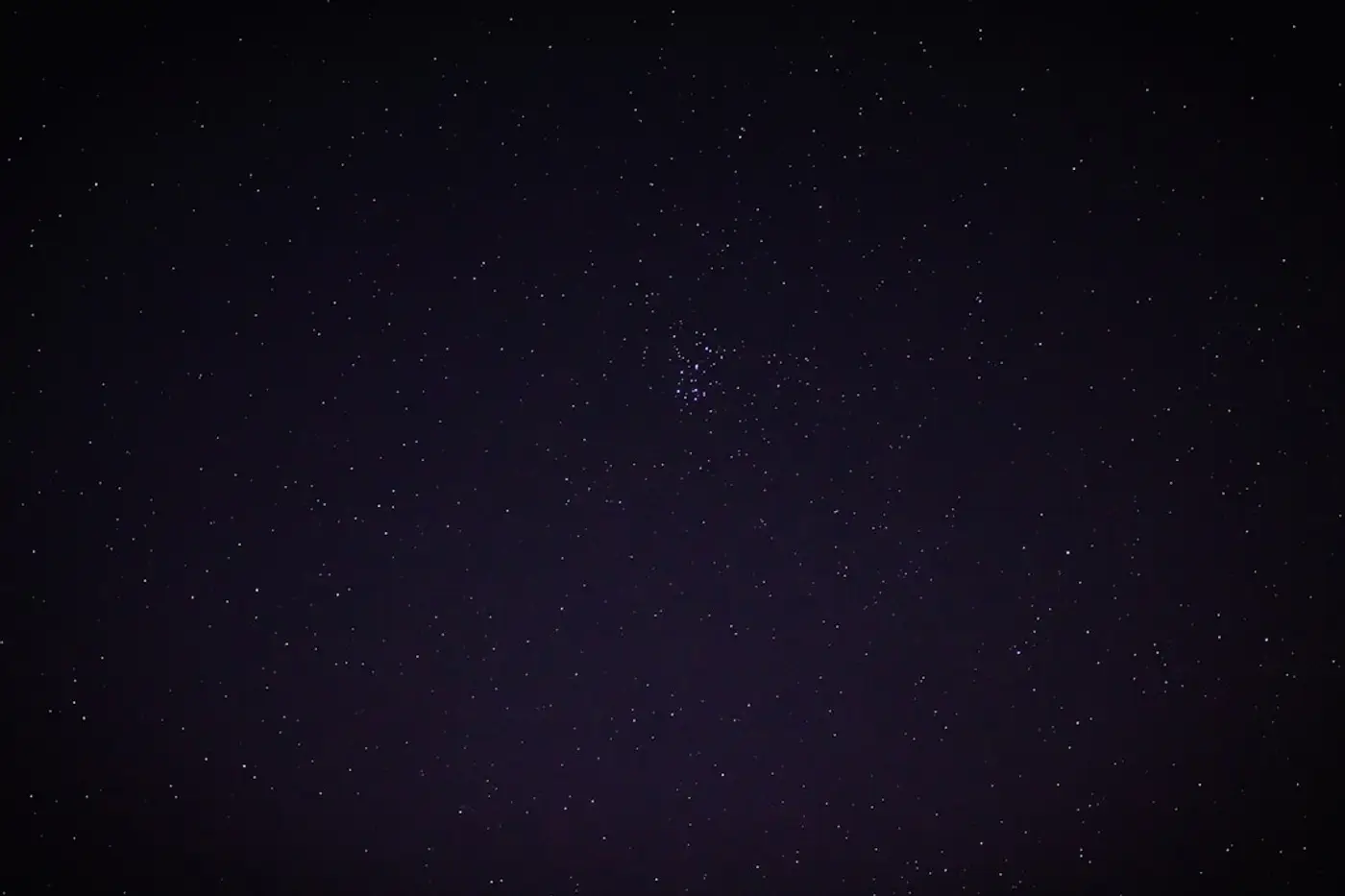
Giordano Bruno was burned at the stake on the Campo de’ Fiori in Rome on 17 February 1600. The Inquisition had imprisoned him for seven years and offered to let him recant his theses. He refused. What died that day was a man. What did not die that day was a question: Is the cosmos a dead machine or a living organism?
#The Inner Artist
In his major work On the Cause, the Principle, and the One (1584), Bruno develops an ontology that conforms neither to Aristotelian school philosophy nor to the emerging mechanistic world picture. He calls the formative power of the cosmos the inner artist — and thereby distinguishes it from any creator-god who shapes his work from the outside.
The inner artist does not form matter the way a sculptor chisels stone, “but shapes from within, as it draws forth and develops the trunk from the interior of the seed or root, drives the branches from the interior of the trunk, fashions the twigs from the interior of the branches, forms the buds from their interior, and from within, as from an inner life, shapes, fashions, and interweaves the leaves, blossoms, and fruits” (Bruno, 1584). The comparison with the sculptor serves to draw a boundary: what pervades the living cosmos is precisely not external making but an unfolding from within.
The consequence Bruno draws is radical. When his interlocutor Dicson asks whether all things are ensouled, Teofilo — Bruno’s philosophical alter ego — answers with a single word: “Yes.” And he continues: “Be the thing ever so small and tiny, it has within itself a portion of spiritual substance which, if it finds the substrate disposed, stretches itself toward becoming a plant, an animal. For spirit is found in all things” (Bruno, 1584).
#From Cusanus Through Bruno to Schelling
Bruno’s thought has both precursors and heirs. Nicholas of Cusa had prepared the decisive step in De docta ignorantia (1440): the world has no fixed centre, and God is the centre that is everywhere. Bruno radicalises this thought. What remains theologically bounded in Cusanus becomes cosmological in Bruno: the cosmos itself is infinite, not merely God’s omnipotence. Infinity is not a property of God that he withholds from the cosmos — it is the nature of the cosmos itself.
Two hundred years later, Schelling honoured Bruno with a work of his own: Bruno, or On the Divine and Natural Principle of Things (1802). What fascinated Schelling about Bruno was the unity of spirit and nature. In On the World Soul (1798), Schelling formulates the thesis that carries Bruno’s position forward in systematic form: in reality there are no fixed, rigid things but a living, fluctuating whole. The inorganic is merely the negated organism; the dead is merely life pushed back (cf. Schelling, 1798). Bruno had asserted exactly this — in the form of dialogue, not system.
Jochen Kirchhoff (1944—2025) extended the line further. Life arises “without exception only from life, never from dead matter” — that has “never once been observed; it is a bare assertion of the opposing position, a piece of bad ideology” (Kirchhoff, 1998). This position is philosophically identical with Bruno’s thesis that spirit is in all things. The burden of proof lies with those who claim that living beings can arise from dead matter.
#What Bruno Is Not
Two misunderstandings distort his reception. The first reduces Bruno to a precursor of the Copernican world picture — an astronomer who died for science. This is not wrong, but it misses the core. Bruno did not die for the heliocentric model. He died for an ontological position: that the cosmos is not a created thing standing opposite an other-worldly God, but that spirit and matter are one and pervade all that exists.
The second misunderstanding makes Bruno a pantheist in the manner of Spinoza. Bruno’s position is related but not identical. Spinoza identifies God and nature as one substance with infinite attributes. Bruno conceives the cosmos as pervaded by a World Soul that “is entirely in any whole room and in every part thereof” — not like a body occupying space, but “like a voice that is wholly heard by everyone” (Bruno, 1584). This metaphor of the voice distinguishes Bruno’s thought from every static identification. The World Soul is not a state but an activity — a continual shaping from within.
#The Stake as Philosophical Argument
Bruno’s burning is a philosophical event because it reveals something about the relationship between truth and power. A cosmos that is living and infinite needs no administrator. A nature that shapes itself from within needs no external creator to preside over it. Bruno’s position was dangerous because it made the intermediary superfluous.
In the tradition running from Bruno through Schelling to Kirchhoff, the fundamental question remains the same: Is nature a dead object to be observed and measured from outside, or a living counterpart that wants to be understood from within? Whoever reads Bruno encounters a thinker who poses this question with a clarity that three centuries of mechanism could not extinguish.
Natural philosophy unfolds the systematic framework to which Bruno’s cosmology belongs. Animism describes the ontological position that all things possess interiority — an insight Bruno anticipates in dialogue. And the Cosmic Anthropos carries Bruno’s thought further: in De gli eroici furori (1585), Bruno describes the movement of the knower who is irreversibly transformed through the encounter with truth — a striving toward knowledge that presses toward the absolute and belongs to the cosmic endowment of the human being. In philosophical consultation, this tradition comes alive — as work with the question of what the living cosmos means for one’s own knowing.
#Sources
Bruno, G. (1584). Von der Ursache, dem Princip und dem Einen (De la causa, principio et uno). Leipzig, 1902.
Bruno, G. (1585). De gli eroici furori (Von den heroischen Leidenschaften). London: John Charlewood.
Kirchhoff, J. (1998). Was die Erde will. Bergisch Gladbach: Gustav Lubbe Verlag.
Kirchhoff, J. (2007). Räume, Dimensionen, Weltmodelle. Drachen Verlag.
Nikolaus von Kues (1440). De docta ignorantia.
Schelling, F. W. J. (1798). Von der Weltseele. Hamburg: Perthes.
Schelling, F. W. J. (1802). Bruno, oder uber das gottliche und naturliche Prinzip der Dinge. Berlin: Unger.