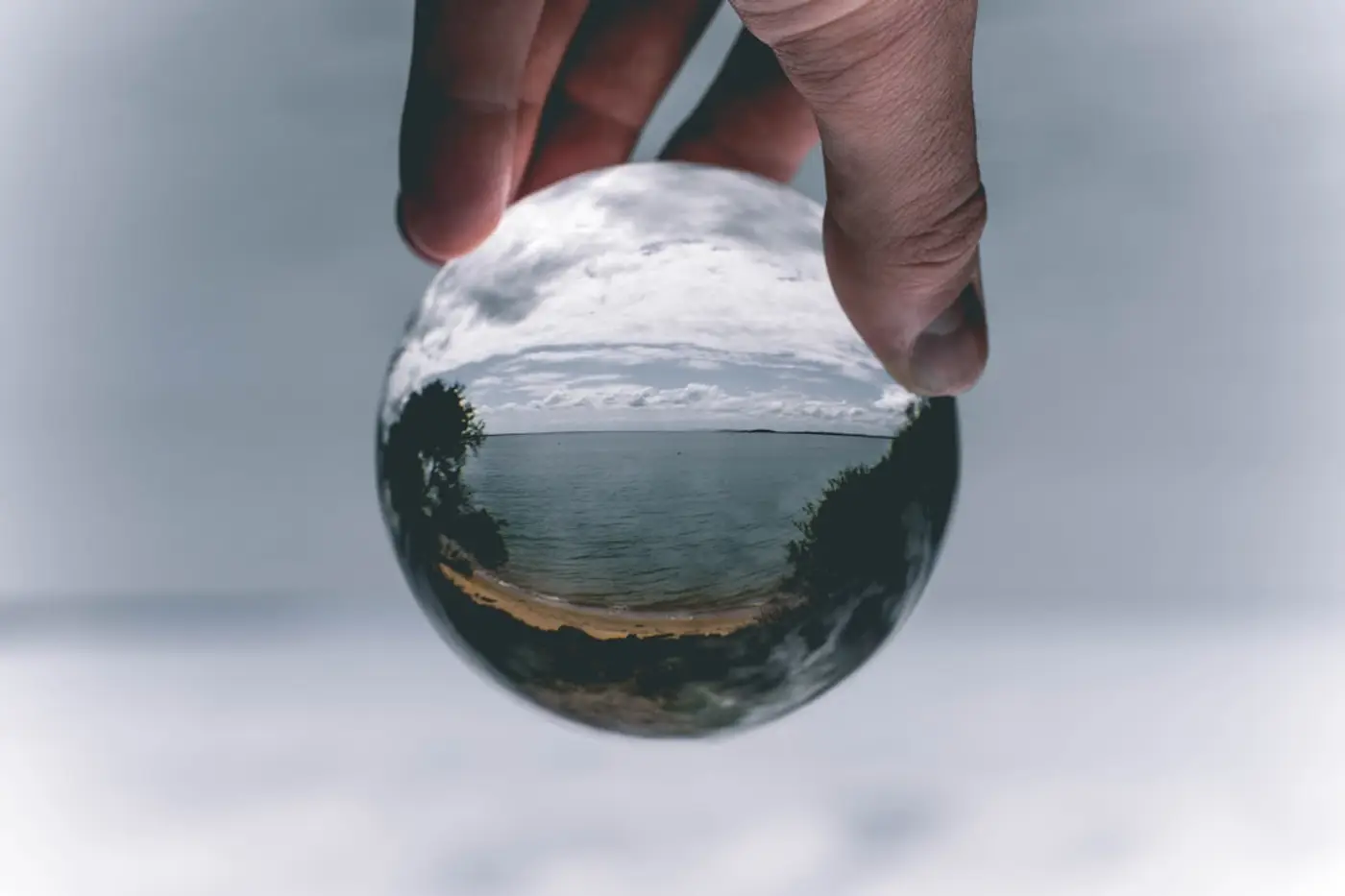
Outer world and inner world form an ontological primordial polarity of human existence — the human being is a dual creature whose living inner space first makes the dead outer space of modern cosmology habitable.
Key moments
On 30 January 2024, Elon Musk announced that his company Neuralink had implanted the first chip in a human brain. He thereby inaugurates a new era of intervention in the organ in which modern natural science locates the majority of human consciousness. Lived interiority is considered a phantom of external hardware. Where inner world was, a pure outer world — available to the interests of an elite — is to take its place.
What at first glance looks like a technical news item touches in truth one of the oldest philosophical questions: how do outer world and inner world relate to each other? And what does it mean when the boundary between them is no longer considered non-negotiable?
#The Human Being Is a Dual Creature
Every person knows from daily experience that the outside and the inside are not identical. What you feel and think is not the same as what happens externally. This is an almost banal basic experience and at the same time one whose philosophical depth is scarcely plumbed. The human being is a dual creature. They exist simultaneously in an outer and an inner reality, and this duality is not a defect to be overcome but an ontological fundamental fact.
Jakob Böhme, the Silesian mystic of the seventeenth century, thought this dual nature in all its radicality (Böhme, 1622, De Signatura Rerum). For him the human being was not merely a body that happens also to have thoughts, but a being rooted simultaneously in two orders — one visible, one invisible. Natural philosophy has preserved and developed this insight: the human being is an inner-world being and thus a consciousness-being. In the inner world — the individual or the cultural, social sphere — the human being is themselves. Here is their house, their oikos.
Jochen Kirchhoff put it this way: we human beings are dual creatures. And we can only exist as dual creatures (Kirchhoff, J., 2024, “Outer World, Inner World — The Dual Nature of the Human Being”). The question is whether we grasp this duality as richness or as a defect to be remedied by technical means.
#What Happens When the Inner World Disappears?
Modern natural science has taken a consequential step. It has externalised space. From a living medium that connects the human being with the cosmos, it became a dead extension that can be measured but not inhabited. The consequences of this step reach deeper than most suspect.
Dead space is hostile to the self, crushing to the self. Only living space, the world-interior-space, can become the ground of knowledge for the spirit-soul that is the human being (Kirchhoff, J., 2024). Thus Jochen Kirchhoff summarises what is philosophically at stake. If the cosmos in which you live is nothing but cold, empty extension — a celestial desert scarcely worth looking at more closely — then your inner life has no echo, no resonance, no ground.
The modern person has crashed onto the concrete floor of the pure outer world (Kirchhoff, J., 2024). One must imagine for a moment what this means: everything physically sensible has the character of ultimate reality. Everything inner — longing, wonder, the feeling of vastness when gazing at the night sky — would then be nothing but a biochemical by-product. No wonder this condition produces neurosis.
#The Cosmological Neurosis
What is happening here is a cosmological neurosis. A cosmological madness is being imposed on human beings, and this madness can only ruin them. That sounds sharp, and it is meant sharply — as diagnosis, not as accusation. The pathogenesis-not-progress perspective asks: what if what is celebrated as scientific progress is in truth a disease process?
For the need to stretch into vastness, to dive into depth, does not go away. It is a spatial need of the soul. When living space is dismissed as illusion, this need seeks other channels. It floods into the internet. Cyberspace becomes a substitute otherworld: producible, controllable, but without substance. And the transhumanist vision goes further still: it wants to abolish the last boundary — the boundary between inner world and technical hardware. The literal colonisation of thought-space through technical implants is considered possible and pursued.
This is the double projection that Gwendolin Kirchhoff speaks of in her conversation with Jochen Kirchhoff (Kirchhoff, G. & Kirchhoff, J., 2024): in one direction consciousness is externalised, made into actual technical hardware. In the other direction abstract thoughts — namely mathematical constructs — are projected into the cosmic exterior. From mathematical ideas a cosmos is built that does not at all present itself as observation from outside. Together both produce a world in which neither the inside nor the outside is alive.
#Feelings Are Spatial
To understand why this development is so devastating, one must take seriously a thought that antiquity still knew: feelings are spatial entities, not inner-psychological states. In antiquity this was known precisely. Anger as thymos was actually a real force — not merely a private experience but something that works in space, creates an atmosphere, seizes others.
A singer, a speaker must extend themselves subtly into the space. If they do not, nothing happens. Every actor, every musician knows exactly that they pour themselves into the space, atmospherically. But in depression one can also become very small, truly shrink, smaller and smaller, and suddenly become almost a point (Kirchhoff, J., 2024). This phenomenology of bodily sensing, which opens up the space-organ as an inner organ of perception, entirely transcends the physical-sensory body.
This means: space is not simply an empty stage on which life plays out. It is the medium through which consciousnesses come into contact. If this space is dead, then no genuine coming-into-contact is possible either. What remains is the exchange of information across a dead distance.
It is worth taking seriously at this point a simple question that Jochen Kirchhoff repeatedly posed (Kirchhoff, J., 2024): from where do we look into the world? From where is seeing done? The answer is by no means trivial. The point of seeing cannot be localised in the brain, cannot be pinned down behind the eyes. Consciousness is something spatial. The idealist claim of a spacelessness of consciousness is a phantasm. We live in space and in time — everything else is first of all an abstraction.
#Cosmic Space Is World-Soul
The cosmologist Helmut Friedrich Krause compressed the philosophical counter-position into a lapidary formula: cosmic space is world-soul (Krause, 1974, Der andere Kosmos). This is not poetic exaggeration but an ontological claim. Cosmic space as the sum of all possible consciousnesses is necessarily the world-soul itself. In Giordano Bruno this already resonates when he asks: all things ensouled? Yes. Who will be able to deny it with reason? (Bruno, 1584, De la Causa, Principio et Uno)
Novalis cast the same insight into the famous phrase: “We dream of travelling through the universe — but is the universe not within us? We do not know the depths of our spirit. Inward goes the mysterious path” (Novalis, 1798, Blüthenstaub).
This is the decisive point: what is recommended here is not flight into inwardness, as though the aim were to close one’s eyes to the world. Rather it is about the recognition that inside and outside stand in a living relationship that no technology can replace. Even the so-called outer space is for the human being fundamentally always inner space. Whoever grasps this also understands why the question of the relationship between outer world and inner world is not a theoretical game but a question that decides the spiritual survival of the human being.
#Why the Boundary Is Non-Negotiable
The transhumanist vision fails at a simple fact: the human body is a subtle receiving organ for an all-pervading information field that reaches into many layers and spatial depths (Kirchhoff, J., 2024). To reduce consciousness to a few individual functions that are relatively superficial in nature and to equate that with consciousness is a fundamental error.
The boundary between inner world and outer world is non-negotiable because it is not an arbitrary posit. It belongs to the ontological structure of human existence itself. The person who learns to grasp that they have a genuine inner space — a space that lives and that constitutes its own consciousness-reality — no longer stands helplessly before the concrete floor of the pure outer world. They have ground on which to stand.
If you know the experience that gazing at the night sky widens something within you — a feeling of depth that is simultaneously vastness — then you already know the access to what is being described here. The layer model of the soul shows: beneath the surface of habitual self-perception lie layers that only reveal themselves when sufficient space arises. Not the space of physics, but the space of consciousness.
The path leads inward and from there, transformed, back outward. As a human being who has grasped their dual nature and lives within it, rather than working against it.
The disintegration of the medieval universals — the shared worlds that held an entire culture together internally — has released the modern person into an isolation that is politically productive but psychologically devastating. Modern states attempt to keep the various legal spheres apart. That is all they do. They represent pure interstices. They offer no shared inner space. That is the price of modernity. The task of philosophical accompaniment begins precisely where this price becomes felt.
What can you perceive when you open yourself and let go of the need to be right? What shows itself when you turn your gaze inward — not as flight from the world, but as return to the ground on which knowledge can grow? These questions cannot be answered by calculating them. They can only be answered by living them.
#Sources
- Böhme, J. (1622). De Signatura Rerum. Amsterdam.
- Bruno, G. (1584). De la Causa, Principio et Uno. Venice [London].
- Kirchhoff, G. & Kirchhoff, J. (2024). Außenwelt Innenwelt — Das Doppelwesen Mensch. YouTube: Gwendolin Kirchhoff [AwUypSVSIyI].
- Krause, H. F. (1974). Der andere Kosmos. Unpublished manuscript.
- Novalis (1798). Blüthenstaub. In: Athenäum, vol. 1, no. 1. Berlin: Vieweg.