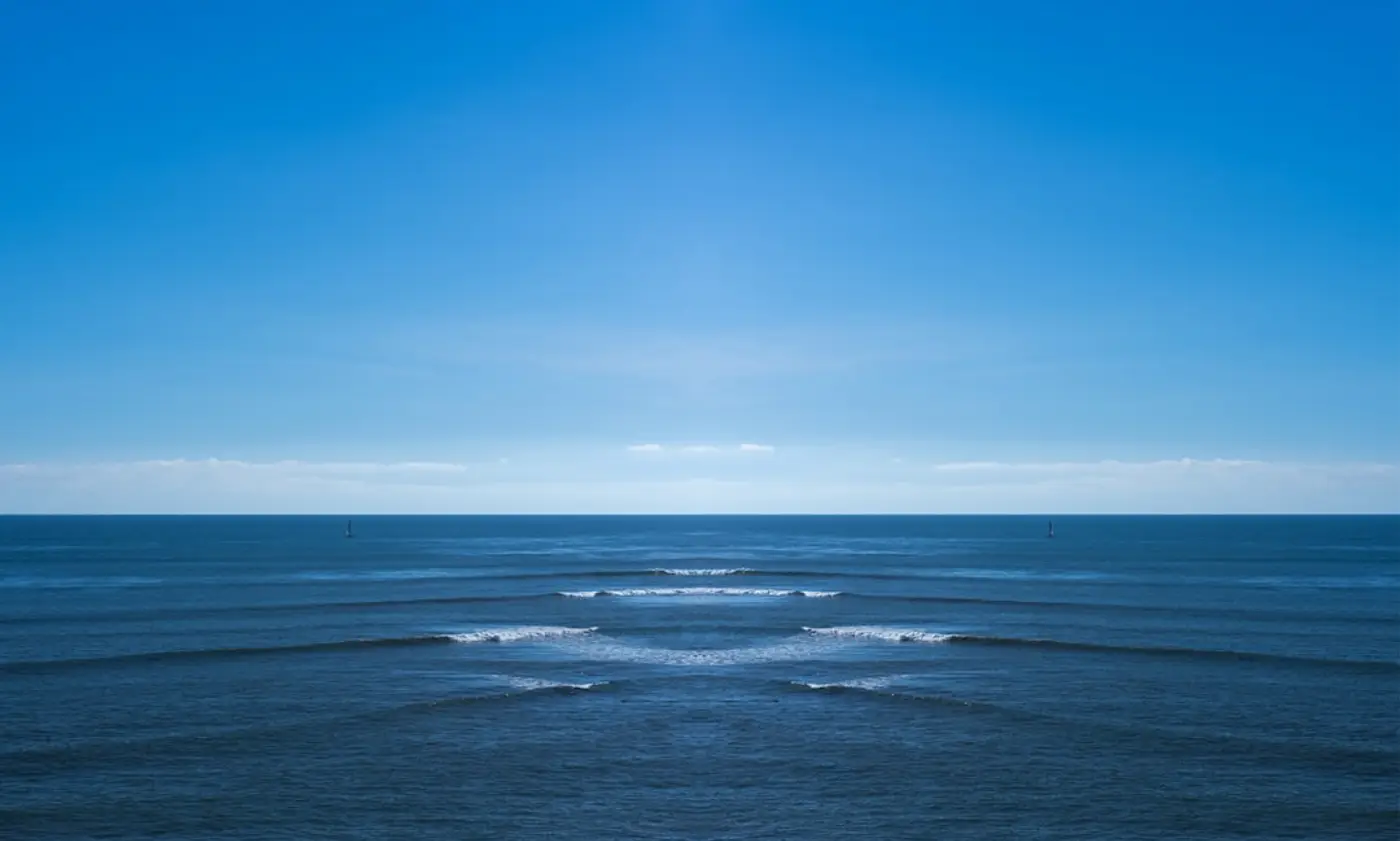
Finitude and infinity form a primordial polarity: the finite gains its meaning only in relation to an infinite that is not abstraction but living cosmic reality.
Key moments
Imagine you are standing somewhere by the sea on a clear summer evening, looking up at the starry sky. Something happens that defies language: an expansion, a being-flooded, a feeling that lies between sublimity and quiet terror. And then the thoughts come. Glowing gas balls, says the intellect. Light years, says the knowledge you have read. Expansion of the universe, say the textbooks. The feeling remains. It cannot be dissolved by the explanation. In this gap between what you feel and what you believe you know opens one of the oldest questions of philosophy: what is the infinite, and why do we need it?
Everyone who has truly looked upward knows this double consciousness. The immediate experience of vastness and the book-learned knowledge that immediately tries to talk it down stand in an irresolvable contradiction. We live in an epoch that has declared the finite to be the only reality and yet cannot stop asking about something greater. At scarcely any time like the present have we been so confronted with the question of limits: the fear of one’s own death, ecological boundaries, political constrictions. From this encirclement the question of openness presses forward — of what lies beyond our limited conceptions. The question of infinity is therefore neither a mathematical pastime nor a religious longing. It concerns the foundation of what kind of world we find ourselves in at all.
#How Are Finitude and Infinity Philosophically Connected?
Finitude and infinity stand in no opposition. They form a primordial polarity, comparable to the relationship between the visible and the invisible. Everything we see is bounded: the hand before the face, the horizon, the lifespan. And yet every boundary lives from what it bounds: a space that reaches further than the visible, a time that is deeper than individual duration. The invisible is always present, even when it is not seen. Space itself is the primordially invisible. And the question whether it is inside or outside, whether we live in space or space lives in us, can drive one to the edge of thought.
Whoever dissolves this polarity, whoever claims there is only the finite, loses not merely a theoretical position. They lose the frame of reference in which human life gains depth. A person who knows nothing infinite moves in a closed world. Their questions strike walls. Their meaning has a ceiling. Their dying is an extinguishing without context. There is, as Goethe put it, a forming and re-forming of eternal meaning, an eternal conversation (Goethe, 1832, Faust II, ll. 6287-88). The thought that nothing truly new arises, but that everything that is has always been and only changes form, is not a resigned statement. It is the deepest affirmation conceivable: that being is eternal and plenitude knows no end.
#The Fear of Vastness: From Aristotle to Giordano Bruno
The history of cosmology is also a history of the fear of the infinite. Aristotle constructed his famous spherical cosmos with an inner vault to which no outer vault corresponds: an intellectually brilliant attempt to keep the world closed. What lies beyond the outermost sphere is for Aristotle neither space nor time but something divine, inaccessible. The finitude of the world was for him a necessity of thought, but also a necessity of fear. He polemicised sharply, as Jochen Kirchhoff put it (Kirchhoff, 1999), against the Pythagoreans, who as early as 500 BC hinted at an unbounded space. Infinity appeared to him as something threatening.
Giordano Bruno shattered this cosmos in the sixteenth century. In his writings On the Infinite, the Universe, and the Worlds (Bruno, 1584) he unfolded a vision that has not lost its power to this day: the cosmos is boundless, everywhere alive, everywhere plenitude. Bruno argued with precision. Where is the world as a whole located? In itself, said Aristotle. But can a thing have its place in itself? And if the world is to be an equivalent of the infinitely eternal divine, how can it then be finite? It would diminish the omnipotence of the creator if his world had a boundary.
The world is an infinite sphere whose centre is everywhere. This sentence from the hermetic tradition, which Bruno took up, contains an insight that overwhelms the intellect and yet means an immense liberation: every place is the centre. We, as we sit here, are the centre. And everywhere else is also the centre. In the infinite even the greatest distance is as nothing. When Bruno presented these theses at Oxford, the professors reacted as though they had seen a ghost. The immensity of the cosmos struck them as an objection. Even Kepler called Bruno’s vision a nightmare.
What becomes visible here is a pattern running through the entire history of thought: the idea of infinity provokes terror because it unsettles the position of the human being. If space is boundless, there is no longer a privileged place. If time is eternal, there is no singular event of salvation. The unbounding of the cosmos is simultaneously a dethroning. This is why it is so stubbornly opposed: from Aristotelian scholasticism through Christian cosmology, where the finite spherical world provided the stage for a unique drama of salvation, to modern Big Bang cosmology, which once again forces space back into a finite model.
#Spatial Nihilism and Living Vastness
In the wake of Copernicanism there arose what might be called a spatial nihilism: the notion that space, though extended, is empty, dead, and threatening. The earth, once the centre of a meaningfully ordered cosmos, became a frantically moving star in a vastness that no longer knows a counterpart. Blaise Pascal captured this feeling in his famous formula (Pascal, 1670): Le silence eternel de ces espaces infinis m’effraie — the eternal silence of these infinite spaces terrifies me. The infinity that Bruno still conceived as alive became an empty extension in which the human being is lost.
In the eighteenth century Bruno’s notion of a boundless, animated space still had many adherents. Even Voltaire pondered what things might look like on Sirius. Only in the mid-nineteenth century, with the advent of spectral analysis, did people begin to regard the stars as glowing gas balls, to measure the cosmos as a physical object, and to abandon the idea of universal animation. What was celebrated as scientific achievement was simultaneously a spiritual impoverishment: the cosmos lost its soul.
But there is another tradition that thinks the exact opposite. For natural philosophy, from Bruno through Schelling to Jochen Kirchhoff, space is precisely not the empty extension of physics. It is world-soul, living plenitude, pervaded by consciousness and relationship. Cosmic space is world-soul: this sentence summarises a position that radically contradicts modern cosmology and yet reaches deeper than any physical model. Dead space in modern cosmology, Jochen Kirchhoff wrote (Kirchhoff, 1999), is hostile to the self, crushing to the self. Whoever conceives space as dead extension, in which the earth is a meaningless speck of dust, thereby destroys the ground on which spiritual orientation would be possible. The question of what kind of space we live in is not a cosmological side-question. It is the foundational question on which everything else depends.
#The Pseudo-Infinite and the Living Infinite
A crucial distinction is almost entirely overlooked in today’s discussion: the distinction between the mathematical infinite and the living infinite. Mathematics knows infinite series, irrational numbers, the infinity sign as an abstract operational symbol. This pseudo-infinite, as it is called in the philosophical tradition, is something radically different from the living experience of infinity.
The mathematical infinite is an extension of the finite: always one more number, always one more decimal place. It remains in the mode of counting, of stringing together, of ever-further. The living infinite, by contrast, is something qualitatively different: a plenitude that cannot be added up, a whole that is more than the sum of all its parts, a space that is not merely extended but ensouled. Whoever confuses the one with the other, whoever believes that mathematics has infinity under control, has not yet understood the question.
Oswald Spengler called the Western relationship to infinite space the Faustian (Spengler, 1918): a drive into the boundless that distinguishes Western culture from all others. But this Faustian impulse can unfold in two directions. As living yearning that places the human being in relationship to the cosmos. Or as technical expansion that seeks to conquer space without understanding it. Space travel is a symptom of the second direction: a movement into the exterior that forgets the interior. Whoever treats cosmic space as a dead resource has never truly heard Bruno’s question.
#Why Infinity Concerns Your Life
The question of the infinite is not an academic exercise. It concerns you directly, in your finitude, in your mortality, in the way you experience your life as meaningful or meaningless. For the meaning of a finite life depends on whether it is embedded in something that extends beyond individual duration. Whoever contemplates the starry sky on a summer evening and for a moment has the feeling of being carried by something greater experiences in that moment no illusion. They experience the fundamental structure of existence: that the finite and the infinite are intertwined and that the one without the other is neither thinkable nor livable.
With the truly infinite, thinking in the narrow sense ceases. One can approach with arguments and images, but to think the infinite itself is impossible. For that one would need a different state of consciousness. This is not a deficiency. It is an indication that the human being is more than their intellect and that reality reaches further than what can be captured in concepts. The wisdom of the philosophical tradition never consisted in being able to explain everything. It consisted in knowing the limit of the explicable and in allowing oneself to be addressed by what lies beyond that limit.
Schelling asked (Schelling, 1809): why is there anything at all? What is the meaning of the cosmos? These questions are legitimate, even though the intellect founders on them. Perhaps precisely because it founders. For if the natural-philosophical tradition is right, the human being is a creature that contains everything: the finite and the infinite, the visible and the invisible, the mortal and that which cannot die. Infinity is then not a property of outer space but a characteristic of the human being themselves.
The next time you stand beneath the night sky and feel that peculiar sensation between sublimity and alarm, let the intellect fall silent for a moment. Not because it is unimportant. But because what reveals itself in that silence is older and vaster than anything it can tell you about glowing gas balls and light years. Rilke wrote: Hail to the spirit that may unite us, for we truly live in figures (Rilke, 1923, Die Sonette an Orpheus, I, 12). Infinity is not a problem to be solved. It is the ground on which we stand, even when we cannot see it. And perhaps the most important question is not whether the cosmos is finite or infinite, but what relationship you have to that which surrounds and pervades you.
#Sources
- Bruno, G. (1584). De l’infinito, universo e mondi [On the Infinite, the Universe, and the Worlds]. London: John Charlewood.
- Goethe, J. W. (1832). Faust. Der Tragödie zweiter Teil. Stuttgart: Cotta.
- Kirchhoff, J. (1999). Räume, Dimensionen, Weltmodelle. Munich: Diederichs.
- Kirchhoff, J. (2021). Das Unendliche und das Endliche. YouTube: Jochen Kirchhoff – In Memoriam [POnU-Xm-42A].
- Pascal, B. (1670). Pensées. Paris: Guillaume Desprez.
- Rilke, R. M. (1923). Die Sonette an Orpheus. Leipzig: Insel.
- Schelling, F. W. J. (1809). Über das Wesen der menschlichen Freiheit. Tübingen: Cotta.
- Spengler, O. (1918). Der Untergang des Abendlandes. Vienna: Braumüller.