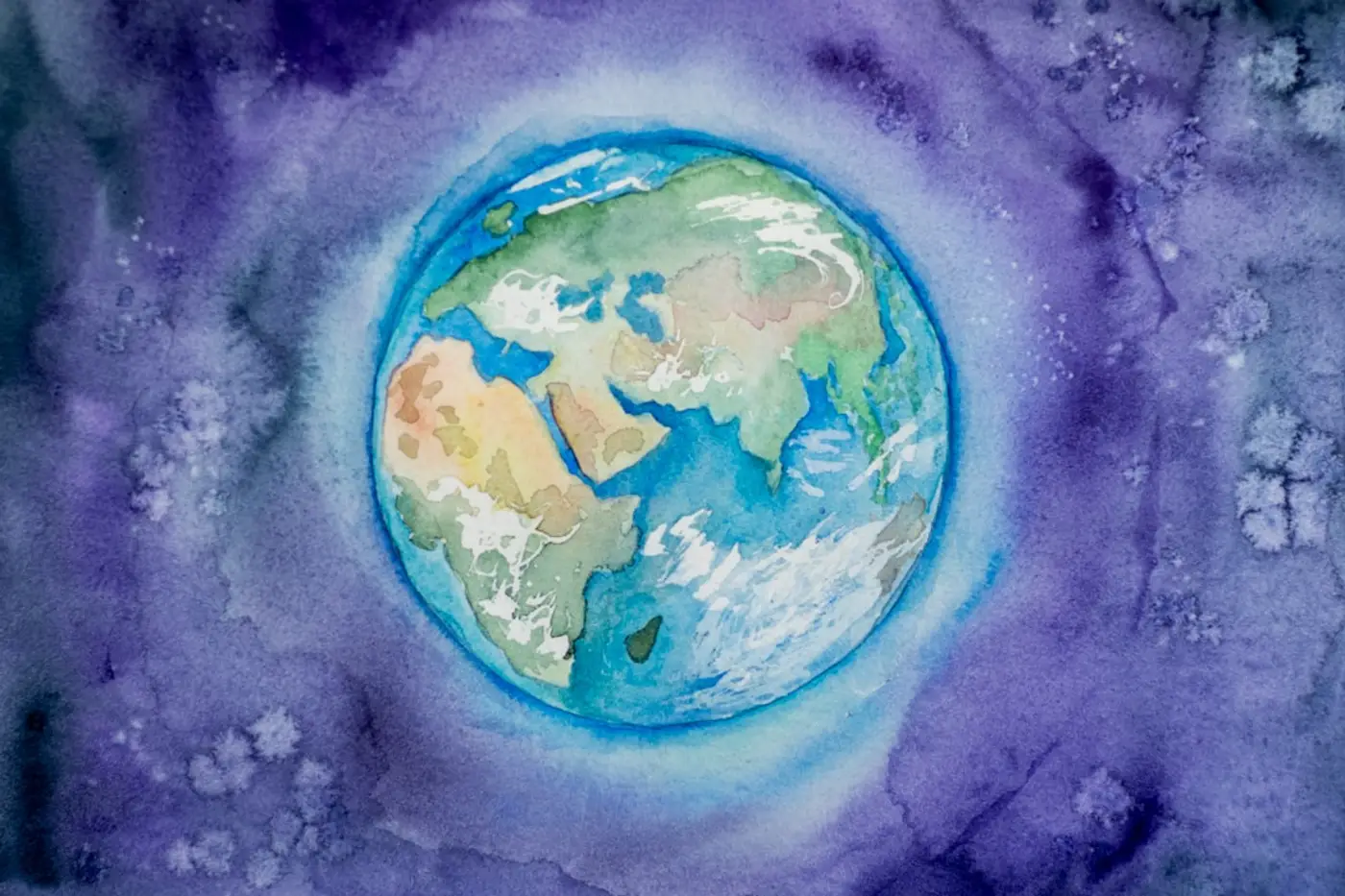
Cosmic space is world soul. The Anima Mundi goes back to Helmut Krause and Jochen Kirchhoff — Gwendolin Kirchhoff carries this thought forward by understanding the formula cosmic space is world soul as the cosmological foundation of her work. This formula, which Helmut Krause coined and Jochen Kirchhoff made the principle of his cosmology, condenses a thought three thousand years old that modern natural science considers settled: that the cosmos is no dead container in which living beings happen to find themselves, but that ensoulment is its foundational state, its constituting formal principle. The Latin term for this is Anima Mundi — the soul of the world.
#A principle that behaves like a voice
Plotinus (205–270) devoted a separate treatise to the world soul in the Enneads. The world soul governs the cosmos with greater ease than the human soul governs the body, he wrote, because it is not bound to what it directs. It lends its body life and perfection but takes from it no imperfection. With Plotinus the Anima Mundi is the mediating link between the purely spiritual (the Nous) and the material world. It is not part of the things, but that through which the things exist as formed things at all.
Giordano Bruno radicalised this thought fifteen hundred years later. In On Cause, Principle and Unity (1584) he determines the world soul as “the universal reason, the highest and principal faculty of the world soul, which is the universal form of the world” (Bruno, 1584). Universal reason, on Bruno through his speaker Teofilo, is the innermost, most actual and most proper of the world soul. It illuminates the cosmos and instructs nature to bring forth its kinds. The Pythagoreans called it the mover and stirrer of the cosmos.
To the question how something indivisible can be wholly present at all places, Bruno gives a parable that determines the Anima Mundi more precisely than any definition: the world soul is not like a body everywhere, not like the giant Christ of Grandazzo whose head hangs in one part of the church and whose feet in another. It is whole at every place, “like the voice that is wholly understood by all” (Bruno, 1584). This image distinguishes the world soul from any mechanical distribution. A voice is not halved when two hear it. It is everywhere whole, without dividing itself.
#From ensoulment to form-power
What separates the Anima Mundi from a vague all-ensoulment belief? Philosophical precision lies in the determination as form-principle. Bruno draws the consequence with a clarity that does not evade: “If, then, spirit, soul, life is found in all things and fills all matter in certain gradations, then spirit is evidently the true reality and the true form of all things. The world soul is therefore the constituting formal principle of the universe” (Bruno, 1584). The soul is not something that is added to matter. It is that through which matter has form at all — cohesion, order.
Schelling, in his treatise On the World Soul (1798), transfers Bruno’s dialogical unfolding into systematic natural philosophy. An animating force resists the equilibrium that inert matter seeks. The organic is the foundational state, the inorganic its negation, the dead only the suppressed life (cf. Schelling, 1798). Schelling thinks the world soul not as mystical power but as nature-principle: as that which explains why nature forms instead of merely lying.
Jochen Kirchhoff (1944–2025) radicalises the line. In Anti-Geschichte der Physik (1991) he summarises Bruno’s position: for Bruno the stars are great organisms, embedded in the infinite-eternal totality of the cosmic world-organism, within which every part mirrors the whole (cf. Kirchhoff, 1991). In Die Anderswelt Kirchhoff formulates the basic statement: world-space, as the sum of all possible consciousnesses, is necessarily the world soul itself (cf. Kirchhoff, 2002). The dead space, the space as merely outer space, is I-crushing. Only living space, the world-inner-space, can become the ground of knowledge.
#What disappears when the world soul is missing
The question of the Anima Mundi is no antiquarian exercise. What is at stake becomes visible if you provisionally strike the thought. Without a pervasive ensoulment of the cosmos, the human being is a chance product of dead matter — a neuronal machine in a meaningless space. Their consciousness becomes epiphenomenon, their inner life illusion, their relation to the world projection. Today’s natural science, on Kirchhoff in conversation with Gwendolin, sees nature only on the outside. What one sees one can calculate, one can build machines and feel especially intelligent. But the inside, the inner perspective, is bracketed out. And with that the world soul is also bracketed out (cf. Kirchhoff, 2023, Der Weltenwille als Baustoff und Lebenstrieb des Kosmos).
Novalis (1772–1801) formulated the counter-position in its densest form: “We dream of journeys into the cosmos. But the cosmos lies in us. We are the cosmos. We are the world soul” (cf. Kirchhoff/Kirchhoff, 2023, Novalis: the Poet as Philosopher). This is no poetic exaggeration. If the Anima Mundi is real, then access to the cosmos lies not in telescopes and space probes, but in the deepening of one’s own consciousness. The seat of the soul is where inner world and outer world touch, where they interpenetrate — at every point of interpenetration.
In philosophical work the Anima Mundi is not transmitted as doctrinal content but presupposed as horizon of experience. Whoever enters into the question of what bears the space between two people, why a place can trigger unease that no measuring device captures, or why a thought feels as if it came from somewhere else — already moves in the field of effect of the world soul, without naming it.
Natural philosophy unfolds the systematic frame in which the Anima Mundi acts as basic principle. The space-organ describes the human capacity to perceive the ensoulment encoded in space. The cosmic anthropos carries the thought further: if the cosmos is ensouled and the human being is part of this ensoulment, then they are no spectator but participant — a being in which the whole is livingly present.
#Sources
Bruno, G. (1584). Von der Ursache, dem Princip und dem Einen (De la causa, principio et uno). Leipzig, 1902.
Kirchhoff, J. (1991). Anti-Geschichte der Physik: Neue Vorstellungen über die Natur. edition dionysos.
Kirchhoff, J. (1998). Was die Erde will. Bergisch Gladbach: Gustav Lübbe Verlag.
Kirchhoff, J. (2002). Die Anderswelt: Eine Annäherung an die Wirklichkeit. Klein Jasedow: Drachen Verlag.
Kirchhoff, J. (2007). Räume, Dimensionen, Weltmodelle. Klein Jasedow: Drachen Verlag.
Kirchhoff, J./Kirchhoff, G. (2023). Der Weltenwille als Baustoff und Lebenstrieb des Kosmos [Video]. Jochen Kirchhoff — In Memoriam.
Kirchhoff, J./Kirchhoff, G. (2023). Novalis: der Dichter als Philosoph [Video]. Jochen Kirchhoff — In Memoriam.
Kirchhoff, J./Kirchhoff, G. (2024). Außenwelt Innenwelt — Das Doppelwesen Mensch [Video]. Jochen Kirchhoff — In Memoriam.
Schelling, F. W. J. (1798). Von der Weltseele. Hamburg: Perthes.