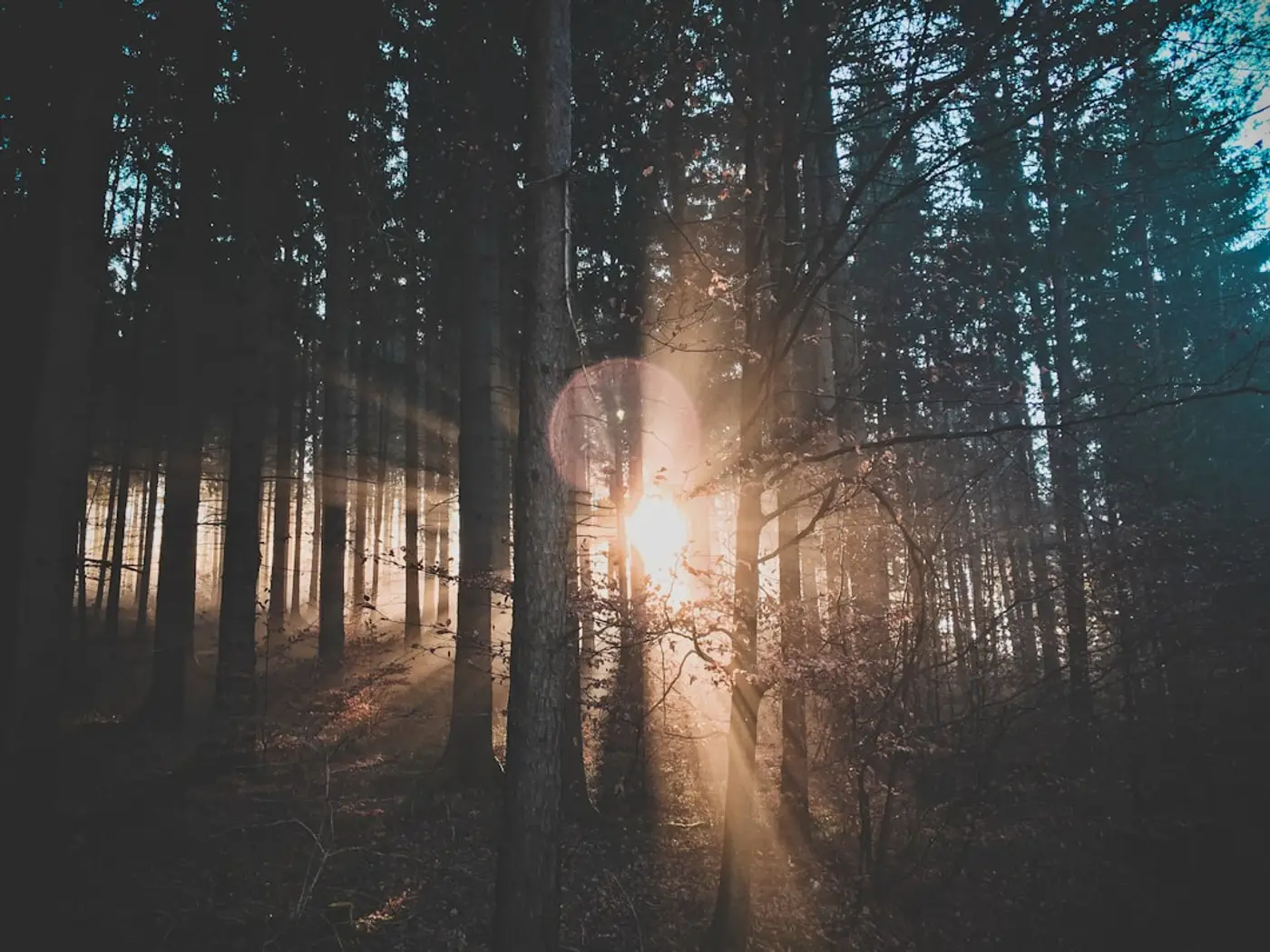
Schelling's natural philosophy conceives of nature as a living organism in which spirit and matter form an inseparable unity — not a dead mechanism to be calculated from without.
Key moments
#Schelling — The Genius of Natural Philosophy
In November 1841, Friedrich Wilhelm Joseph Schelling entered the lecture hall of the University of Berlin to deliver his inaugural address. Among the audience sat Friedrich Engels, Soren Kierkegaard, and the anarchist Bakunin. They expected a liberator — someone who would shatter the ossified state of philosophy. What they witnessed instead was an old man who spoke slowly, deliberately, presenting himself as the consummator of philosophy. The hall emptied from one lecture to the next. Schelling’s late Berlin years are considered a failure.
Yet what he had written decades earlier, in nine extraordinary years between 1797 and 1806 — as a young man from twenty-two to thirty-one — ranks among the most radical work European philosophy has ever produced. Here lies his true legacy: a natural philosophy that defends the living cosmos against dead abstraction. If you find yourself wondering why your relationship with nature feels so torn, why the world appears simultaneously measurable and incomprehensible, Schelling’s thinking offers not only a diagnosis but a way back.
#What is Schelling’s natural philosophy?
The question sounds simple. The answer is not — because Schelling’s natural philosophy is not a theory that can be summarised in three sentences. It is an approach to thinking that begins with a decisive rejection of a particular conception of nature.
You may recognise that conception from your own schooling: nature as an object to be measured, calculated, and reduced to formulas. Nature as a resource examined solely for its utility. Schelling saw in this attitude not merely a simplification but a falsification — one that reached its philosophical apex in the work of his teacher Fichte.
What did Schelling write against Fichte (Schelling, 1797)? Nature is to be used, exploited. Its entire existence amounts to the purpose of being worked and managed by human beings — as though every subjection to human ends were not a killing of the living. The sentence dates from 1797. It strikes the mentality of our age with an accuracy that is startling. Nature as mere raw material for human purposes: what Fichte articulated is the intellectual foundation of what returns today as the smart city, cyborgisation, and technological salvation of the world.
Schelling’s natural philosophy sets against this a single core idea, condensed into one sentence: Nature shall be visible spirit, and spirit shall be invisible nature (Schelling, 1797). This is not a poetic flourish. It is an ontological claim: nature and spirit are not two separate domains that must be joined after the fact. At their root, they are one. When you look at a tree, you are not encountering a mute thing but a form in which the same spirit that thinks in you finds expression. The system of nature, Schelling writes, is at the same time the system of our spirit. This alone is why we can know nature at all. Were there no spirit in nature, human thought would bounce off it like a ball off an iron wall.
Schelling called this approach Realidealismus — a realistic idealism that understands the material world as the self-revelation of spirit (Schelling, 1800). The outer world lies open before us, he wrote at twenty-two, so that we may rediscover in it the history of our own spirit. In that sentence lies the entire programme of his natural philosophy.
#Why does Schelling matter for natural philosophy?
Schelling is not the only thinker who regarded nature as alive. Giordano Bruno did so before him, Goethe beside him, Jochen Kirchhoff after him. But Schelling was the first to give this insight a systematic philosophical form within German Idealism. He combined it with an epistemology, a philosophical cosmology, and a critique of mathematical natural science whose radicalism reverberates to this day. Three contributions stand out.
His first systematic contribution was the critique of mathematical abstraction. Schelling compared the mathematical description of nature to the attempt to grasp the works of Homer by counting the characters (Schelling, 1797). Of the inner movement, one knows nothing at all. Of course you can mathematise the motion of the stars, but in the end you have understood nothing of the essential. Natura Naturans — the inner striving of nature — must be understood. Otherwise it is no natural science.
His second contribution was the idea of the organic unity of all natural forces. Schelling postulated a primordial interconnection of forces that unfolds through successive stages of transformation (Schelling, 1798). It was no coincidence that the Danish physicist Hans Christian Oersted, a reader of Schelling, discovered the deflection of a magnetic needle in an electric field. That experiment founded electromagnetism. Schelling had philosophically anticipated the connection between electricity and magnetism years before Faraday confirmed it experimentally.
His third contribution — perhaps the boldest — was the dissolution of the boundary between the living and the dead. All rigid being in nature, he wrote, is an illusion (Schelling, 1797). Things as such are illusions — expressions of inhibited forces, inhibited currents, inhibited impulses of will. The solidity of matter is not a primordial state but the result of thwarted willing. The inorganic is merely the negated organism; the dead is merely life driven back. Bound in rigid fetters, it lies in the dead remains of true substance.
No physics textbook would put it that way. And yet modern physics has long confirmed that only a tiny fraction of matter is actually solid. The rest is energy, field, motion. What Schelling meant was more radical still: that this field is not a dead mechanism but that spirit inheres within it. The organic is primary; the mechanical is derivative. When you hold a stone in your hand, you are not simply holding dead matter but inhibited life — a suppressed striving that in its own way participates in the living order of the whole.
#What does Schelling have to do with living nature?
Here Schelling’s thinking separates definitively from what the academic establishment understands by natural philosophy. For Schelling, nature was not an object of contemplation to be analysed from outside. It was a living counterpart that reveals itself to those who fall silent within themselves.
To the degree that we ourselves fall silent within, nature speaks to us. That is how Schelling formulated this insight (Schelling, 1797). Even in metals and stones, the mighty drive toward determinateness and individuality is unmistakable (Schelling, 1797). It is a sentence that anticipates thinking empathy as a method of knowledge. Jochen Kirchhoff carried this thought further: every genuine thought is feeling. Feeling is the truly real thinking — that thinking takes place in feeling (Kirchhoff, J., 2022). There is a difference between living and dead thoughts. Some circulate in the intellect like abstract somethings; others possess a vitality that goes beyond mere representation.
Goethe understood this immediately. Among all the philosophers of his era, Schelling was the only one against whom Goethe raised no objections. He invited the young man — who could have been his grandson — to Jena, secured him a professorship, drank tea with him, and talked endlessly. The two shared a common certainty: that nature does not want to be described but understood. Goethe had shown in his Theory of Colours (Goethe, 1810) that nature reveals itself to those who expose themselves to it fully, not to those who dissect it in laboratory experiments. Schelling gave that idea its philosophical architecture. Nature as living process, as organic flourishing, as metamorphosis, as eternal creation that never ends.
Novalis, Schelling’s contemporary in the Romantic circle, gave this thought its own poetic form (Novalis, The Novices of Sais, 1798/1802): Nature would not be nature if it had no spirit — not that singular counterimage of humanity, not the indispensable answer to this mysterious question.
#The forgotten third way
There is a question that stands behind the whole of Schelling’s thinking — a question that may be driving you as well: Is there a third way between resignation to the merely real and drifting off into unrealistic fantasy?
Schelling’s answer was German Idealism in its most vital form: a Realidealismus that engages fully with reality while remaining open toward spiritual breadth. It requires the full charge of the Enlightenment and the critical spirit, combined with an exploratory contact-making that genuinely tests.
This stance has consequences that reach far beyond academic philosophy. Whoever treats nature as a dead mechanism that can be reduced to its utility value will, as Jochen Kirchhoff carried Schelling’s thought forward, sooner or later also work toward the material destruction of what has been so devalued. The conceptual destruction of the cosmos leads, in the long run, to the destruction of the Earth.
The counter-vision is not a romantic return to nature. It is a different kind of thinking — one that brings the living into the apparatus of theory itself. Everywhere in nature we see differentiated cooperation: an interplay of opposites that organises itself, from the inside out. The fundamental difference between the organic and the mechanical lies precisely here: the mechanical is steered from outside to inside, toward human purposes. The organic organises itself. The organic is that which reproduces and brings forth things of its own kind. A machine is built; it can even build a second machine. But it cannot beget a machine. That is something entirely different.
#Reading Schelling today
If you decide to read Schelling’s works, you face a challenge. There is no single masterwork. His natural philosophy is distributed across fragments, drafts, and lectures — magnificently formulated passages alongside nearly impenetrable sections. These are books, as Jochen Kirchhoff put it, in which you can drown. The wonderful passages have to be sought out. They do not stand there in glowing letters.
And yet: what you find when you search holds weight. It holds weight because Schelling did not erect a system that must be accepted or rejected wholesale. He formulated core ideas. With a philosopher, he wrote, one must begin where he has not yet proceeded into the consequences. In his core ideas. For in further development, he may err against his own intention.
His core idea is that the world in which you live is neither dead matter nor mere representation but the living self-revelation of a spirit that speaks in every natural thing. That the cosmos, as Novalis put it, must be romanticised — not in the sense of prettifying it, but of qualitative intensification: the lower self is identified with a higher self, and the original meaning is recovered.
The question Schelling leaves you with is not a historical one. It is addressed to you: What happens to you — and to the world — when you stop regarding nature from outside and begin to understand it from within?
As long as I am identical with nature, Schelling wrote, I understand what living nature is as well as I understand my own life. But the moment I separate myself, and with me everything ideal, from nature, nothing remains for me but a dead object. And I cease to comprehend how a life outside me is possible (Schelling, 1797, Ideas for a Philosophy of Nature, Introduction).
Perhaps you notice that your own experience is already contained in that sentence: the wonder that seizes you when you truly encounter a natural thing without immediately categorising it. Schelling gives that wonder its philosophical ground.
If you would like to engage with this question — not as an academic exercise but as a living exploration of your own thinking — you will find a space for it in a philosophical consultation.
#Sources
- Goethe, J. W. v. (1810). Theory of Colours. Tübingen: Cotta.
- Kirchhoff, J. (2021). Schelling: Genie der Naturphilosophie (“Schelling: Genius of Natural Philosophy”). YouTube: Jochen Kirchhoff – In Memoriam [Hw-jL1EER5Q].
- Novalis (1802). The Novices of Sais. In: Novalis Schriften, ed. Friedrich Schlegel and Ludwig Tieck. Berlin: Buchhandlung der Realschule.
- Schelling, F. W. J. (1797). Ideas for a Philosophy of Nature. Leipzig: Breitkopf und Härtel.
- Schelling, F. W. J. (1798). On the World Soul. Hamburg: Friedrich Perthes.
- Schelling, F. W. J. (1800). System of Transcendental Idealism. Tübingen: Cotta.
- Schelling, F. W. J. (1809). Of Human Freedom. Landshut: Philipp Krüll.