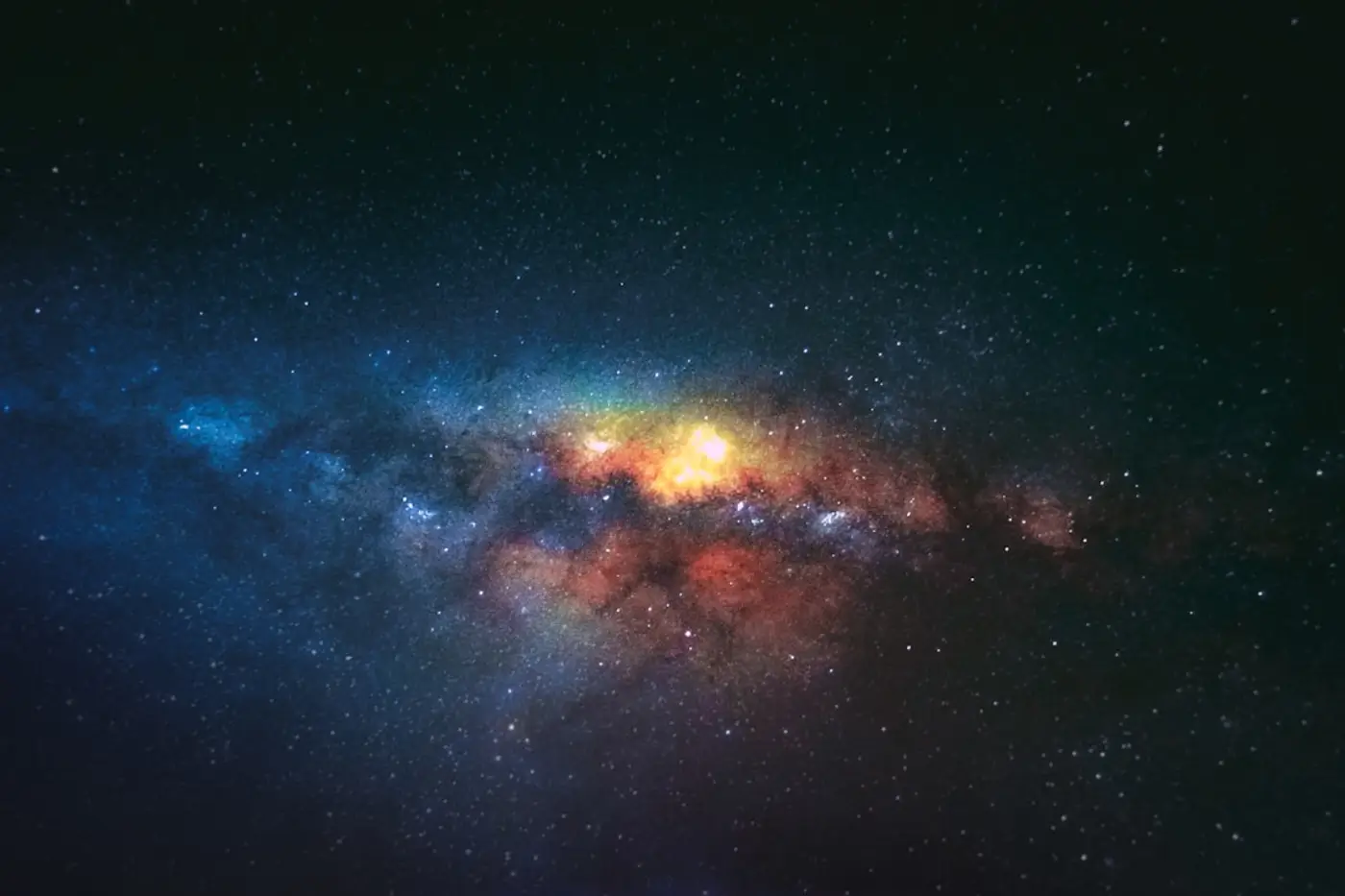
Is the cosmos a dead expanse through which incandescent gas spheres drift, or a living organism of which the human being is a conscious member? The question sounds pre-scientific. It is not. It is the presupposition underlying every cosmology — and mainstream astrophysics has not answered it but silently decided it.
#What philosophical cosmology asks
Modern astrophysics describes distances, masses, spectral lines. It can calculate how fast galaxies are receding from one another and construct models for the first fractions of a second after a postulated Big Bang. What it does not answer — and structurally cannot answer — is the question of what the cosmos essentially is. For that question concerns not measurable quantities but the ontological constitution of what is being measured.
Philosophical cosmology begins where physics stops asking. It investigates whether the cosmos is an aggregate of dead matter that happens to form structures, or whether the whole is pervaded by an ordering principle worthy of the name World Soul. This question is not abstract. It determines how you understand yourself within the cosmos, how you relate to the Earth, and what knowledge can even mean for you.
#The Timaeus and the question of the World Soul
Plato’s Timaeus is the oldest systematic draft of a philosophical cosmology in Western thought (Plato, c. 360 BC). The Demiurge, creative reason itself, fashions the cosmos as an ensouled living being unlike any other. The World Soul permeates the entire body of the universe and holds it together. Space, time, and gravity are not neutral containers but expressions of a living order.
This thought was philosophically rediscovered during the Italian Renaissance. Giordano Bruno (1548-1600) radicalized it in a way that has scarcely been surpassed. In his treatise On the Cause, the Principle, and the One, he asked whether all things are ensouled and affirmed it without qualification: the World Soul is the constitutive formal principle of the universe and of everything it contains (Bruno, 1584). If life is found in all things, then the soul is the form of all things. Bruno conceived the cosmos as infinite, the celestial bodies as ensouled organisms, space as living substance. For these positions he was burned at the stake on the Campo de’ Fiori in 1600.
#From Schelling to Kirchhoff: the cosmological lineage
Friedrich Wilhelm Joseph Schelling took up this tradition in 1798 with On the World Soul (Schelling, 1798). The purpose of the most exalted science, Schelling wrote, can only be this: to demonstrate the reality, the presence, the living thereness of God in the whole of things. For Schelling, immanence and transcendence are empty words because his philosophy abolishes this opposition: everything flows together into a God-pervaded world. In his dialogue Bruno (Schelling, 1802), he wrote that the celestial bodies are of all ideas in God the most perfect, because they express the finite alongside the infinite most purely: blessed animals and, compared with mortal human beings, immortal gods.
Yet if Schelling’s insight into the living God-Nature finds no consequence in how life is actually lived, it remains academic metaphysics. Jochen Kirchhoff (1944-2025) drew that consequence and carried the cosmological lineage into the present. His Anti-History of Physics is the attempt to bring to consciousness the development of the fundamental ideas of physics since Copernicus and to confront them with an entirely different view of the universe (Kirchhoff, 1991). Kirchhoff’s central thesis: all neuroses are ultimately rooted in the alienation between the human being and the cosmos that runs rampant on this Earth. Without the living cosmos that sustains and fills us, we remain more or less neurotic phantoms. The dominant cosmology — which proceeds from monstrously extreme events in the cosmos, from black holes, dying suns, and cosmic cold — produces a world picture that inwardly prepares the destruction of the Earth.
Kirchhoff formulates the core of his cosmology in a sentence that traces back to his teacher Helmut Krause (1904-1973), a Berlin philosopher whose cosmological thinking grounded Kirchhoff’s entire body of work: cosmic space is World Soul. This means: space is not an empty container in which bodies float, but a living substance that permeates and sustains everything. What physics describes as vacuum is in truth the densest and most alive reality there is.
#The human being as mirror of the cosmos
In Kirchhoff’s philosophical cosmology, the human being is no accidental by-product of cosmic processes. Rather, the human being is the point at which the cosmos becomes conscious of itself. The Cosmic Anthropos describes the archetypal form of the human being as an entity that carries all layers of existence within itself — from the mineral through the vegetal and the animal to the spiritual. This stratification is not merely a biological fact but a structural principle: the human being mirrors the cosmos, and the cosmos mirrors itself in the human being.
Bruno had thought the same, though from the side of the cosmos: everything we apprehend in the cosmos encompasses, because it carries within itself that which is all in all, the entire World Soul in its own way. This is no metaphor. It is an ontological claim about the structure of reality, one that crystallizes in the concept of analogy: structural correspondences run through every level of being, from the subatomic through the personal to the cosmic.
#Why the cosmological question becomes practical
The question of whether the cosmos is alive is not an academic exercise. It determines how a person understands themselves in the world. Whoever conceives the cosmos as a dead mechanism can only grasp themselves as a biological machine. The question of meaning then becomes a luxury problem, the theme of death an insoluble horror, the destruction of nature a logical consequence. Goethe wrote in his Maxims and Reflections: everything that is in the subject is in the object, and something more besides (Goethe, 1833). The cosmology we hold shapes the subject we are.
Philosophical cosmology opens a different possibility. It asks whether the space organ — that capacity to perceive space as qualitative — is not a path of knowledge that in principle precedes the measuring approach that today’s critique of science calls into question. It asks whether the fact that the human being can know the cosmos at all does not indicate that like is known only by like — that something lives in the human being which is cosmic in nature.
Whoever speaks of cosmology always speaks of themselves as well. When you contemplate the night sky and feel something that goes beyond mere calculation, that is not a sentimental residue of a pre-modern worldview. It is the beginning of a philosophical question that Plato, Bruno, Schelling, and Kirchhoff each sought to answer in their own way.
Natural philosophy provides the conceptual framework for these questions. Philosophical cosmology is its application to the oldest and largest of all questions: what is the whole in which we live?
#Sources
- Plato (c. 360 BC). Timaeus. In: Plato, Complete Works.
- Bruno, G. (1584). On the Cause, the Principle, and the One. London: John Charlewood.
- Schelling, F. W. J. (1798). On the World Soul. Hamburg: Perthes.
- Schelling, F. W. J. (1802). Bruno, or On the Divine and Natural Principle of Things. Berlin: Unger.
- Goethe, J. W. (1833). Maxims and Reflections. Posthumous, in: Goethe’s Works, Weimar Edition.
- Kirchhoff, J. (1980). The Anti-History of Physics: New Conceptions of Nature. Darmstadt: Luchterhand.