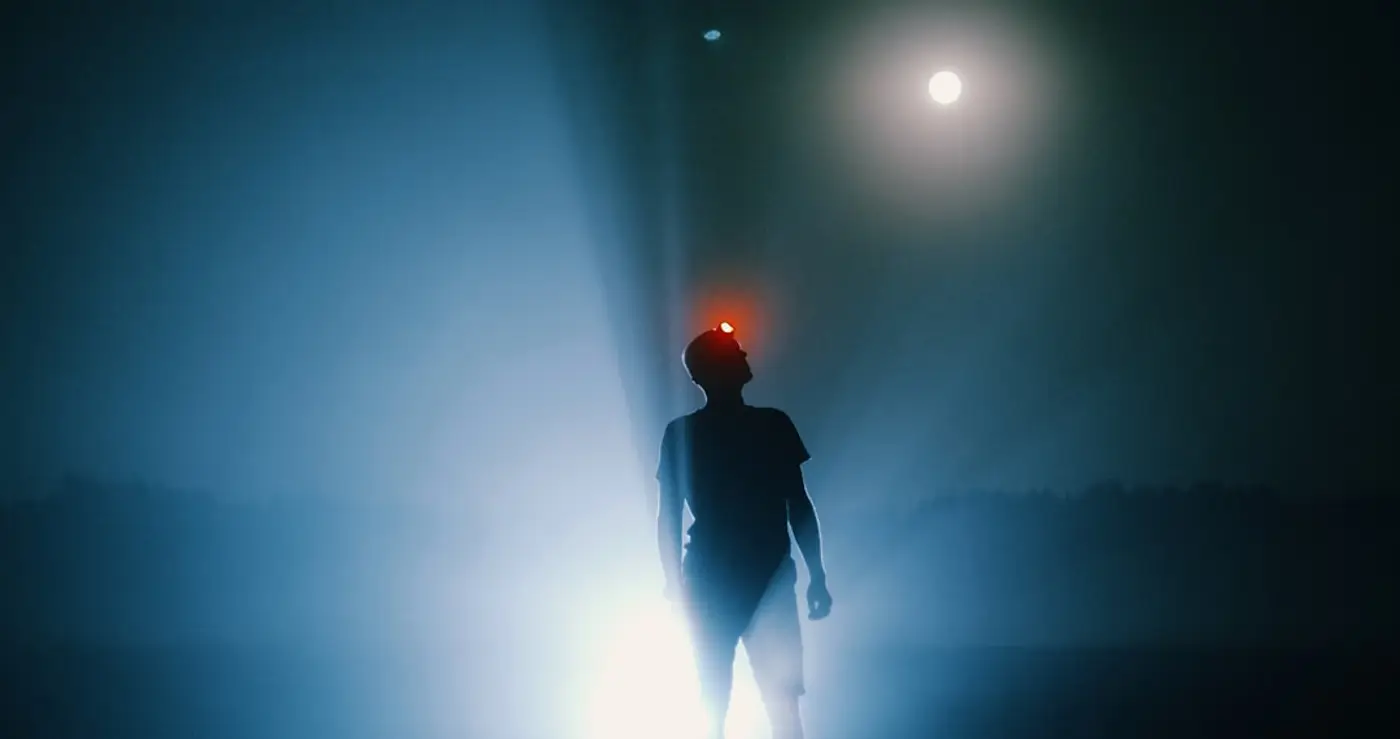
Transhumanism promises the human being of the future. This human is to think faster, live longer, merge with machines, and leave the limits of biology behind. In this vision, the human being as presently constituted is a transitional form — a not-yet-finished product in need of technical perfection. Full humanism offers the counter-diagnosis: the human being is not a deficient creature that needs upgrading. It is a cosmic consciousness-being that has not yet exhausted the depth of its own endowment. The problem is not that the human being is too limited. The problem is that it has not become what it already is.
#The Choice Between Two Visions of the Future
Gwendolin Kirchhoff coined the term in her debate with the cognitive scientist Joscha Bach: a full-humanist future in place of a transhumanist one (cf. Kirchhoff, G., Everlast AI Debate, 2026). What at first glance looks like a play on words carries a fundamental decision: where does civilisational energy flow? Transhumanism directs it outward, into technical enhancement. Full humanism directs it inward, into conscious awakening. Both claim to lead the human being beyond its present state. But the directions are opposite.
This difference can be pinned to a single question: is the human being a deficit creature that must be supplemented, or a consciousness-being that can deepen itself? The first answer leads to the cyborg, the brain-computer interface, technical immortality. The second leads to Herzensbildung, philosophical work, the cultivation of the capacity for feeling. If you pose the question this way, it becomes visible that both paths perceive the present state of the human being as inadequate — only one concludes that more technology is needed, while the other concludes that more depth is.
#Not More Humanism, but Whole Humanism
Full humanism is not intensified humanism. It adds nothing to the classical humanist programme. What it does is more radical: it names what the humanism of the Enlightenment excluded. Schiller’s Letters on the Aesthetic Education of Man (1795) diagnosed the split that the Enlightenment project drove into the human being — the separation of understanding and feeling, duty and inclination, reason and sensibility. Classical humanism wanted the rational human being. Full humanism wants the whole one.
What fell outside classical humanism were entire dimensions of being human: embodiment as a form of knowledge, the capacity for feeling as a compass, the cosmic dimension as a source of meaning. The natural philosophy of Romanticism, especially in the form Schelling gave it, still had these dimensions in view. Kirchhoff’s full humanism picks up there — not as restoration, but as expansion: it includes first-person phenomenology, the wisdom of East Asian traditions, the insights of indigenous cultures, the discoveries of early Romanticism and Weimar Classicism (cf. Kirchhoff, G., Everlast AI Debate, 2026).
#The Promethean Error
The promethean impulse has a compelling logic: if the human being suffers, the cause lies in its limits, and the limit must be overcome. Mumford showed in The Myth of the Machine (1967) how this impulse becomes self-perpetuating, until the machine no longer serves the human being but the human being serves the machine. The mega-machine produces a freedom that is none, because it systematically shrinks the space for the non-mechanical. Transhumanism is the most recent condensation of this pattern: it promises liberation through technology and generates in the process a dependency it calls progress.
Jochen Kirchhoff (1944-2025) traced this diagnosis to its metaphysical foundation. In the Anti-Geschichte der Physik (1991), he showed that technological civilisation rests upon an unconscious metaphysics: the assumption that the cosmos is a dead mechanism and the human being a random product within it, capable of improving its situation only through technical manipulation. Full humanism disputes this assumption. It proceeds from the premise that the cosmos itself is alive and the human being within it is not a foreign body but an expression of cosmic conscious awakening (cf. Kirchhoff, J., Was die Erde will, 1998). The consequence is far-reaching: if the human being is a cosmic being, then its direction of development lies not in technical extension but in deepening its relatedness to the whole.
#Drive Toward Awareness Rather Than Drive to Optimise
The core of full humanism lies in an anthropological reversal. It replaces the assumption of a deficient creature with the assumption of a being endowed with a drive toward awareness — an inner dimension that underlies the living itself (cf. Kirchhoff, G., Everlast AI Debate, 2026). This drive is not promethean; it does not aim at transgressing limits outward but at deepening inward.
What this means in practice can be grasped through the distinction between cleverness and wisdom. The clever person can build, disassemble, optimise. The wise person can judge whether they should. Transhumanism is a project of cleverness. It perfects the means and does not ask about the ends. Full humanism begins with the ends: what is our relationship to the living? What is our relationship to death? What is our relationship to transcendence? These questions cannot be answered technically, and precisely therein lies their value. If you take them seriously, what changes is not your knowledge but your relationship to the world.
When you observe in yourself the impulse to solve a problem through escalation rather than through pausing, you touch the point where full humanism and the pathogenesis diagnosis converge. The diagnosis makes the optimisation drive visible that masquerades as normality. Herzensbildung names the capacity that can take its place: a thinking-feeling relationship to the world that does not produce but matures. And the cosmic anthropos describes the image of the human being from which full humanism draws its orientation: a being that carries all dimensions of existence within itself, whose task is not self-transcendence but birth into its own wholeness.
#Sources
- Kirchhoff, G. & Bach, J. (2026). Streitgespräch: „Der Mensch soll abgeschafft werden!” Wohin steuert uns KI wirklich? [Video]. Everlast AI, YouTube. https://www.youtube.com/watch?v=vSwmJDMw4xY
- Kirchhoff, J. (1991). Anti-Geschichte der Physik: Neue Vorstellungen über die Natur. edition dionysos.
- Kirchhoff, J. (1998). Was die Erde will. Bergisch Gladbach: Gustav Lübbe Verlag.
- Mumford, L. (1967). The Myth of the Machine: Technics and Human Development. New York: Harcourt, Brace & World.
- Schiller, F. (1795). On the Aesthetic Education of Man, in a Series of Letters. In: Die Horen.