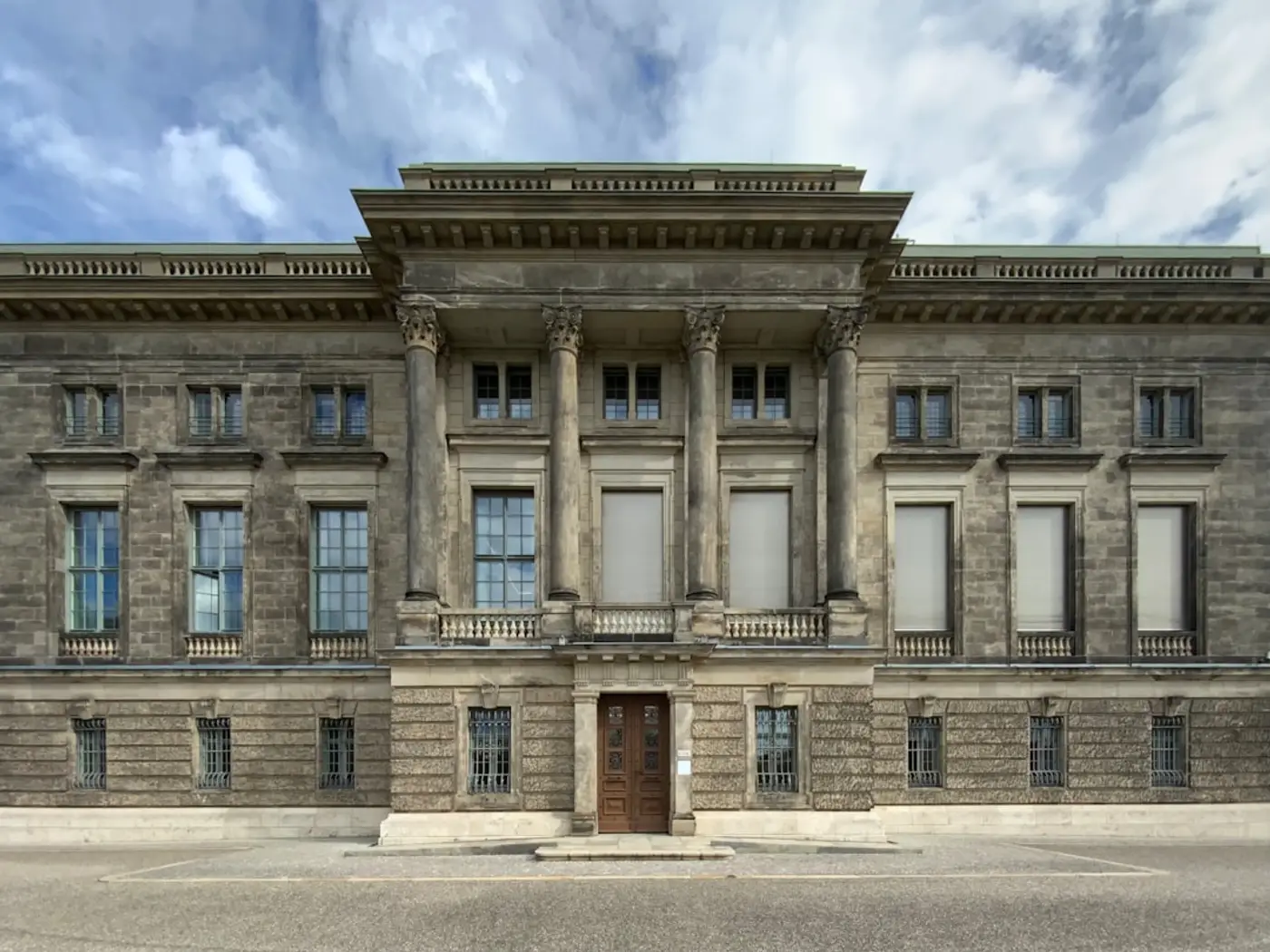
Between 1786, the year of Goethe’s departure for Italy, and 1832, his year of death, there emerges in a small Thuringian town an intellectual programme that reaches far beyond literary history. Weimar Classicism is the last moment in European intellectual history in which poetry, natural inquiry, and philosophy are understood as dimensions of a single project. What comes after is fragmentation: art becomes autonomous, science becomes specialised, philosophy becomes academic. In Weimar, these separations have not yet been carried out.
#Goethe: Natural Research as Philosophy
Goethe’s contribution to Weimar Classicism is not exhausted by Iphigenia in Tauris (Goethe, 1787) and Faust. It lies equally in The Metamorphosis of Plants (Goethe, 1790) and the Theory of Colours (Goethe, 1810). Goethe practises natural research not alongside his poetry but from the same fundamental stance: the conviction that nature reveals itself to whoever penetrates it through contemplation, not to whoever dissects it. In conversation with Eckermann he puts it thus: “The highest thing a human being can attain is astonishment; and when the Urphanomen astonishes him, let him be satisfied” (Goethe, in: Eckermann, 1836, 18 February 1829).
The Urphanomen — the irreducible foundational phenomenon at which the observer must pause — is Goethe’s counter-design to the analytical method. Where Newton splits light into spectral colours and takes the splitting for knowledge, Goethe insists: what underlies a phenomenon is itself a phenomenon, not an abstractly traceable quantity. The intuitive judgement that he develops in his engagement with Kant’s third Critique unites perceiving and thinking in a single act. This cognitive stance lives on in natural philosophy, which conceives the cosmos as a living whole, and it is the core of what distinguishes Weimar Classicism from a mere stylistic period.
#Schiller: The Aesthetic Education as an Anthropological Programme
Schiller’s theoretical contribution is frequently reduced to the dramas. The philosophically decisive part lies in his treatises. In On the Aesthetic Education of Man (Schiller, 1795), he designs a programme that unites aesthetics and anthropology. The human being, according to Schiller’s analysis, is torn between two drives: the sense drive, which binds us to the sensuous present, and the form drive, which pushes us toward the universal. Neither makes the person free so long as it rules alone.
The resolution lies in the play drive, whose object is beauty. “Man only plays when he is in the fullest sense of the word a human being, and he is only fully a human being when he plays” (Schiller, 1795, Letter 15). This is not a plea for entertainment. Schiller means the capacity to activate sensibility and reason simultaneously without sacrificing one to the other. What philosophical practice knows as the unity of thinking and feeling has its conceptual precursor in Schiller’s play drive.
In On Naive and Sentimental Poetry (Schiller, 1795), he formulates a second distinction that reaches beyond literary theory. The naive poet is nature; the sentimental poet seeks it. Goethe is for Schiller the paradigmatic naive: one who sees the law of nature in the appearance without needing to force it conceptually. Schiller himself knows that he has lost immediacy and can regain it only through reflection. This tension between immediacy and reflection runs through the whole of Weimar Classicism and gives it its productive dynamism.
#The Goethe-Schiller Axis: Two Approaches, One Project
What unites Goethe and Schiller is not literary practice but a philosophical conviction: the human being reaches full stature only where thinking, feeling, and acting are not divided. Goethe arrives at this insight through the contemplation of nature, Schiller through philosophical analysis. Their collaboration, which begins in 1794 with the famous conversation about the Urpflanze, is the most productive intellectual partnership in German intellectual history.
The point at which their paths cross is instructive. Goethe describes a plant he sees with his eyes. Schiller replies: “That is not an experience, that is an idea.” Goethe answers: “I am very glad to have ideas without knowing it, and even to see them with my eyes.” In this scene the programme of Weimar Classicism is condensed: the conviction that ideas and appearances do not belong to two separate worlds but interpenetrate one another.
#Schelling and Natural Philosophy as the Third Pillar
Weimar Classicism is incomplete without Schelling’s natural philosophy, even though Schelling was not a Weimarer. His Ideas for a Philosophy of Nature (Schelling, 1797) provides the philosophical justification for what Goethe practises intuitively and Schiller reflexively: the unity of nature and spirit. Nature, says Schelling, is the visible spirit, spirit the invisible nature.
Schelling gives the classical programme its ontological depth. Goethe’s contemplation, Schiller’s aesthetics, and Schelling’s natural philosophy together form what one might call the tripartite foundation of Weimar Classicism: a mode of knowing that grasps the cosmos as a living whole in which the human being is not an observer but a participant. Jochen Kirchhoff continued this line in his works and insisted that Schelling’s identity philosophy is not romantic speculation but a position that can be measured against reality (Kirchhoff, 2007).
#What Is Lost After Weimar
Goethe’s death in 1832 marks not only the end of a person but the end of a way of thinking. What follows is the specialisation we take for granted today: literature detaches from natural research, philosophy becomes a university subject, science becomes measurement science. The Theory of Colours is deemed a curiosity, Schiller’s aesthetic theory obsolete, Schelling’s natural philosophy romantic reverie.
The verdict says more about those who judge than about what is judged. Whoever considers the loss of the unity of art and science a form of progress has never asked what was lost in the separation: the capacity to perceive a phenomenon simultaneously as natural event, aesthetic experience, and philosophical question. Weimar Classicism is the last epoch in which this triple perception was the norm, not the exception.
For philosophical work, Weimar Classicism remains a point of orientation. Whoever asks for the foundations of epistemology that does not separate thinking from perceiving finds them in Goethe. Whoever seeks an anthropology in which reason and sensibility do not exclude each other finds it in Schiller. Whoever wants to think both together within an ontological framework finds it in Schelling. Weimar Classicism is therefore less a closed epoch than an unfulfilled programme, carried forward in the philosophy of Romanticism and systematically developed in German Idealism.
#Sources
- Goethe, J. W. (1787). Iphigenie auf Tauris. Leipzig: Goschen.
- Goethe, J. W. (1790). Die Metamorphose der Pflanzen. Gotha: Ettinger.
- Goethe, J. W. (1810). Zur Farbenlehre. Tubingen: Cotta.
- Goethe, J. W. (1833). Maximen und Reflexionen. Posthumous, in: Goethes Werke, Weimarer Ausgabe.
- Eckermann, J. P. (1836). Gesprache mit Goethe in den letzten Jahren seines Lebens. Leipzig: Brockhaus.
- Kirchhoff, J. (2007). Räume, Dimensionen, Weltmodelle. Klein Jasedow: Drachen Verlag.
- Schelling, F. W. J. (1797). Ideen zu einer Philosophie der Natur. Leipzig: Breitkopf und Hartel.
- Schiller, F. (1793). Uber Anmut und Wurde. In: Neue Thalia. Leipzig.
- Schiller, F. (1795). Uber die asthetische Erziehung des Menschen in einer Reihe von Briefen. In: Die Horen. Tubingen: Cotta.
- Schiller, F. (1795). Uber naive und sentimentalische Dichtung. In: Die Horen. Tubingen: Cotta.