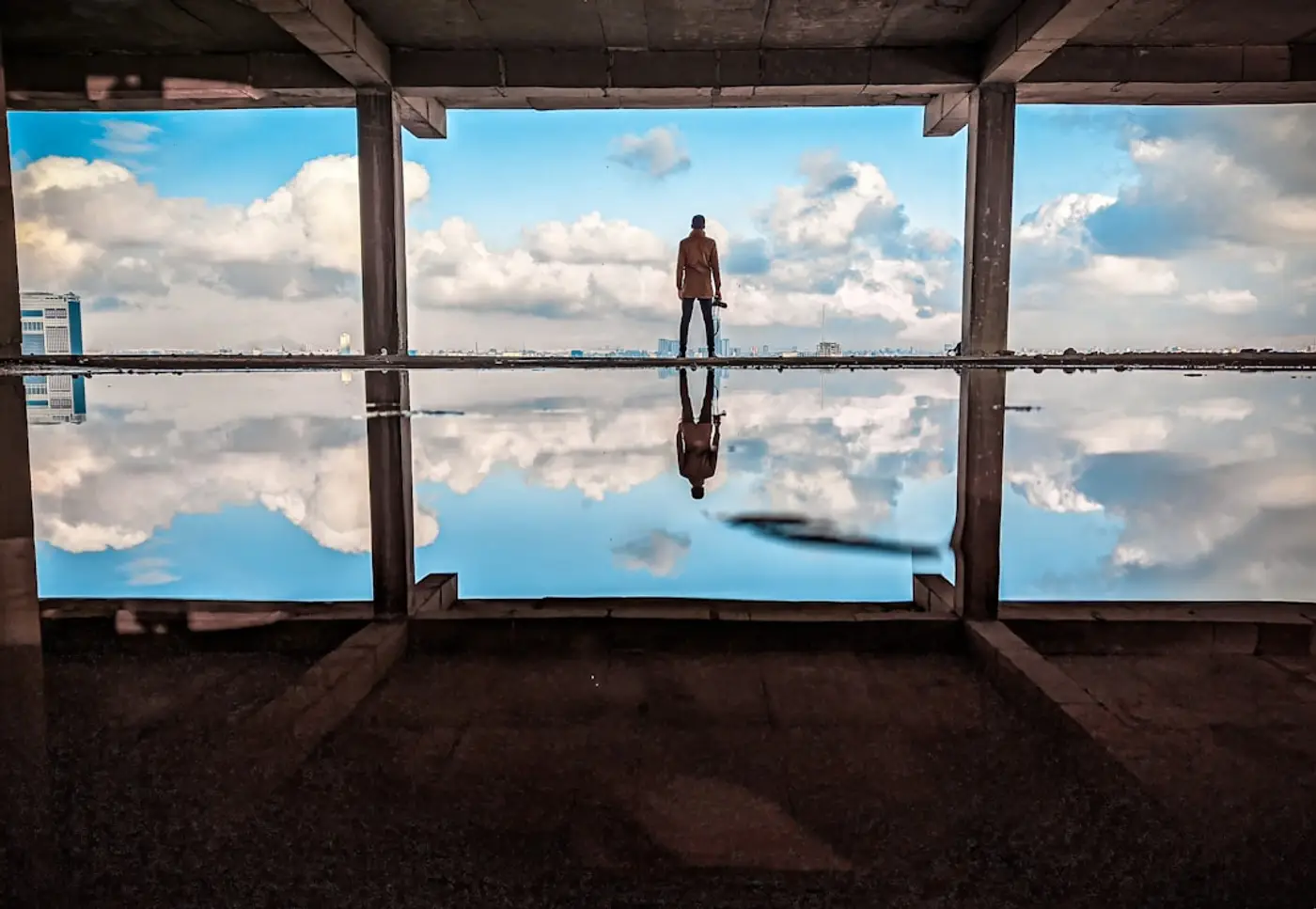
Every natural science begins with observation. Gwendolin Kirchhoff understands by this the philosophically serious observation of one’s own consciousness — not the self-contemplation dismissed as unscientific. But the one observation every scientist conducts continuously — the observation of their own consciousness — counts in the same science as unreliable. Introspection, the methodical inner view, was banished from academic psychology in the twentieth century because it cannot be standardised. What was lost in the process is the only access a human being has to subjective experience. When you see red, feel pain, or sense a presentiment that cannot be put into words, you depend on data no brain scanner can deliver.
#From world-ground to laboratory technique
The history of introspection begins not in the laboratory but in philosophy. Heraclitus formulated the first transmitted methodological reflection of inner view: “I searched myself” (Fragment B 101). For him, introspection led, as Jochen Kirchhoff commented in a conversation about Heraclitus, “in the deepest depth into the world-ground” (cf. Kirchhoff, J., 2022). What Heraclitus understood as cosmic self-investigation narrowed in the course of centuries. For him, the Logos that the human being finds in themselves was the same Logos that pervades the cosmos.
Descartes made inner view the foundation of his Meditations in 1641: the only thing that cannot be doubted is the fact that I doubt. The thinker becomes self-evident in the act of thinking. What with Heraclitus was an immersion into the depth of the world becomes with Descartes a withdrawal into the certainty of the isolated subject. This narrowing has consequences to this day. Modern psychology took up the Cartesian cut: it separated the observing subject from the observed object and tried to make introspection a controllable laboratory procedure.
Wilhelm Wundt set up the first experimental-psychological laboratory in Leipzig in 1879 and trained subjects in systematic self-observation. The behaviourists under John B. Watson rejected this method a few decades later as unscientific: only outwardly observable behaviour counted as data basis. What could not be measured did not methodologically exist. The price of this decision was high. Psychology gained objectivity but lost access to what it actually wanted to investigate: experience.
#Why the third-person perspective does not suffice
Thomas Nagel posed in 1974 the question that exposes the core of the problem: “What Is It Like to Be a Bat?” (Nagel, 1974). No matter how complete neurophysiological knowledge of bat echolocation may be, it does not tell you what it feels like to be a bat. The explanatory gap between neuronal description and lived experience, which David Chalmers later termed the hard problem of consciousness, is not a deficit of today’s science that could be remedied tomorrow. It is structural. The third-person perspective can describe correlates of consciousness, but consciousness itself lies, by definition, in the first person.
Gwendolin Kirchhoff defended this point in the Everlast AI debate 2026 against Joscha Bach: even second-order perception, for instance a camera filming itself, is still no consciousness. Coherence alone produces no experience. “The actual content of consciousness can only be apprehended from the first person” (cf. Kirchhoff, G., Everlast AI, 2026). Bach, who as cognitive scientist methodologically prefers the third person, conceded at the same point that first-person introspection “must be an essential instrument of psychology and must find its way back into this space” (cf. Bach, Everlast AI, 2026). The concession is remarkable: even from the perspective of formal modelling, inner view cannot be eliminated.
#Introspection as access to the world
Jochen Kirchhoff (1944–2025) carried the rehabilitation of introspection further philosophically. In a conversation about epistemology he brought up Nietzsche’s formulation: “We belong to the character of the world.” From this it follows that in the introspection of the human being “something of the actual structure, even of the truth of the world” reveals itself (cf. Kirchhoff, J., 2019). Inner view shows not only something about the individual, but about the cosmos to which the individual belongs.
This position is rooted in Schelling’s insight that thinking and feeling may not be separated without damaging knowledge itself. A system that contradicts the holiest feelings and ethical consciousness “does not deserve the name of reason” (cf. Schelling, 1809). Goethe formulated the methodical consequence: thinking observation, a seeing that comprehends at the same time, and a comprehending that perceives at the same time. What natural science excludes as disturbance — the bodily, felt, subjective dimension of the knower — is in the natural-philosophical tradition the actual organ of knowledge.
Kirchhoff named this blind spot of modern research the “subject-blindness of natural science”: the scientist removes themselves as living human and makes themselves into the “objective registering apparatus of reality” (cf. Kirchhoff, J., 2019). The price is the cutting off of precisely that dimension in which truth shows itself — the inner dimension. If you ask why science cannot explain consciousness, here lies the answer: it has methodologically closed the only access to it.
#What introspection is not
The rehabilitation of inner view does not mean a return to pre-scientific subjectivity. Philosophical introspection is neither brooding — the unfruitful circling in one’s own head — nor therapeutic self-reflection, which aims at biographical content. It directs itself at the structures of experience itself: at what shows itself in perception when attention turns inward, without losing itself in personal stories.
The meditative practice of the Vipassana tradition, the phenomenological schooling of a Husserl, Goethe’s participatory observation of nature and the thinking empathy Gwendolin Kirchhoff practices are different accesses to the same basic capacity: the ability to use one’s own consciousness as organ of knowledge. What unites them is the conviction that the human being as inside-outside being has an access to reality that no external apparatus can replace. When you observe yourself — not with therapeutic intent but with philosophical attention — you use precisely this capacity.
Gwendolin Kirchhoff brought this access in the debate with Bach to a short formula: to the first person belong “phenomenology, the gathered knowledge of meditative practice, and the entire access to the world of indigenous peoples” (cf. Kirchhoff, G., Everlast AI, 2026). Introspection so understood is no withdrawal from the world but a deeper entering into it. Whoever looks inward — methodically, attentively, conceptually sharpened — finds there the cosmos to which they belong.
Related entries: philosophy of consciousness | qualia | thinking empathy | space-organ