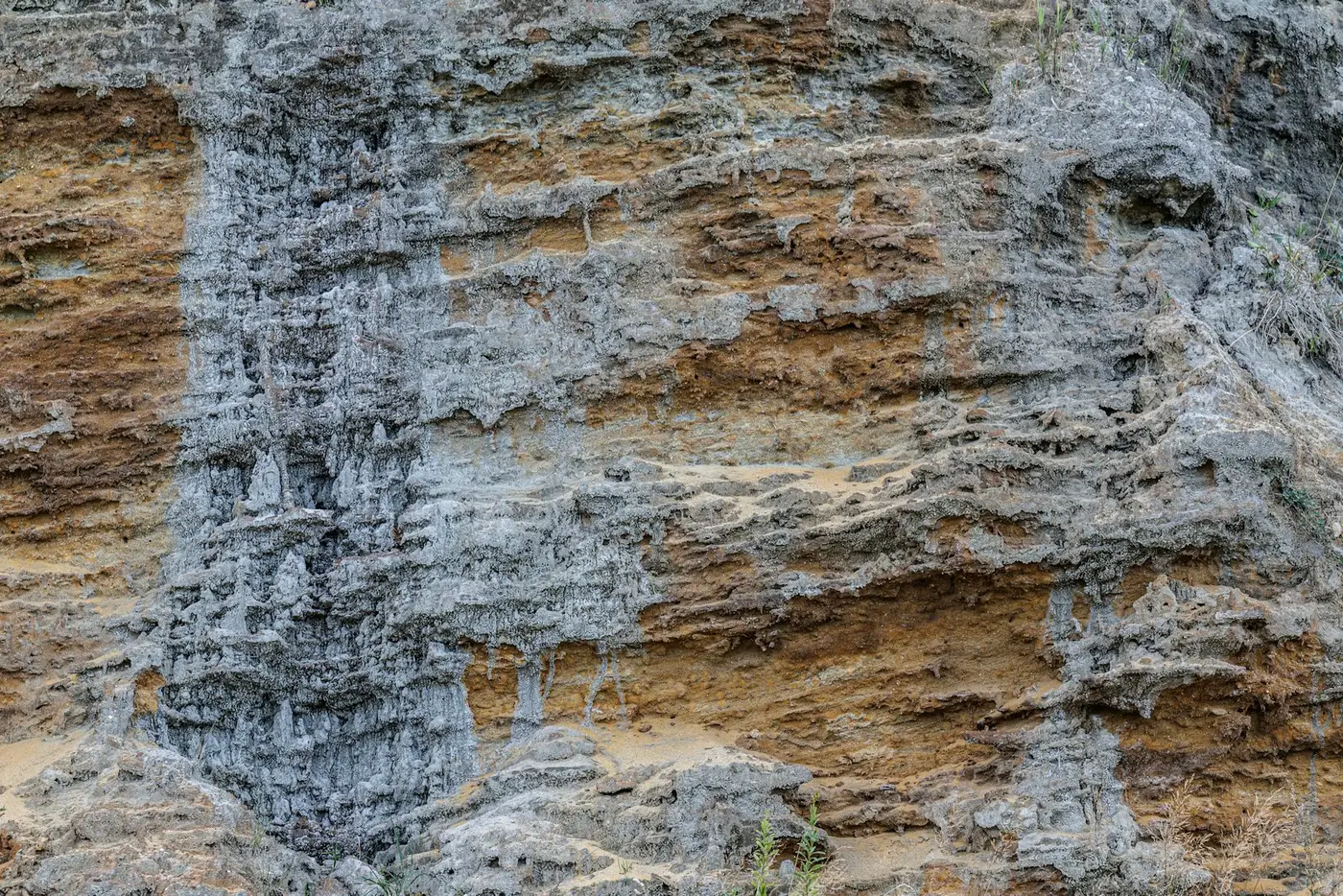
When you hear the word “layers,” you probably think of depth psychology: a surface concealing hidden conflicts that need to be uncovered. The layer model used in philosophical work means something different (cf. interview with Gwendolin Kirchhoff, 2026 (unpublished)). It is not a therapeutic method but a structure of cognition. And it has two axes, not one.
#Two Axes, Not Just Surface and Depth
The first axis describes a vertical movement: from surface presentation, through emotional truth, to ontological reality. A person says: “I’m a bit disappointed.” The real sentence lies deeper: “You betrayed me.” Between what is said and what wants to be said lies the difference between talking about something and actually speaking it. Talking about it leaves everything on the surface. Speaking it touches the deeper layer, and only there does something actually happen.
The second axis concerns the feeling-core, and here lies the decisive point: this core is not psychological in nature. It does not mean a feeling in the therapeutic sense, not an affect to be regulated or processed. The feeling-core designates the living centre of a situation — the point where the essential thought and the essential relationship meet (cf. interview with Gwendolin Kirchhoff, 2026 (unpublished)). In every serious question there is such a point: what matters to you, even before you can name it. The layer model thus distinguishes two axes: the movement into depth and the approach toward this living centre, which is to be understood ontologically, not psychologically.
#Cognition in Stages
That reality is layered and that access to it comes in degrees belongs to the oldest insights of philosophy. Plato (c. 428-348 BCE) distinguished in the Republic four states of cognition corresponding to four segments of being: rational insight for the highest, understanding for the second, conviction for the third, and mere conjecture for the fourth (Plato, Republic, 509d–511e). Each higher stage sees more reality, not merely different reality. The Allegory of the Cave describes the ascent through these stages: from the shadows of appearance to the light of the Ideas (Plato, Republic, 514a–517a).
The natural philosopher Giordano Bruno differentiated four levels of cognition in ascending order: the senses, which can deceive; the intellect, which orders sense impressions; reason as intuitive beholding, a living mirror; and spirit as pure seeing without discursive thought — a head that is entirely eye (Bruno, 1584). In our capacity for cognition, Bruno held, everything that can be known is already present. Knowing is an act of recollection: something unfolds that already lies within possibility.
Jochen Kirchhoff (1944–2025) translated this layered thinking into a cosmological perspective. The human being is a dual creature with an inner world and an outer world, and this polarity is ontological: the inner world is a reality of consciousness in its own right, with its own laws, a different physics (J. Kirchhoff, 2007). The boundary between inner and outer is fundamentally indeterminate. In Kirchhoff’s perspective, the modern Platonic cave manifests in three moments: chorismos, the stark separation into facts and values; lethe, the ontological barrier erected by forgetting and ignorance; and simulation, the model that takes the place of the essence (J. Kirchhoff, 1998).
#The Mythic as a Permanent Layer
A far-reaching consequence of the layer model concerns the relationship to myth. The mythic is not a bygone stage of consciousness that humanity has left behind. It is a permanent layer of reality that can be contacted (J. Kirchhoff, 2007). Myth speaks of fundamental patterns active in every moment, not of one-time events in the past. Whoever lets only the surface count — the measurable, the datable, the verifiable — cuts themselves off from what gives rise to the surface in the first place.
Schelling formulated the philosophical foundation for this insight: nature does not produce its knowledge all at once but in a successive process, leading stage by stage to self-knowledge (Schelling, 1797). Human cognition, too, unfolds in layers. There is no shortcut from conjecture to insight. Whoever skips a layer loses contact with what sustains it.
#From the Surface to What Actually Matters
In philosophical accompaniment, the layer model serves as orientation (cf. interview with Gwendolin Kirchhoff, 2026 (unpublished)). When someone speaks about their situation, the first task is to recognise which layer is being spoken from. Has your conversation not yet left the surface? Has the emotional truth been touched but not yet spoken aloud? And beneath this emotional truth — does an ordering question lie deeper still?
The work consists in advancing from layer to layer without skipping any. Whoever devalues the surface to reach depth quickly loses the person they are speaking with. Whoever remains on the surface touches nothing. The feeling-core is not sought like a hidden object; rather, it becomes audible when the conditions are right — when genuine speaking becomes possible, marking the difference from merely talking about things.
In order work, the third layer — the ontological order — becomes visible in the room. You absorb an extraordinary amount from your family’s feeling-body without directly suspecting it (cf. Kirchhoff, G., Systemisches Familienstellen, eine Einführung, 2024). Family secrets have their effects even when they are not known; they are still felt. What appears on the surface as an inexplicable pattern reveals itself in Familienaufstellung (family constellation work) as the expression of a deeper layer: an interrupted relationship, an unspoken truth, an order that has been violated.
#The Capacity to Read Layers
Thinking empathy describes the capacity to advance from layer to layer — a thinking that does not take the surface for the whole but listens for what lies beneath. Without this capacity, the layer model remains an abstract description. With it, the model becomes orientation in concrete work. Pre-birth points to a layer that precedes all others: the origin from which a person comes and which continues to work within them, hidden beneath the layers of habit and postponement.
#Sources
- Bruno, G. (1584). De la causa, principio et uno. London: John Charlewood.
- Hellinger, B. (1994). Ordnungen der Liebe: Ein Kurs-Buch. Heidelberg: Carl-Auer.
- Interview with Gwendolin Kirchhoff, 2026 (unpublished).
- Kirchhoff, G. (2024). Systemisches Familienstellen (nach Bert Hellinger), eine Einführung – SYMPOSIUM. YouTube: Gwendolin Kirchhoff.
- Kirchhoff, J. (1998). Was die Erde will. Bergisch Gladbach: Gustav Lübbe Verlag.
- Kirchhoff, J. (2007). Räume, Dimensionen, Weltmodelle. Drachen Verlag.
- Plato. Republic (c. 375 BCE). Line analogy (509d–511e) and Allegory of the Cave (514a–517a).
- Schelling, F. W. J. (1797). Ideen zu einer Philosophie der Natur. Leipzig: Breitkopf und Härtel.