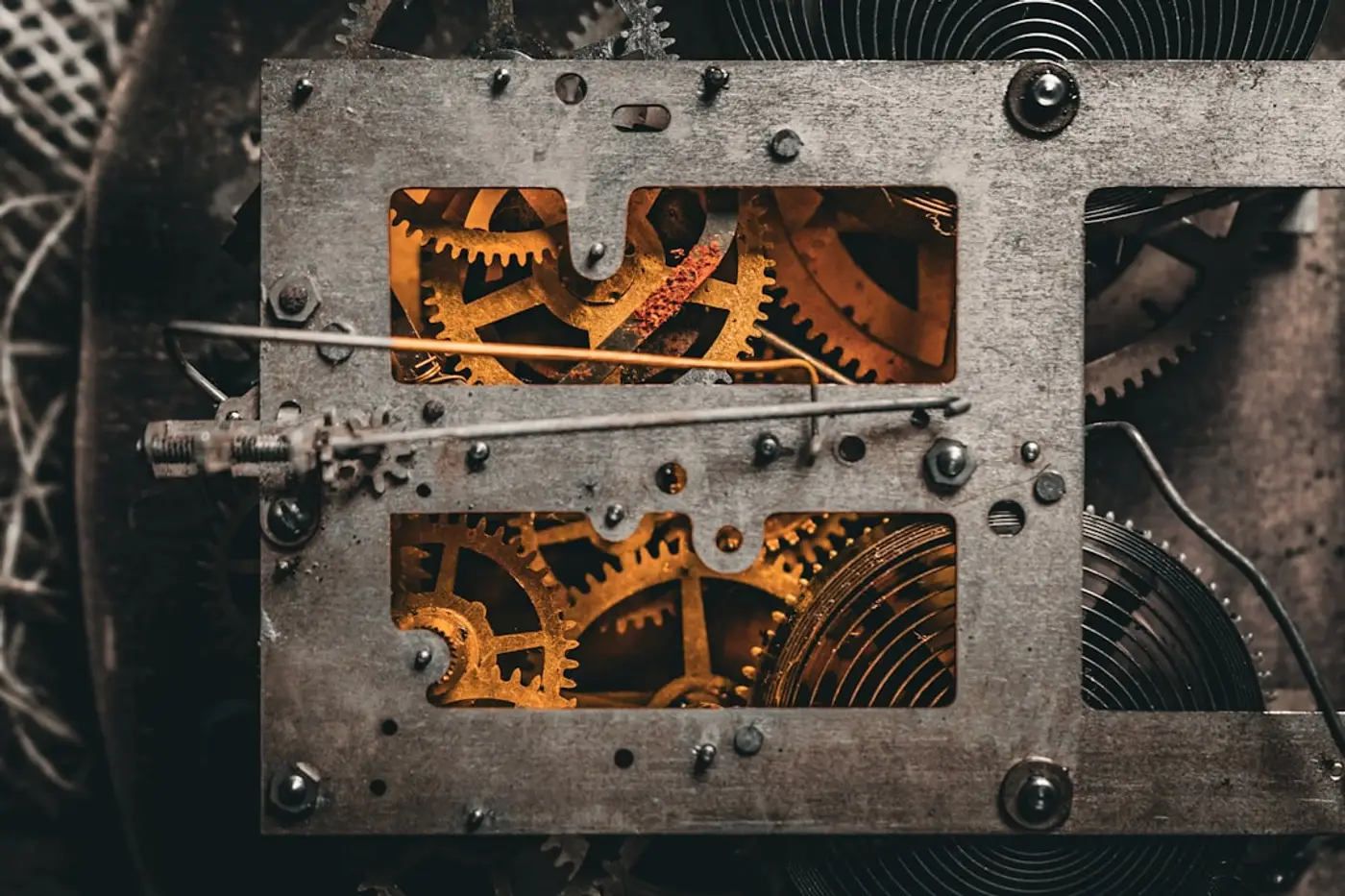
Determinism is the thesis that every event in the cosmos is fully determined by antecedent causes. When you hear this term, you probably think of physics, of causal chains, of the calculability of nature. Yet the real decision embedded in determinism is not a physical one. It concerns the question of what kind of cosmos we inhabit: a dead mechanism in which freedom would at best be self-deception, or a living whole to which freedom belongs as a fundamental character.
#Three Thinkers, Three Dead Ends
The history of philosophy has formulated three fundamentally different answers to the determinism question, all departing from the same point and diverging in different directions.
Arthur Schopenhauer (1788-1860) divided the question into two levels. In the world of appearances — empirical nature — strict necessity holds. Every action follows from the interplay of motive and character. A person does what they do because they are what they are. In his words: the individual, the person, is not the will as thing-in-itself but already an appearance of the will — already determined and entered into the form of appearance (cf. Schopenhauer, The World as Will and Representation, 1819, Brockhaus, Leipzig, Book II, section 23). At the same time, behind this phenomenal world lies the will as thing-in-itself — groundless and free. Freedom exists, but it lies beyond the person, beyond the individual, beyond any concrete action. The empirical world remains determined.
Friedrich Nietzsche (1844-1900) radicalised the critique in a different direction. For him, the very idea that there is such a thing as a will that causes actions was already a linguistic prejudice. In Beyond Good and Evil he wrote: “Willing seems to me above all something complicated, something that is a unity only as a word” (Nietzsche, Beyond Good and Evil, 1886, C.G. Naumann, Leipzig, section 19). In Twilight of the Idols he sharpened the attack: “The initial great fatality of error: that the will is something that produces effects — that will is a faculty… Today we know that it is merely a word…” (Nietzsche, Twilight of the Idols, 1889, C.G. Naumann, Leipzig, ch. “The Four Great Errors”, section 3). For Nietzsche, free will is not a philosophical problem but a theological construct invented to assign guilt: “Human beings were thought of as ‘free’ so that they could be judged, so that they could be punished” (ibid., ch. “The Four Great Errors”, section 7).
With this, Nietzsche pulled the ground from under both sides of the debate. Not only is free will a fiction — unfree will is one too. Yet what remains when both collapse? Nietzsche himself stopped at the destruction and replaced the will with the will to power, a concept that does not solve the freedom question but circumvents it.
#The Hidden Centre
Schelling, in his Freedom Essay of 1809, opened the text with a sentence that brings the problem to its point: “It is time for the higher — or rather the true — opposition to come to light, that of necessity and freedom, with which the innermost centre of philosophy first comes into view” (Schelling, Philosophical Investigations into the Essence of Human Freedom, 1809). For Schelling, the freedom question was not one problem among many. It was the centre of philosophy.
His solution differed fundamentally from Schopenhauer’s. Where Schopenhauer banished freedom into the thing-in-itself and ceded the phenomenal world to determinism, Schelling thought both together. He showed that both arbitrary freedom — deciding without reason for A or not-A — and empirical determinism — explaining every action by antecedent causes — commit the same error: they know only external determination or chance. Equally unknown to both is that higher necessity which is an inner necessity, springing from the being of the agent itself (cf. Schelling, ibid.).
The result Schelling formulated with a clarity rare in the history of philosophy: “Necessity and freedom stand within each other, as one being that only appears as one or the other when viewed from different sides — in itself freedom, formally necessity” (Schelling, ibid.). Freedom is not the absence of necessity but its innermost shape, when the necessity springs from the being itself and is not imposed from without.
#Why the Dead Cosmos Needs Determinism
Here it becomes visible why the determinism question cannot be resolved in physics or psychology. It depends on an ontological prejudgement: is the cosmos a mechanism or an organism? In a mechanism there are only external causes. Every event is compelled by another, and the chain of causes stretches back infinitely without ever encountering a being that acts from within itself. Freedom would be a logical contradiction in such a cosmos.
Jochen Kirchhoff (1944-2025) showed in his work that determinism is not a finding but a symptom. It belongs to the pathogenesis of modern thinking: a creeping sickness of our relation to the world that declares the living dead and then notes with astonishment that freedom is nowhere to be found in the dead (cf. Kirchhoff, Was die Erde will, 1998, Gustav Lubbe Verlag, Bergisch Gladbach). Materialism posits dead matter as the basic substance and must explain consciousness, meaning, and freedom as epiphenomena — as foam on the surface of a blind process. Determinism is the logical consequence of this positing, not its proof.
Whoever, by contrast, thinks the cosmos as alive — as the natural philosophy from Schelling to Kirchhoff does — for them freedom does not belong among the things that need to be explained away. It belongs to the fundamental structure of reality. Not as caprice, not as groundless self-deciding, but as the capacity of a living being to act from its own innermost depth.
#Neither Fatalism Nor Arbitrariness
In philosophical work, this insight emerges where a person recognises that their decisions are neither mere mechanical consequences of their biography nor arbitrary whims. Perhaps you know this yourself: a decision that was simultaneously necessary and free — not compelled and not arbitrary, but fitting. Schelling’s formula for this is precise: free is that which acts solely according to the laws of its own being and is determined by nothing else, neither within nor without (cf. Schelling, ibid.).
The current debate about free will and neurodeterminism repeats in simplified form what Schelling, Schopenhauer, and Nietzsche had already worked through in the nineteenth century. Neuroscience shows that brain processes precede decisions. From this it is concluded that the human being is unfree. But the conclusion follows only if one presupposes that the human being is something other than their body and that the body is a mechanism. Both premises are not discoveries but ontological stipulations that determinism requires in order to present itself as a result.
The question is not whether you are free. It is whether we inhabit a cosmos in which freedom is possible at all. And this question is not answered by experiments but by the decision whether we conceive the cosmos as living or as dead.
Philosophically related: Natural Philosophy (the living cosmos as precondition of genuine freedom), Materialism (the counter-position that enforces determinism), Consciousness Philosophy (the question of whether consciousness is a fundamental feature or a by-product of the cosmos).