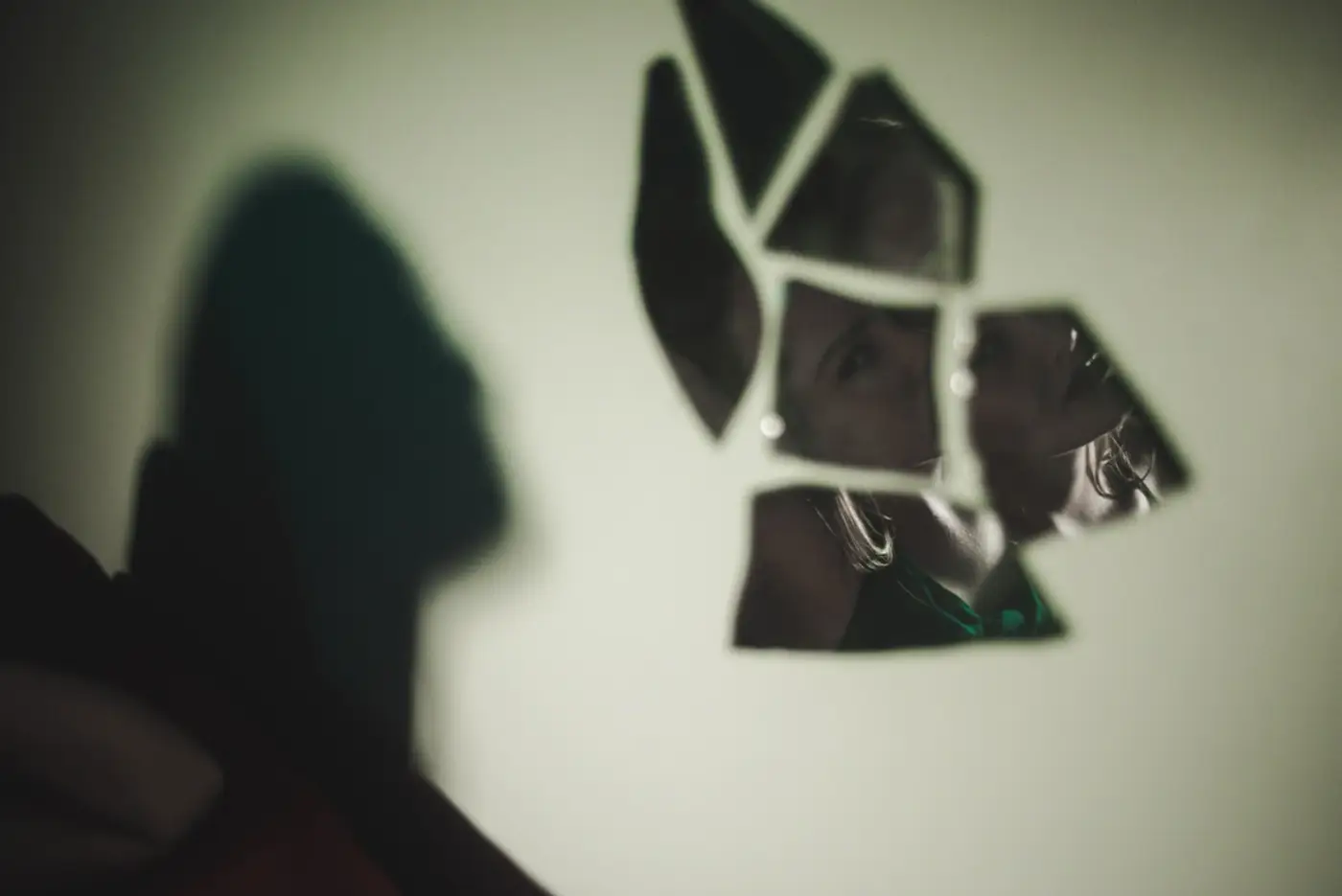
To understand C.G. Jung (1875–1961), you have to go further back than psychoanalysis. Jung himself knew this. His path led beyond Freud into a depth older than modern psychology: into the natural philosophy of the Romantics, into Schelling’s treatise on freedom, Goethe’s morphology, and Romantic medicine. He is, one could say, a late heir to the Romantic discovery of the unconscious.
#How does Jung’s unconscious differ from Freud’s?
The break with Sigmund Freud in 1913 was not a personal quarrel, even though it manifested as one. The disagreement lay in the matter itself. Freud wanted to erect a dogma (his own words) against what he called the “black tide of the occult.” The unconscious was to be made controllable, reducible to the libidinal conflict, dissectable through interpretation. Jung saw something different. In his clinical work at the Burghölzli hospital in Zurich, particularly through the word association experiment, he encountered a layer that lies beyond personal biography.
In the word association experiment, 100 words are presented one after another while reaction times are measured. This method led Jung to discover what he called feeling-toned complexes: entanglements of psychic impressions that interfere with thinking, and whose emotional charge reaches far beyond the personal. Henning Weyerstraß, for 19 years a board member of the C.G. Jung Society, describes the method this way in conversation with Gwendolin Kirchhoff: what matters is not what the subject says, but when they say it. The hesitation reveals the complex. And behind the complex lies an archetypal energy that generates an image — one we project onto the world without knowing it (cf. Kirchhoff & Weyerstraß, 2024, 30:46–32:52 and 56:36–56:53).
Freud wanted to talk the unconscious away. Jung wanted to enter into communication with it — not by manipulative intervention, but by listening, by receiving. Weyerstraß, drawing on Jung, captures the difference precisely: the unconscious is something like a being within my being that feels and thinks quite differently and has a far broader experiential basis than I do (cf. Kirchhoff & Weyerstraß, 2024, 41:35). Not to straighten out the psyche, but to let it speak: this attitude marks the core of Jungian psychology, and at the same time the point where it becomes philosophy.
#The collective unconscious and the archetypes
In Symbols of Transformation (1912), Jung formulated the thesis that led to the final break with Freud: there exists a layer of the unconscious where personal matters no longer play a role. Here, primordial images hold sway — what Jung calls archetypes — and they recur in the myths, fairy tales, religions, and dreams of all cultures. The archetype is not itself an image but a disposition that generates images. It works like a projector: Shadow, Anima, Animus, and Self appear without the conscious mind having summoned them.
The Shadow is a figure of particular significance. It stands as guardian before the gates to the depths and denies entry so long as consciousness treats it as an enemy. Jung read the Epic of Gilgamesh as a paradigm: Gilgamesh and Enkidu, equal in strength, come to realize that they cannot measure themselves against each other in combat. The path leads through dialogue, not through overpowering. For philosophical work, this insight is central: the Shadow carries knowledge that consciousness lacks. Whoever addresses it with respect finds the door opened.
#What does philosophy have to say about the collective unconscious?
Jung’s discovery does not stand in isolation. It belongs to a tradition of thought reaching back to Romantic philosophy. Carl Gustav Carus (1789–1869) had already written in Psyche (1846) that the key to understanding conscious psychic life lies in the region of the unconscious. Eduard von Hartmann (1842–1906) developed a metaphysics in his Philosophy of the Unconscious (1869) that assigned the unconscious a world-constitutive role. Yet both stopped at theory: Carus described, Hartmann speculated. Jung knew both and went beyond them by making the archetypal not a metaphysical postulate but something empirically accessible — through the word association experiment, dream analysis, and the method of active imagination.
The connection to Schelling’s natural philosophy runs deeper than mere intellectual history. Schelling (1775–1854) had posited in his 1809 treatise on freedom an unconscious ground in God himself — a dark will that precedes consciousness and presses toward awareness in the human being. Jung’s collective unconscious can be read as a secular parallel: a layer older than the individual, one that comes to expression in the individual and whose images carry an order that consciousness alone could never produce.
Jochen Kirchhoff pointed out in Spaces, Dimensions, World Models (2007) the kinship between Jung’s theory of archetypes and Romantic natural philosophy: both work from the insight that reality is layered and resists reductionist approaches. What Jung calls the individuation process — the movement by which a person becomes who they are — touches upon what is understood in philosophical accompaniment as a birth process: a transformation that does not repair but brings forth.
#Individuation and the question of wholeness
Become who you are. This is Jung’s ethical imperative — not as a program of self-perfection, but as a response to the archetypal disposition that seeks to be realized in the individual. Individuation means not defeating the split-off parts of the psyche (Shadow, Anima, Animus) but entering into relationship with them. Jung himself put it in a formula: I’d rather be whole than good.
This wholeness is not a harmonious final state. It includes the dark sides that consciousness would prefer to overlook. It demands the capacity to endure contradictions, because at a higher level they are contradictions no longer — an attitude that runs through Jung’s entire typology. The unconscious, says Jung, is simultaneously greater and smaller than consciousness, younger and older. Whoever cannot bear such paradoxes remains on the surface. Whoever accepts them enters the field where genuine insight occurs.
What Jung describes here has immediate philosophical practicability. For working with people who stand at inner thresholds, this thought carries direct significance. What appears in a therapeutic context as a layer beneath the layer — the layer model of truth lying deeper than what is presented — can be understood with Jung as a movement of the unconscious seeking expression. What makes something unconscious? It is like a turning away from a particular feeling-core, a turning away from a perception that happens automatically because there is so much we cannot bear (cf. interview with Gwendolin Kirchhoff, 2026 (unpublished)). The question then becomes: what do we leave behind, and how can it be integrated again?
C.G. Jung did not answer this question conclusively. He gave it a space: the space of active imagination, of dialogue with inner figures, of attentiveness to what rises from the depths. This space is not foreign to philosophical work. Whoever listens in a consultation to what is at work behind a person’s words is working in a tradition that reaches through Jung to the Romantics and from the Romantics back to Schelling, Goethe, and the pre-Socratic philosophers.