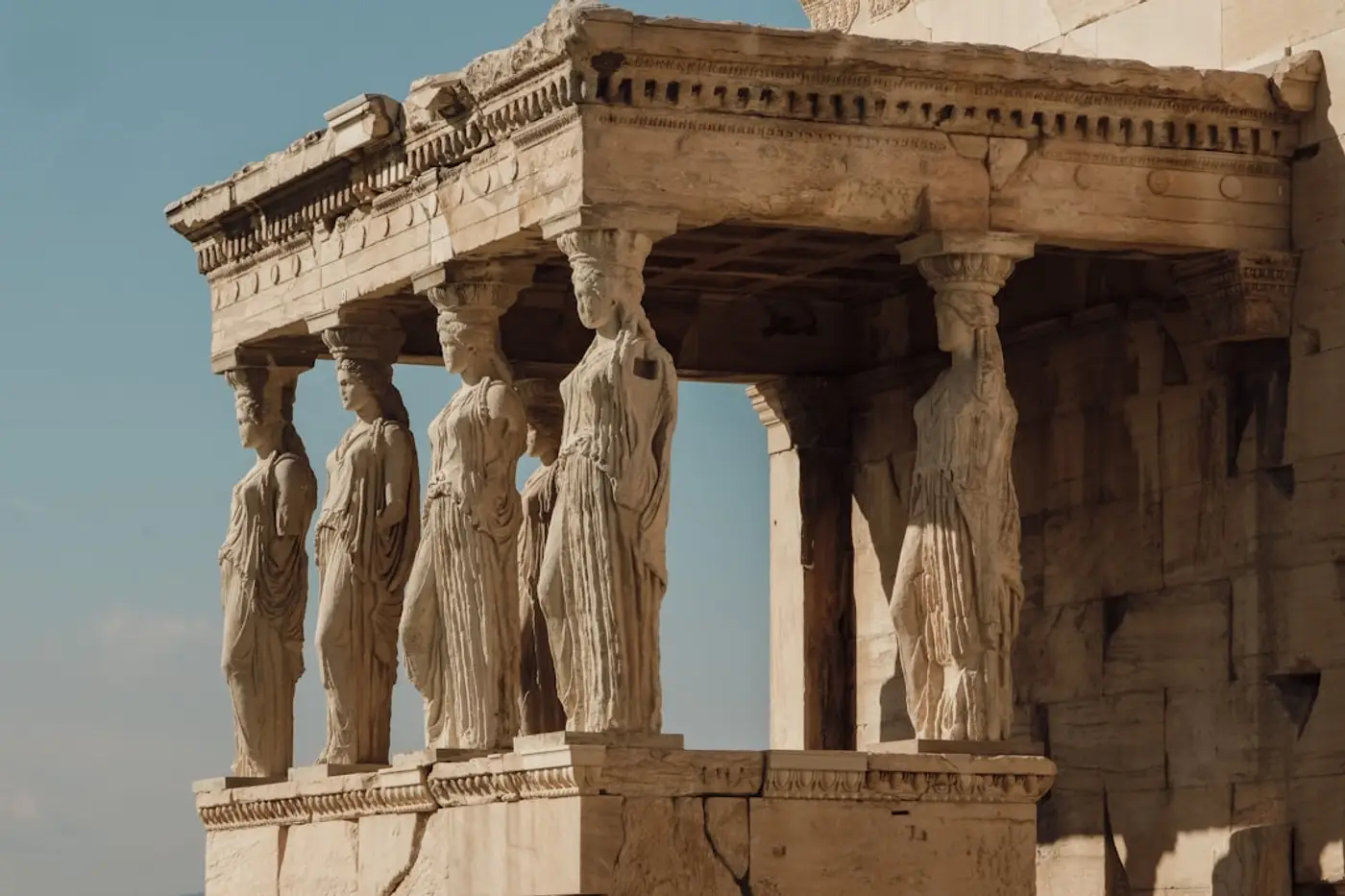
In natural philosophy, polytheism denotes an experiential reality: gods are cosmic forces of consciousness that become accessible through heightened perception — not as belief, but as perception.
Key moments
- 00:00 Walter F. Otto and the Theophania
- 05:00 Childhood Experience — How the Gods Find You
- 12:30 Orpheus and the Origin of Music
- 23:00 Are the Gods Still Present?
- 28:00 Hölderlin — A God Is Man When He Dreams
- 48:00 Numbers and Gods — the Divine Seven
- 65:30 Do We Live in a Godless World?
- 75:00 One Dies Differently When the Gods Are Present
Walter F. Otto was no esotericist. He was a classical philologist, one of the most respected of his time, and in 1956 he wrote a book entitled Theophania — The Spirit of Ancient Greek Religion (Otto, 1956), in which he formulated a thesis that still provokes: the Greek gods are not an invention. They are an experiential reality.
Whoever hears this sentence for the first time hesitates. Something in you resists — not because the thought is unfamiliar, but because it opens a door you closed long ago. Gods belong in literary history, in school lessons, at best in mythology. They do not belong in reality. Or do they?
#Why the Question of the Gods Is a Philosophical One
The question of the gods is usually treated today as a historical one. Cults are reconstructed, textual sources analysed, classifications made. The gods are explained — and in this explanation they disappear. What Walter F. Otto describes, by contrast, is something different: a form of encounter. In his understanding, the Greek gods are cosmic forces that are not believed but experienced. The god shows himself to the one whose capacity for perception is strong enough — and in that moment the god thinks through the human being.
This is a claim that shatters the literary frame. It demands that we take natural philosophy seriously — not as one discipline among many, but as an approach to the world in which the cosmos is alive and the human being is an organ of this living whole. Heraclitus already knew this when he greeted visitors who found him at his hearth with the words: “Here too there are gods” (Heraclitus, c. 500 BC). Not on Olympus, not in the distance — at the hearth, in the everyday, in the ordinary.
#Gods as Cosmic Forces — Not as Idealised Humans
A widespread misunderstanding consists in thinking of the Greek gods as superhuman beings — as idealised versions of ourselves, with the same weaknesses, only larger, more beautiful, more powerful. Jochen Kirchhoff decisively rejects this reading. In a conversation on the experiential reality of the gods he describes how, in Greece, the gods first appear “as a predicate”: “Aphrodite not a person, but first of all what is at work in a particular event” (Kirchhoff, 2024, 09:47). That is to say: the gods denote qualities of the cosmos, not characters in a narrative.
If Aphrodite signifies beauty, attraction, living connection, then she is at work wherever these qualities appear in the world — in nature, between human beings, in art. This is something fundamentally different from a projection of human longings onto the heavens. It is the attempt to grasp cosmic efficacy in figures accessible to human perception.
Walter F. Otto emphasises a trait of the Greek gods that is usually lost in popular reception (Otto, 1956): the gods are beautiful per se. Their beauty is not ornament but expression of their cosmic nature. They are visible — not in the sense of physical presence, but in the sense that a sharpened consciousness can perceive them. “Where a god appears, there is a different clarity,” writes Hölderlin. And this clarity possesses a beauty fundamentally different from human beauty: it is imperishable, because it belongs to another order.
The Indian tradition knows this distinction as the opposition between Devas and Asuras — between divine forces and demonic ones. In the Iranian context the attributions are exactly reversed: what one culture venerates as gods, the other rejects as demons. This mirroring indicates that the issue is less about the figures themselves than about the question of which quality the human being turns towards — and which spirit they serve.
The Orpheus myth condenses this understanding into an image: Orpheus sings, and the stones move, the animals listen, the rivers pause. This is not an allegory of the power of art. It describes a cosmic efficacy in which music — as integer ratio, as expression of cosmic order — makes the boundaries between realms of being permeable. The gods are present in this music, and through it the human being touches a reality that exceeds their own.
#Hölderlin and the Return of the Divine
Friedrich Hölderlin is perhaps the only poet of modernity who treated the question of the gods not as a literary game but as an existential task. His famous sentence from Hyperion (Hölderlin, 1799) — “A god is man when he dreams. A beggar when he reflects” — cannot be reduced to a romantic glorification of the irrational. Hölderlin, himself a philosopher and fellow thinker of Hegel and Schelling, sought a form of perception beyond merely conceptual thinking: a form in which the divine becomes experienceable.
Jochen Kirchhoff describes Hölderlin’s path as tragic (Kirchhoff, 2024): “In his hymns he actually attempted, mantrically, magically, to conjure the gods back — to bring them into appearance again. It broke him.” His contemporaries could not follow. Hölderlin himself wrote: “So I came among the Germans. […] Craftsmen you see, but not human beings.” Craftsmen, in the Greek sense of the word: Banausoi. People incapable of divine feeling.
The tragedy lies in the fact that Hölderlin had the experience — and found no space of resonance. “A sage may illuminate many things for you,” Kirchhoff quotes him, “but where a god appears, there is a different clarity.” This different clarity cannot be manufactured. It shows itself — or it does not. And the question that remains is whether a culture that no longer has room for this clarity has not lost something decisive.
#Self-Deification as a Symptom of Godlessness
When the gods disappear, the human being steps into their place. This is the diagnosis Jochen Kirchhoff makes of modern culture. In Wilhelm Müller’s poem cycle Die Winterreise — set to music by Schubert — we read: “If no god will walk the earth, then we ourselves are gods.” Kirchhoff sees in this not a triumph but a perversion (Kirchhoff, 1998): “Modern man plays at being a quasi-god — as a quasi-nothing. He has stamped himself into a cosmic ant and yet presumes to claim divinity.”
This self-deification manifests today in transhumanism, in genetic manipulation, in the idea of technically improving the human being — of surpassing creation. Kirchhoff calls it a “distinct, mocking, presumptuous quality.” What is worshipped is not the divine but power over nature. “Man brews the world-spirit, he slaps the world-spirit on the shoulder, mate to mate,” Kirchhoff formulates. “He just has a few suggestions for improvement.” It is idolatry — in the old, precise sense of the word.
The Chandogya Upanishad (8.7–12) tells a story that captures this distinction precisely. The god Indra and the demon prince Virochana both seek the Atma, the Self. Both receive the same teaching. But the demon stops at the body — he declares the flesh to be the Atma and teaches his followers to deify the body. Indra, however, turns back, doubts, continues seeking, passes through 101 years of contemplation until he reaches the deeper truth. The difference lies not in the seeking — both seek. It lies in the willingness to pass through the superficial and withstand the uncomfortable.
#What Philosophical Significance Does Polytheism Hold Today?
The significance of polytheism does not lie in “believing in gods again” — as though that were a decision of the will. It lies in perceiving a layer of reality that modern consciousness systematically screens out. Jochen Kirchhoff puts it this way: “There is a very deep layer in the human being, a layer of consciousness, that also knows that the gods exist” (Kirchhoff, 2024).
This knowledge is not knowledge in the scientific sense. It is a knowledge of the whole human being — an intimation that precedes thinking and exceeds it. Walter F. Otto calls it Theophania: the appearing of the divine (Otto, 1956). It presupposes a capacity for perception that must be cultivated — and that atrophies in a culture that only counts, measures, and makes things exploitable.
Kirchhoff sees in the divine names of the planets a last testament of this forgotten connection: Jupiter is still Jupiter, Mars still Mars, Venus still Venus. The names preserve a quality older than astronomy. One could not simply rename the celestial bodies — they are called what they are, and they are what they are called. The names point to an analogical thinking in which the earthly and the cosmic mirror each other — in which every planet expresses a soul-quality that is active in the human being.
In music too Kirchhoff sees a trace of the divine. The integer tone-ratios that Pythagoras understood as cosmic order, the seven as Apollo’s number, acousmatics as the doctrine of divine numbers — all of this points to a layer of reality in which sound and cosmos are not separate. The abstract cipher, by contrast, mere quantification, is hostile to the gods. “The number as cipher kills the gods,” says Ernst Jünger (Jünger, 1974). The triumph of the cipher means the fall of the divine. In great music, however — in Bach and Mozart and Beethoven — something of this divinisation of number lives on, as though the gods still spoke through the sound.
#The Gods and the Human Being — an Ontological Question
At the end of the conversation Jochen Kirchhoff poses the question in its full sharpness: “Do we live in a godless world or do we live in a world filled by the gods? What speaks for one, what speaks for the other?” He answers with a certainty that has nothing dogmatic about it: “I do not believe in a godless world. For me, the world is not godless.” And then, almost in passing, a sentence that spans the horizon of the entire conversation (Kirchhoff, 1998): “Human beings are fallen gods. And they still carry in themselves the very last remnants of the divine — the very last remnants that allow them to live at all.”
This is not mythological speculation. It is an ontological statement about the cosmic anthropos — about the human being as a creature whose deepest core is divine, even when they know nothing of it. C. G. Jung came close when he spoke of archetypes — but he deliberately left open whether these archetypes are merely psychological or actually metaphysical. Kirchhoff goes further. For him the gods are forces of consciousness that pervade the entire cosmos, not merely the human psyche. The question of the gods is therefore no historical curiosity but one that concerns your own life: “One dies differently when the gods are present than when they are not.”
As a young man, Jochen Kirchhoff wrote a poem that he quoted sixty years later: “Despite the demons and blasphemous scoffers — gloriously the eternal gods still reign.” Perhaps in this verse lies the simplest answer to the question that runs through the conversation. The gods are there. They reign gloriously. Whether we perceive them is the question put to us — not to them.
If this question touches you, you will find in the conversation between Gwendolin and Jochen Kirchhoff an hour that opens the space Hölderlin sought in vain. Not as an answer, but as an invitation to raise your gaze — and to look for the signs that Kirchhoff suspects where most have long since stopped looking. The essay The Mythical as a Way into the World deepens this thought further.
#Sources
- Heraclitus (c. 500 BC). Fragments. Transmitted by Diogenes Laertius et al.
- Hölderlin, F. (1799). Hyperion oder der Eremit in Griechenland. Tübingen: Cotta.
- Jünger, E. (1974). Zahlen und Götter — Philemon und Baucis. Stuttgart: Klett-Cotta.
- Kirchhoff, J. (1998). Was die Erde will. Bergisch Gladbach: Lübbe.
- Kirchhoff, J. (2024). Sind die Götter unter uns? Conversation with Gwendolin Kirchhoff. YouTube: Jochen Kirchhoff – In Memoriam [SYeyRsA_oOk].
- Otto, W. F. (1956). Theophania — Der Geist der altgriechischen Religion. Hamburg: Rowohlt.