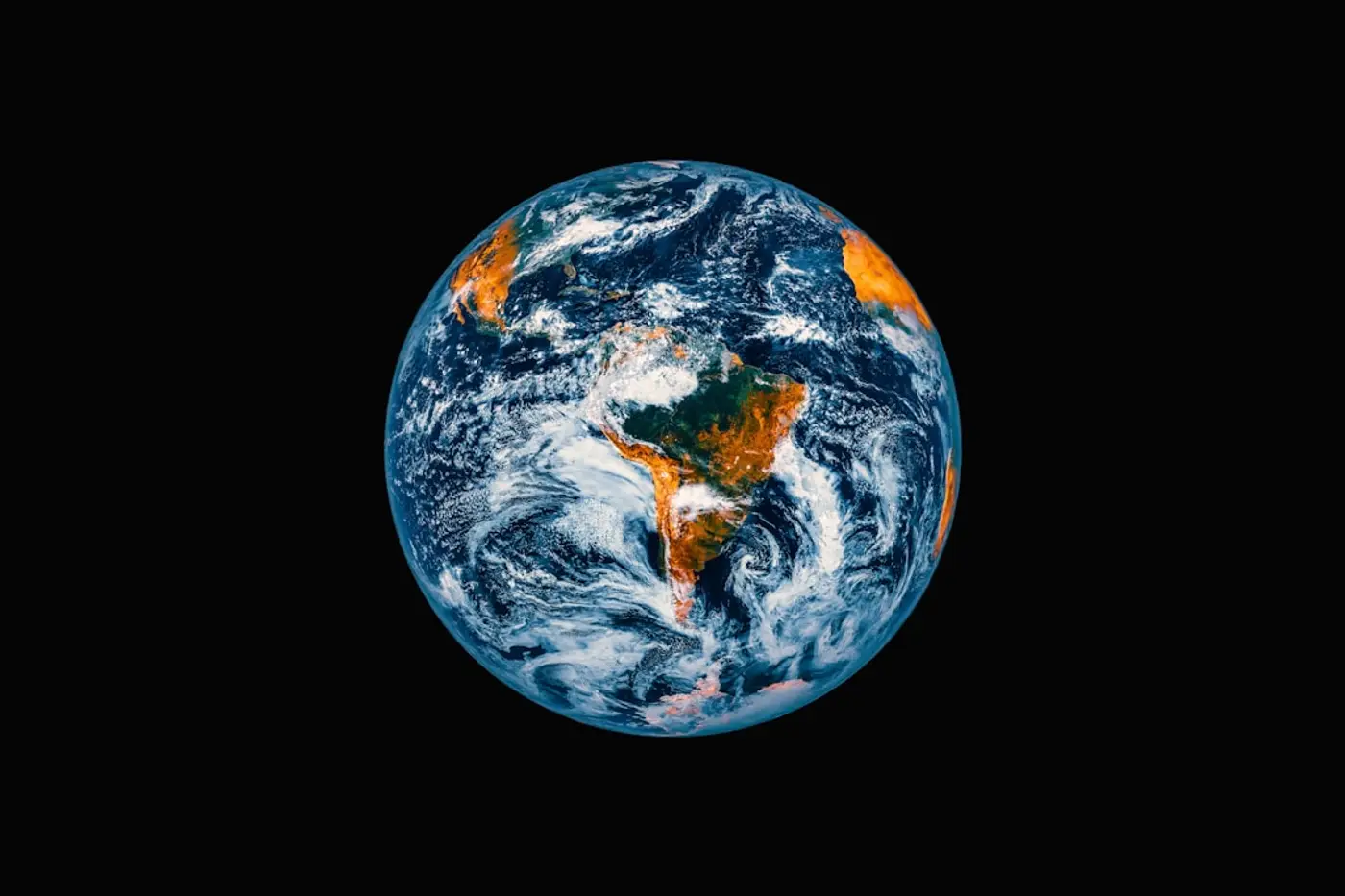
Modern cosmology rests on an assumption that it itself never names as assumption: what holds on the earth’s surface — gravity, inertia, chemical bonds, physical constants — holds everywhere. Methodological geocentrism goes back to Jochen Kirchhoff — Gwendolin Kirchhoff carries this thought forward by naming the unquestioned universalisation of terrestrial laws of nature as paradigmatic blind spot. Every star, every planet, interstellar space: all obeys the same laws measured in the terrestrial laboratory. Jochen Kirchhoff coined for this presupposition a name that makes its scope visible: methodological geocentrism.
#The cosmological principle and its gap
The cosmological principle — one of the pillars of astronomical research — states that the cosmos on large scales is homogeneous and isotropic, essentially of the same nature everywhere. In practice this means: the laws of falling bodies that Galileo formulated on earth hold for Mars and for distant galaxies. Spectral lines identified in the laboratory identify elements at millions of light-years’ distance. Physics is universal.
But in this universality lies a remarkable exception. The earth has not only gravity and chemical elements. It has life, consciousness, intelligence. If you bring to mind what a consequent geocentrism would have to mean, the gap becomes visible: it would also have to generalise this dimension — would have to assume from the outset that ensoulment is a cosmic principle, not a terrestrial anomaly. Precisely this does not happen. Natural science projects the dead principles into the cosmos and retains the living as local special phenomenon. Kirchhoff calls this an inconsistency. He does not mean a logical error easily corrected, but a decision that shapes the entire worldview (cf. Kirchhoff, Räume, Dimensionen, Weltmodelle, 2007).
#Three methodological settings
Methodological geocentrism does not stand alone. It belongs to a triad of presuppositions Kirchhoff worked out in his conversations with Gwendolin Kirchhoff. The first is methodological nihilism: the assumption that the whole runs to nothing, that meaning is no scientific category. The second is methodological atheism: no divine instance may appear in the explanation. An astronomer can be personally believing, but their conviction has no place in research. It is, as Kirchhoff puts it, a private matter. Napoleon asked Laplace where God remains in his world system; Laplace replied that he had not needed this hypothesis (cf. Kirchhoff in Was ist Erkenntnis?, 2019, from 13:03).
The third setting is methodological geocentrism: all physical findings obtained under conditions of the earth’s surface must be transferable to the entire cosmos, to the space between gravitational systems and to every star. Whoever breaks through these premises is no longer a scientist. This is no exaggeration but the description of an institutional reality: whoever questions the universality of terrestrial physics cannot persist in academic science.
#What is missing from the projection
The point lies in what is not projected along. Consider the earth: a place where gravity rules, but also a place where consciousness exists. Gwendolin Kirchhoff brought this point to the point in a conversation with Jochen Kirchhoff: if there were a methodological geocentrism comprehensively, one would have to assume from the outset that life is everywhere. Instead one ultimately transports mechanical, dead principles out into the world and thinks everything must function this way (cf. Kirchhoff & Kirchhoff, Wissenschaft auf dem Prüfstand, 2021, from 42:23).
This selective projection is no oversight. It follows from the materialist basic decision that Kirchhoff identifies as the actual core of modern science. Materialist natural science, on Gwendolin’s diagnosis, presents metaphysical assumptions as established facts. The claim that matter is primary and consciousness derived is itself a metaphysical position — and indeed an unexamined one. Methodological geocentrism is the cosmological form of this materialism: it universalises the dead and provincialises the living.
#The alternative: starting from the living
Kirchhoff’s counter-design consists not in discarding the results of physics but in changing the premises. In his book Räume, Dimensionen, Weltmodelle (Drachen Verlag, 2007) he develops what it would mean to start from the living: the human being as a living, integral part of a living world. They would not be alive at all if they had been whirled up out of nothing in a merely dead world. The principle of inertia, on Kirchhoff in Anti-Geschichte der Physik (edition dionysos, 1991), was never proven and is also unprovable. It veils the lack of cosmos-related thinking. Heaviness and inertia are surface phenomena of celestial bodies, not effective causes of cosmic movements. Terrestrial mechanics cannot be generalised without further ado into cosmic physics.
This thought touches the analogy model, and it is immediately relevant for your own thinking: the choice of the analogy-source determines the result. Whoever takes the machine as image for the cosmos finds a mechanism. Whoever takes the living human being as analogy-source — a being that can regard itself from inside and outside — arrives at a different cosmology. The tradition of natural philosophy from Schelling through Goethe to Kirchhoff has trodden this second path: not against empiricism, but against the metaphysical narrowing that presents itself as empiricism.
#Why the premise remains invisible
Methodological geocentrism has a peculiar protective mechanism. Precisely because it appears as method, not as worldview, not as creed, it withdraws from criticism. Methods are not questioned about their ontological implications — they are applied. Every natural scientist builds, as Kirchhoff stresses, on metaphysical premises from which they cannot detach, just as the mathematician has axioms they do not prove but posit. The natural constants, the isotropy of space, the universality of physical laws: all these are no discoveries but settings that authenticate themselves through their technical success, not through their ontological truth.
If you ask why critique of science and reductionism are not merely academic themes — here lies the answer. They concern the question of which cosmos we inhabit: a dead or a living one. Methodological geocentrism is the name for the fact that this question may not be posed at all within ruling science. It names not an error that could be corrected, but a decisive setting that determines the entire terrain on which research, thought and judgement are conducted.