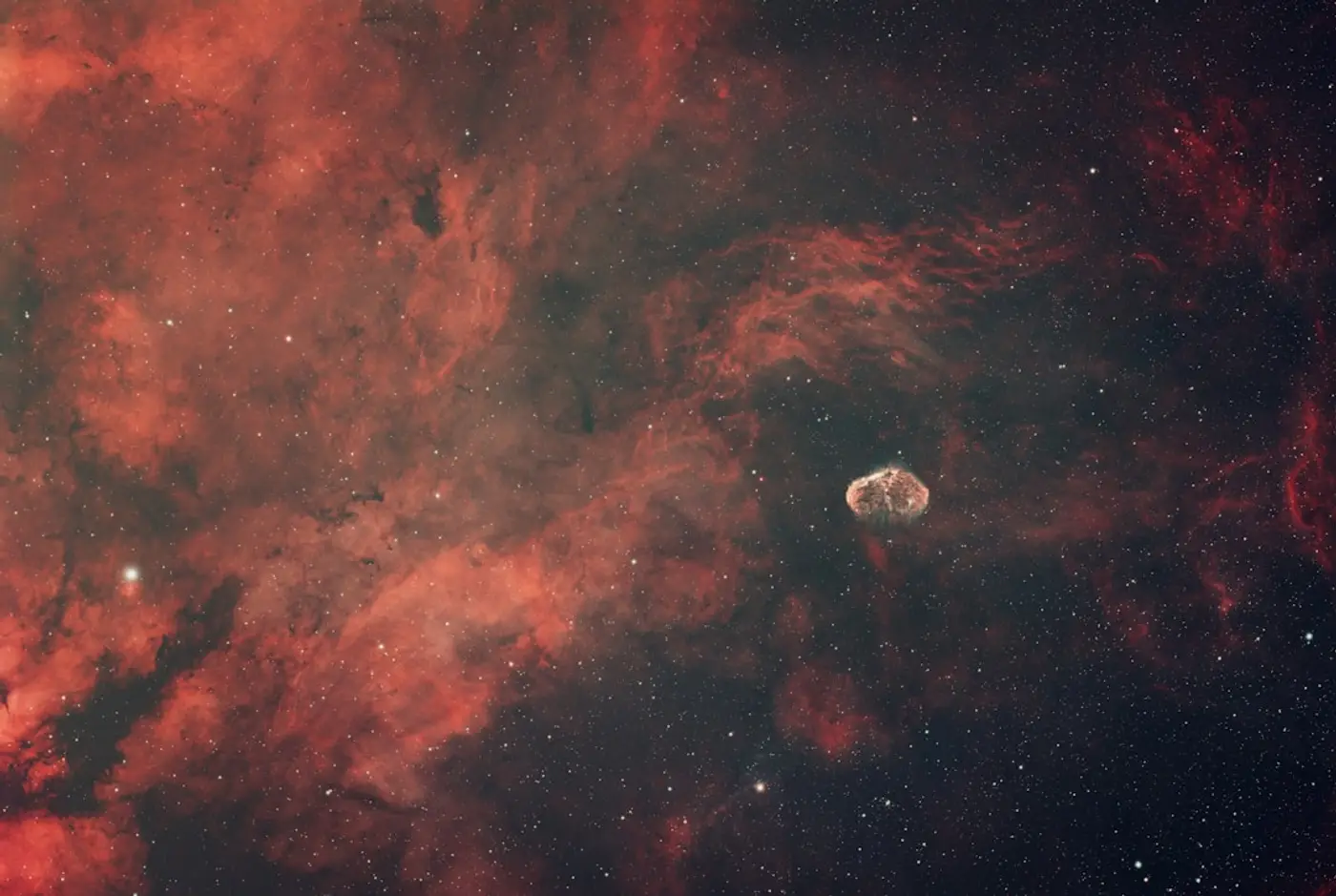
The world-will is the inner force of all natural processes — not blind drive but a spiritual principle that enlivens the cosmos from within and pervades every appearance with vitality.
Key moments
- 00:00 Introduction: Will-Metaphysics as a Tradition of Thought
- 10:00 From Meister Eckhart through Böhme to Schelling
- 29:30 Schopenhauer: The Will in the Forces of Nature
- 38:27 Space-Energy — Helmut Krause's Cosmic Will-Space
- 44:00 The Living Arises Only from the Living
- 48:00 Maya, Indian Philosophy, and the Eternal Will
- 56:00 Cultivating the Will and Self-Affirmation
The question of the will belongs among the great riddles of philosophy. Not the will as a psychological trait, not what one means when saying: I want this or that. But the will as a cosmic principle. As that which moves the world from within. What holds it together, enlivens it, pulses through it. The German tradition of thought has a name for this principle: the world-will.
It is a word scarcely used today. And yet it contains a thought that has lost none of its relevance. For the question of whether the world has an interior, whether behind the measurable forces something stands that is more than mechanical function, concerns not only philosophy. It concerns your relationship to reality itself.
#What Is the World-Will and What Role Does It Play in Cosmology?
The world-will is a concept from natural philosophy that names the inner dimension of all natural processes. It does not mean an abstract mechanism, nor the blind urge that Schopenhauer described. It means: force with interiority. Every natural force, from gravitation to the growth of a plant, has not only a measurable exterior but also an inner quality. Something that relates to itself, that has a centre, that looks out into the world.
Jochen Kirchhoff put it thus (Kirchhoff, 2024): the world has an interior, and this interior is called will. That sounds simple, but the consequence is far-reaching. If the cosmos has an interior, then it is not the dead machinery that abstract physics treats it as. Then it is alive. And we are not randomly cast-in observers but part of this living interconnection.
#The Line of Thought: From Meister Eckhart through Schelling to Schopenhauer
Will-metaphysics is no isolated thought. It has a history spanning centuries — one that belongs among the deepest contributions German thinking has made to world philosophy.
At the beginning stands Meister Eckhart in the fourteenth century (Eckhart, c. 1328). The mystic taught that in the deepest willing of the human being, a divine willing resonates. Whoever wills in the absolute sense, says Eckhart, is no longer separated from the ground of things. Jakob Böhme carried this thought further into his nature-mysticism (Böhme, 1612): the will, for him, is at work not only in the human soul but in every natural phenomenon — in stone, in fire, in the growth of plants.
Friedrich Wilhelm Joseph Schelling then gave this thought philosophical system (Schelling, 1809). The world, says Schelling, is infinite affirmation of itself. The world-will is not a blind drive but a spiritual principle that unfolds in nature step by step, from the simplest matter to human consciousness. Nature is visible spirit, spirit invisible nature.
Arthur Schopenhauer took up the thought of the world-will but changed it fundamentally (Schopenhauer, 1819). In Schopenhauer, the will is blind — a purposeless urge without meaning or reason. The World as Will and Representation shows a cosmos that suffers because the will ceaselessly affirms itself without knowing where. Schopenhauer attempted to trace the will downward into the forces of nature: what appears on the higher level as sexuality shows itself on the subatomic level as attraction and repulsion. The same basic principle on different levels of being.
Friedrich Nietzsche corrected Schopenhauer without abandoning the basic thought (Nietzsche, 1886). For Nietzsche, the will is not blind but affirmative. And he follows Boscovich: atoms are not solid bodies but extensionless centres of force. Matter is shaped force — not substance but will in spatial form. Nietzsche called the Germans “of the day before yesterday and the day after tomorrow” (Nietzsche, 1886, Beyond Good and Evil, §240). Will-metaphysics belongs to that which is of the day after tomorrow.
#Schopenhauer’s Blind Will and What Lies Beyond It
Schopenhauer remains the best-known will-metaphysician, and many know only his version: the will as dark, blind drive. But precisely here lies a distinction that is decisive for understanding the cosmic anthropos.
Schopenhauer’s will has no centre, no gaze, no spiritual quality. It is pure energy without direction. Schopenhauer therefore seeks redemption in the negation of the will: in asceticism, in art, in turning away from the world. Why negate the will? Because it produces only suffering.
The tradition leading from Schelling through Helmut Krause to Jochen Kirchhoff sees it differently. The will is not blind. It gazes. It has degrees of subjectivity; it relates to itself and to the world at once. Iron has a perspective — not in the crude sense, but as being-in-its-environment, as a form of context. The plant has a richer one, the animal richer still, and the human being has the richest inner perspective known to us.
Today’s natural science sees nature only from the outside. It measures, counts, describes formulas. One can launch objects into space, set up telescopes, and observe galaxies. One can consider oneself highly intelligent while doing so. But one sees only the exterior. The telescope conveys only the exterior. The inner perspective is missing, and without it nature remains mute.
The critique of science that follows from will-metaphysics is therefore not a rejection of natural science. It is the question of whether a science that systematically excludes the interior of nature can ever understand what it describes. A human being who knows only the exterior is, at bottom, dead. That was Jochen Kirchhoff’s provocative formulation. Only through the inner gaze is the human being truly alive.
#Space-Energy: The World-Will as Spatial Force
Helmut Krause, physicist and cosmologist, called the world-will space-energy (Krause, 1997). This concept is more than a synonym. It contains a precise physical insight: space is not empty. The mere position of bodies relative to one another — what Oswald Spengler called positional energy — is already a form of energy. Space itself is, as Spengler put it, a will-space (Spengler, 1918).
In Krause’s cosmology, celestial bodies radiate against one another. Their straight field-lines meet, reflect back, and produce — depending on angle and intensity — various forms of wave movement, up to soliton waves that close in upon themselves. That would then be matter: not solid substance but self-enclosed movement. Will that has become form.
Krause arrived at this insight, as Jochen Kirchhoff reported, through a fundamental intuition after long meditation. Not through formulas. What he described is a cosmos in which force does not act blindly but shapes itself, orders itself, returns into itself.
Spengler, in his Decline of the West (Spengler, 1918), brought together — remarkably — Giordano Bruno’s conception of infinity and Beethoven’s music. Beethoven, who studied the Upanishads and developed a pantheistic belief in God, sensed in music a fundamental vitality that reaches beyond the purely aesthetic. Music is, for Schopenhauer, the art form that expresses the will directly. But music is governed by whole-number ratios. It has rhythms, harmonies, an inner structure. That means: the will itself has a nature. It is not chaotic but pre-structured. There is a matrix to this music that has to do with the ordering principle of the cosmos.
Krause’s book The Building Material of the World (Krause, 1997) is freely available at jochenkirchhoff.de — an invitation to study the fundamental questions of philosophical cosmology at the source.
#The Living Arises Only from the Living
There is a sentence that Jochen Kirchhoff repeated again and again, one that condenses the whole of will-metaphysics into a single observation: no one has ever, at any time on this earth, seen life arise from the dead. Never. From life arises life (Kirchhoff, 2024).
That sounds plain, almost trivial. But the consequence is anything but trivial. If the living arises only from the living, then the world in which we live cannot be the dead world of abstract physics. Then we must live in a living world, because we ourselves are alive. The world-will is then no metaphysical construct but the simplest explanation for what already lies before our eyes.
Whoever holds the dead world of formulas to be absolute cannot speak about the world-will at all. They speak about formulas. One can do that — it is even quite entertaining. But they know nothing, because the interior is entirely absent. Will-metaphysics begins where this reduction no longer holds.
Indian philosophy knew this connection long ago. In the Upanishads it is said: the eternal will, the cause of existence-less existence. And the Sanskrit word Maya has a double meaning that is illuminating for will-metaphysics: in Hinduism it denotes the creative foundational principle — the world as living formation. In Buddhism it means the principle of illusion — the world as a veil that holds the individual fast in their separateness. Both are true. The world is creative and deceives at the same time: it deceives you about the fact that you are not only the individual but are anchored in the universal.
#Not Only Those Who Gaze, but Also Those Who Are Gazed Upon
One of the most astonishing thoughts to emerge from the conversation between Jochen Kirchhoff and Gwendolin Kirchhoff about the world-will concerns the relationship between the human being and the cosmos. We are not only those who gaze — who peer through our telescopes into the cosmic night. We are also those who are gazed upon. We are meant.
This is the opposite of what modern cosmology teaches. There the human being is an accident, a by-product of processes that mean no one. Will-metaphysics reverses this relationship: the cosmos is not indifferent. The relationship between human being and world is reciprocal — not one-sided, not merely observational, but pervaded by an analogy-relation that connects both sides.
When you affirm and seize yourself as a living being — this self-seizure — then you are within the will-principle. You will yourself as yourself. And in affirming yourself, you also affirm the whole. This is a thought found in Schelling as much as in Nietzsche and in the Upanishads. The affirmation of the individual is at the same time an affirmation of the cosmos.
#What Does the World-Will Mean for You?
The question of the world-will is no purely academic question. It concerns your relationship to reality. Do you perceive the world as a dead mechanism in which you function? Or as a living interconnection in which you can move, recognise, and respond?
The cultivation of the will begins with the enlivening of your perception of the world. That is perhaps the most practical insight of this entire philosophical tradition. You are a physical-sensuous being, with everything that entails. But you are not exhausted by it. And that in which you are not exhausted — that remainder which stays when everything measurable has been subtracted — you can grasp. That has, as Jochen Kirchhoff expressed it, something to do with wisdom.
The will is inexhaustible. You can go as deep as you wish. It always goes deeper still. Or higher still. Between these you stand. This in-between position is not comfortable. But it is the place where thinking can become alive — where the creative foundational impulses are strengthened through the committed engagement of your own thinking and willing. Therein lies what Jochen Kirchhoff called the dignity of the human being: not as an abstract right, but as a living enactment.
Philosophical consultation offers a space in which such questions are not answered but taken seriously — as a living engagement with what you recognise in your innermost being as real.
#Sources
- Böhme, J. (1612). Aurora oder Morgenröthe im Aufgang. Görlitz.
- Eckhart, Meister (c. 1328). Predigten und Traktate. Transmitted in manuscripts.
- Kirchhoff, J. (2023). Der Weltenwille als Baustoff und Lebenstrieb des Kosmos. YouTube: Jochen Kirchhoff – In Memoriam [FPoHkJ_bEqQ].
- Krause, H. (1997). Der Baustoff der Welt. Freely available at jochenkirchhoff.de.
- Nietzsche, F. (1886). Jenseits von Gut und Böse. Leipzig: Naumann.
- Schelling, F. W. J. (1809). Über das Wesen der menschlichen Freiheit. Tübingen: Cotta.
- Schelling, F. W. J. (1842). Philosophie der Offenbarung. Paulus-Nachschrift.
- Schopenhauer, A. (1819). Die Welt als Wille und Vorstellung. Leipzig: Brockhaus.
- Spengler, O. (1918). Der Untergang des Abendlandes. Vienna: Braumüller.