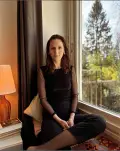
Fear of Death: What It Is Really Afraid Of
What does the fear of death fear? In her childhood fear, Gwendolin Kirchhoff found a picture in which she had not died at all but lay buried alive under a block of granite. At around fifteen she saw it: that cannot be death.


The fear of death, looked at closely, is not necessarily afraid of death itself: in her own childhood fear, Gwendolin Kirchhoff found a picture in which she had not died at all but lay buried alive under a block of granite. Perhaps you know this fear from nights when the thought of your own mortality will not go away and the brooding has no end, or from a moment when death was suddenly very close. It deserves a careful look. Whether you fear death is only the first question. The second is which picture of death you fear.
Gwendolin Kirchhoff examined this fear in her talk “Nachdenken über den Tod” (Thinking about death, 2024) using the phenomenological method. She looks closely at how something presents itself in a person’s subjective, bodily experience, in this case her own (cf. Kirchhoff, G., 2024, Nachdenken über den Tod (1), 02:58–03:18). This essay follows her description step by step and sets a few voices from philosophy beside it.
#What is death anxiety?
For Gwendolin Kirchhoff, death anxiety is not a single feeling: look at it more closely and it fans out into three components (cf. Kirchhoff, G., 2024, Nachdenken über den Tod (1), 03:18–03:34). She names the fear of one’s own mortality, the acute fear of death as a terror that marks a threshold, and risk. The fear of dying, of pain, illness and loss of control at the end of life, is something different: being afraid of dying is not the same as fearing death. It is a subject of its own, at home in end-of-life care and pastoral care; this essay stays with the fear of death itself.
She deals with risk only in passing in this talk, and she gives her reason: compared with the open fear of one’s own mortality, the feeling of risk is a muted feeling, very action-oriented and evasive; death is not directly present in it but appears as something that prudence can avoid (cf. ibid., 03:43–04:02). She does not make light of it, though. She notes “that this kind of awareness of risk, that is, the risk of death, motivates an incredible number of the actions a person carries out in their life” (ibid., 04:04). In the shape of risk, as she describes it, death is everywhere, in our daily actions too, only emotionally hidden and not quite felt (cf. ibid., 04:15–04:23).
| Component | How Gwendolin Kirchhoff describes it |
|---|---|
| Fear of one’s own mortality | an open feeling, in her childhood every night before falling asleep |
| Acute fear of death | terror at a threshold, a cut in space |
| Risk | muted, action-oriented and evasive, death emotionally hidden |
#What does the fear of your own mortality feel like?
Gwendolin Kirchhoff described the fear of her own mortality from her own childhood. She grew up in what she calls a Buddhist household, where rebirth was taken for granted. Even so, at the age of about seven or eight she became aware of her own mortality and had states of anxiety at night before falling asleep, for several years, every night. She distracted herself with audio-drama cassettes so that she could fall asleep and bear it (cf. Kirchhoff, G., 2024, Nachdenken über den Tod (1), 04:53–05:24).
In the thoughts that circled through those nights she distinguishes three qualities. There was time that trickled away mechanically, like an hourglass running out, time that did not mean her. There was a room of death, dark and bodiless, where only her inner speech, a quality of feeling and a seeing of the darkness were present. And this room weighed on her: “I feel as if I were buried alive under a block of granite” (ibid., 06:48). She describes it as without exit, a state of complete powerlessness in which nothing changes (cf. ibid., 05:31–07:06).
At the same time, as soon as she touched this picture, an almost addictive need rose in her: for an open space and for a living time that takes her along on an adventure, in which things are not foreseen and which means her (cf. ibid., 07:12–07:46). The fear had two sides, then. Beside the dread of mechanical time and the heavy room stood the longing for the opposite.
#What was missing from Gwendolin Kirchhoff’s picture of death?
Three things you might expect were missing from Gwendolin Kirchhoff’s childhood picture of death: a judgement, a meaning and other people. “But what the picture did not contain, although one might traditionally have expected it, was any idea of a judgement.” (Kirchhoff, G., 2024, Nachdenken über den Tod (1), 07:53) She had no sense of an afterlife with a heaven or a hell, although as a child she was very conscientious and knew an inner authority of conscience that she associated with the starry night sky (cf. ibid., 08:01–08:37).
“What was also missing was any idea of some meaning that life has.” (ibid., 08:38) Time, as she describes it, ran inevitably towards this being-buried-alive, regardless of reward and punishment; her own decisions would have changed nothing (cf. ibid., 08:43–09:03). And finally, she was aware of her own mortality, not of the mortality of others. “The others weren’t there in this world of death either; I was completely alone there.” (ibid., 09:17)
Today something strikes her about this picture: it resembles the way modern cosmology imagines the cosmos, as time running out mechanically, indifferent to human life, into which human life is existentially thrown (cf. ibid., 09:34–09:51). She calls the picture a kind of fantasy in which she had lived unconsciously (cf. ibid., 09:22–09:27). This fantasy resembled a worldview, and there was no room in it for meaning, for a judgement or for other people.
#Why are people afraid of death?
We are afraid of death, goes one obvious answer, because we fear non-existence. Arthur Schopenhauer took this answer seriously and put it to the test:
The argument is strong. Nobody is terrified of the endless time in which they had not yet been born, and Schopenhauer concludes that the time after death, taken by itself, cannot be any more terrible (cf. Schopenhauer, 1844, Die Welt als Wille und Vorstellung, vol. 2, ch. 41). Epicurus put the reassurance even more briefly: as long as we are, death is not here, and when death is here, we are no more (cf. Epicurus, Letter to Menoeceus, 125). Plato already knew this fear and its childlike form. In the Phaedo, Socrates teases his friends Simmias and Kebes that they seem “to be afraid, like children, that when the soul leaves the body the wind may literally blow it apart and scatter it” (Plato, Phaedo, 77d–e). What is meant is the soul, which might dissolve into nothing after death.
This argument does not fit Gwendolin Kirchhoff’s childhood picture, though. What was feared there was not non-existence or being scattered, but going on without a way out: a consciousness lying alone in the dark, unable to escape. Jochen Kirchhoff, in conversation with her, named what a world without the reality of consciousness does to this fear. For anyone who thinks a human being comes out of nothing and goes back into nothing, he said, this “naturally intensifies the fear of death into something monstrous”; death then becomes “the black wall” against which one is smashed (Kirchhoff, J., in SYMPOSIUM, 2024, 12:10).
That shifts the question: what does a person fear in death when their picture of death hangs on a worldview they have never examined? For more on this background, see nihilism and death in philosophy.
#What took Gwendolin Kirchhoff’s fear of death away?
By her own account, Gwendolin Kirchhoff lost the fear of her own mortality at around fifteen, through an insight. “And then, at around fifteen, I lost my fear of death.” (Kirchhoff, G., 2024, Nachdenken über den Tod (1), 09:56) She gives the reason straight away: “Because I had actually recognised an error in thinking in my picture of it.” (ibid., 10:04) For her this shows that philosophy and thinking help: if you look at things closely, at some point you work out what it was (cf. ibid., 10:10–10:16).
The error lay in the picture itself. “In this picture of death, you see, I can’t have died at all, I’m still alive” (ibid., 10:22), alive in the space of a concrete fantasy, buried alive as if under a block of granite, motionless and put on ice. “And that cannot be death.” (ibid., 10:36) Once she had seen how unreal this picture was, her understanding, in her words, flipped at once “into an inescapability of life” (ibid., 10:51). Since then she has not had this fear of her own mortality (cf. ibid., 10:58).
In her case, the thought of rebirth came into play at once. But she notes that one could just as well say that death is simply the end, and that either way life is inescapable. For her individual span of time, death then has no relevance any more; it is not a room in which she will somehow be, and life is, for her, all there is (cf. ibid., 11:01–11:43).
That was her path, not a method that takes the fear away from everyone. How you might deal with your own fear of death cannot be derived from it like a recipe. What you can take from it is more a direction for your gaze: to look closely at which picture your fear has before its eyes, and to check whether that picture really shows death.
#Does the fear of death go away once you see through it?
For Gwendolin Kirchhoff the fear of her own mortality went away, but at first something else took its place. With the inescapability of life came, for her, the inescapability of suffering as well (cf. Kirchhoff, G., 2024, Nachdenken über den Tod (1), 12:15–12:24). She had banged her knee and realised that in a lifetime she cannot, with the best will in the world, avoid cutting herself now and then, burning herself or banging her knee, and “that suffering and embodied existence cannot be thought apart” (ibid., 12:38).
In connection with Buddhism, she did not want to be reborn again back then and experience new suffering. She adds: “My attitude has changed since then, yes, but that’s how I thought about it at the time.” (ibid., 13:22) The dread of her own mortality turned into the wish to pass the test of her own death: “I want to pass the test of my death, to die a good death” (ibid., 13:35). She now saw death “as a kind of mystery and a kind of test to be passed” (ibid., 13:48).
With that, something was added that had been missing from the childhood picture. More and more she connected death with her authority of conscience, which she associated with the starry sky; where she had perceived no judgement before, she now perceived one (cf. ibid., 13:58–14:18). “But I had the distinct feeling that I would judge myself.” (ibid., 14:19) And a wish for redemption arose (cf. ibid., 14:30). So the dread of death had not simply gone. It had changed, from the dread of a room without exit to the wish to pass the test of one’s own death.
#Is the fear of death really a fear of yourself?
According to Jochen Kirchhoff, the fear of death is the fear of oneself. In a conversation with Gwendolin Kirchhoff in 2020, he said that behind the fear of death lies another fear, a person’s fear of themselves, because in the final confrontation with dying they are confronted with themselves; all their power games and ego games fall apart there (cf. Kirchhoff, J., 2020, The Great Reset als Technische Welterlösung?, 1:19:56–1:20:22). His formula is: “the fear of death is the fear of oneself” (ibid., 1:20:32).
Gwendolin Kirchhoff’s own description is not the same, but it touches his at one point. On her path from the childhood picture to her youth, too, a person standing before themselves appears in the end: death as a test to be passed and the feeling that she would judge herself. For you this yields no diagnosis but a question to put to yourself: what exactly do you shrink from when you think of your own death, from nothingness, from a room without exit, or from what you might learn there about yourself?
#What happens in acute fear of death?
In acute fear of death, according to Gwendolin Kirchhoff, death appears as a threshold. She describes an awareness of a threshold that floods over you: now, in this moment, it becomes clear to me, I am going to die (cf. Kirchhoff, G., 2024, Nachdenken über den Tod (1), 17:00–17:10). To her it appears as “a kind of impenetrable, black, smooth wall” (ibid., 17:12), and further: “It is like a cut in space, and behind it is total unknowability” (ibid., 17:24).
Faced with this terror, she says, we examine the direction of our life force. It becomes acutely clear what is a waste of time, what deeper wishes we have and where we may be investing our time wrongly (cf. ibid., 18:09–18:34). “And from this nearness to death, life orients itself”, human activities fall into order: “They don’t become arbitrary; instead there is a feeling of something meant.” (ibid., 18:45–18:53) And something else happens in the immediate nearness of death: there “truth becomes more important than self-deception” (ibid., 19:38). The will to truth is perhaps, for her, a child of this awareness of death, because before death there is suddenly a sharp distinction between the real and the unreal (cf. ibid., 19:46–20:02).
Here lies the difference from the night-time fear of mortality. That fear saw a room in which one goes on living, buried alive and unable to escape; acute fear of death sees a threshold that one cannot see past and beyond which uncertainty begins, the unknown in the strictest sense. Both touch the awareness of one’s own finitude, but in opposite ways. What a near-death experience says about this threshold is a question of its own.
#When is fear of death a matter for psychotherapy?
Fear of death is a matter for psychotherapy when it dominates your everyday life, turns into panic attacks or keeps you from sleeping for weeks. Then it belongs in the hands of a licensed psychotherapist or a doctor, not in a philosophical conversation. A pronounced fear of death and dying has a name of its own, thanatophobia, and for those affected there are professionals who work with it psychotherapeutically. When psychotherapy is the right path is described in more detail on the page Wann Psychotherapie statt philosophischer Begleitung? (in German).
If the fear of death turns into thoughts of not wanting to live any more, or thoughts of ending your life, this is not the time for reflection but the time for immediate help: in Germany, the emergency number is 112. TelefonSeelsorge, the German crisis line, is available on 0800 111 0 111 or 0800 111 0 222, around the clock, free of charge and anonymously. Outside Germany, call your local emergency number or crisis line.
Philosophical accompaniment can complement psychotherapy. It does not replace it. Its field is the question that stands behind the fear, once the fear no longer floods you.
#What remains when you look closely at the fear of death?
In Gwendolin Kirchhoff’s childhood fear of death there was first an imagined picture, and only behind it the question of death itself. In her picture, Gwendolin Kirchhoff found a time that did not mean her, a room without exit and a loneliness without other people. She also found in it the longing for the opposite, for a time that means her and for an open space. And when she recognised that this picture cannot be death, what remained was not emptiness but the inescapability of life.
Whether this movement takes place in your own reckoning with death, nobody can promise. What you can do is look closely, talk about death and put your own picture of it into words, alone or in a conversation. If the fear of death has led you into an existential crisis or a life crisis, you will find more there. For more on Spinoza’s sentence about the free human being and on the philosophy of birth, see Reflecting on death. If you are preoccupied with the death of a loved one, the essays on the stages of grief and on losing your mother may help.
#Sources
- Epicurus (c. 300 BC). Letter to Menoeceus. Cited 125.
- Kirchhoff, G. (2024). “Nachdenken über den Tod (1)” [Video]. SYMPOSIUM, YouTube. https://www.youtube.com/watch?v=KSltRJB88jg, 02:58–20:02.
- Kirchhoff, G. & Kirchhoff, J. (2024). “Die Anderswelt: Nachdenken über den Tod (2) – Ein Gespräch mit Jochen Kirchhoff” [Video]. SYMPOSIUM, YouTube. https://www.youtube.com/watch?v=o-secv4Z-pM, 11:33–12:24.
- Kirchhoff, J. (2020). “The Great Reset als Technische Welterlösung?” [Video]. Jochen Kirchhoff – In Memoriam, YouTube. https://www.youtube.com/watch?v=Kgnj2zTzcxc, 1:19:56–1:20:35.
- Plato (c. 385 BC). Phaidon, 77d–e. German trans. Friedrich Schleiermacher. Quoted from: Sämtliche Werke, vol. 1, Berlin [1940], p. 758; English translation ours.
- Schopenhauer, A. (1844). Die Welt als Wille und Vorstellung, vol. 2. Leipzig: Brockhaus. Ch. 41. Quoted from: Zürcher Ausgabe. Werke in zehn Bänden, vol. 4, Zürich 1977, p. 546; English translation ours.
If this resonates personally, you can see how a philosophical consultation with me unfolds — or simply write to me.