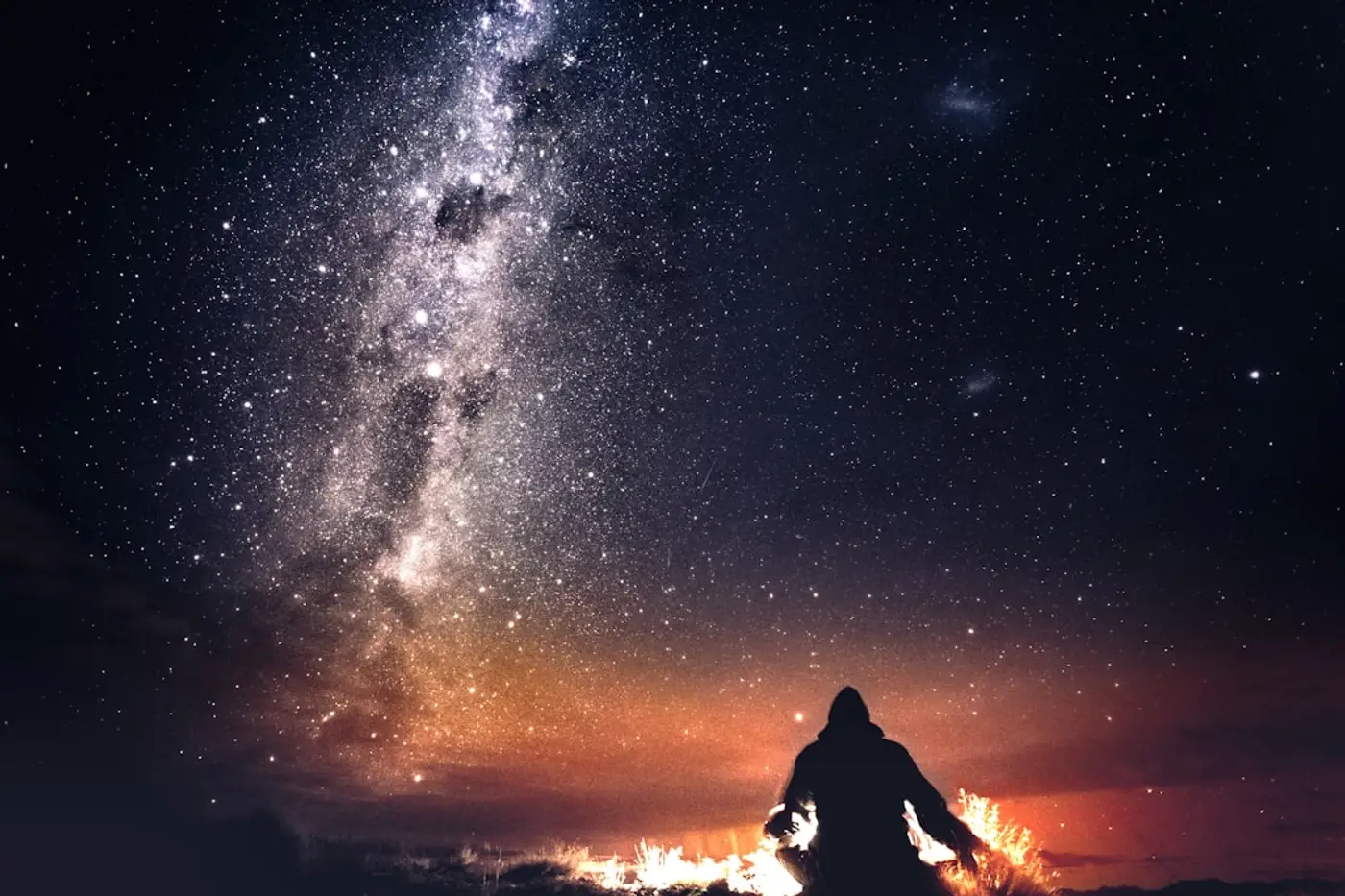
What happens when a person, under controlled conditions, has experiences that shatter the bounds of individual biography — cosmic unity states, identification with the formation of galaxies, memories of one’s own birth? Academic psychology declares such reports pathological or epiphenomenal. Esotericism accepts them uncritically as confirmation of any number of world-designs. Transpersonal psychology is the only current that has attempted to research these experiences systematically without explaining them away or mystifying them. But it has left open a question that weighs more heavily than all the answers it has found: What do these experiences tell us about the nature of consciousness itself?
#Where the Movement Comes From
Transpersonal psychology arose in the late 1960s as the fourth force in psychology, after psychoanalysis, behaviourism, and humanistic psychology. Abraham Maslow, who had formulated the hierarchy of needs, recognised that his conception of self-actualisation was too narrow. There were experiences Maslow called “peak experiences” that reached beyond the personal self and could not be accommodated within any existing psychological framework. In 1969, Maslow and Anthony Sutich founded the Journal of Transpersonal Psychology. The name was programme: trans-personal, beyond the personal.
Stanislav Grof (*1931) became the formative figure of the movement. Over five decades he mapped states of consciousness that academic psychology could neither explain nor reproduce — first through psycholytic therapy with LSD, from the 1970s onward through holotropic breathwork (Grof, 1975; 1988). Ken Wilber designed integral models from the 1970s on that sought to bring together Western psychology, Eastern contemplation, and developmental theory. What all these approaches shared was the core conviction that mainstream psychology systematically excludes an essential part of human experience.
#What Transpersonal Psychology Made Visible
The achievement of the movement lies in its cartography. Grof’s four basic perinatal matrices describe layers of experience connected to the phases of biological birth yet reaching far beyond them (Grof, 1975). The first matrix maps the oceanic unity before the onset of contractions. The second describes cosmic entrapment when the cervix is still closed. The third encompasses the struggle through the birth canal. The fourth contains the transit — the actual birth — frequently accompanied by experiences that exceed individual boundaries. Each matrix opens access to domains that point beyond personal biography, to what Grof called the transpersonal unconscious.
Maslow, Grof, and their successors took seriously an experiential domain that academic psychology had consigned to the categories of pathology. Mystical states, near-death experiences, prenatal memories, experiences of cosmic identification — these are documented phenomena that can be reproduced under controlled conditions. Dismissing them with the label of psychosis is too easy.
#Where Philosophy Begins
What transpersonal psychology accomplishes — providing access to experiences beyond the individual ego — also occurs in philosophical work. The starting point differs. Transpersonal psychology describes and classifies. It says: these experiences exist, they follow certain patterns, they can be ordered into matrices. What it typically does not ask is the ontological question: What must be true about the nature of reality for such experiences to be possible?
When a person in an altered state of consciousness experiences the formation of galaxies, there are two possibilities. Either the brain is producing an impressive hallucination, or the person is perceiving something that is inherent in the nature of consciousness itself: that consciousness is not private, not confined to the skull, not a by-product of neural activity, but something that has belonged to the cosmos from the beginning. Transpersonal psychology usually leaves this question open or touches on it only glancingly. For all its empirical care, it remains ontologically underdetermined.
Jochen Kirchhoff (1944—2025) posed precisely the question that goes unasked here. His natural philosophy rests on the fundamental thesis: consciousness can only arise from consciousness (J. Kirchhoff, 1998). The cosmos is not dead matter that at some point produced consciousness but a living whole in which spirit inheres. Friedrich Wilhelm Joseph Schelling formulated this in his Ideas for a Philosophy of Nature: “Nature is to be the visible spirit, spirit the invisible nature” (Schelling, 1797). Within this tradition, the experiences Grof mapped become intelligible. Cosmic identification, pre-human developmental stages, transpersonal unitive experiences are not hallucinations of an overstimulated brain but points of access to the reality of a cosmos that is itself conscious.
#The Birth Process as Bridge
The most productive connection between transpersonal psychology and natural philosophy lies in the birth process. Grof showed empirically that people live through the perinatal matrices in expanded states of consciousness, that biological birth as a primal psychic event recurs in later life crises (Grof, 1988). Gwendolin Kirchhoff turns this empirical observation into a philosophical structural principle: “Life is not a series of deaths but a series of births. Births always follow the same course: at the beginning the feeling is very delicate and protected by a dense covering. Then at some point a vital thrust arrives.”
What Grof described is the psychological finding. What natural philosophy adds is the framework: the birth process repeats because the cosmos itself is generative, because becoming, not mechanism, is its fundamental principle. Pre-birth, the state of being stuck where something wants to break through that has not yet found space, becomes recognisable in this perspective as the ground structure of human emotionality. Something always wants to be born. The emotional structure never loses this character.
The question thereby shifts. Transpersonal psychology asks: What are the experiences that reach beyond the ego? Natural philosophy asks: What must the cosmos be for a being within it to have such experiences? And philosophical practice asks: What does it mean for a concrete human life if the person is not a spectator of a dead cosmos but part of a living whole?
#What Is Missing and What Remains
Transpersonal psychology opened a door that academic psychology kept closed. The layer model of consciousness that emerges in Grof’s research is not psychological speculation but empirically grounded cartography. That this cartography has not entered the mainstream says more about the limits of the mainstream than about the quality of the research.
What transpersonal psychology lacks, however, is the philosophical depth that turns description into knowledge. Without an answer to the question of what consciousness is, the cartography remains an impressive collection of travel reports from a land whose geography no one can explain. Schelling’s natural philosophy and Kirchhoff’s cosmological extension supply this geography: a cosmos in which consciousness is not an epiphenomenon but a fundamental principle. Within this framework, transpersonal research receives the ontological ground it could not provide from within itself.
Those interested in Grof’s perinatal matrices and their connection to Kirchhoff’s natural philosophy will find a detailed account in the entry on consciousness research. The philosophical significance of pre-birth as a ground structure of emotionality is developed in the entry Pre-Birth.
#Sources
- Grof, S. (1975). Realms of the Human Unconscious. Stuttgart: Klett-Cotta. [German: Topographie des Unbewussten].
- Grof, S. (1988). The Adventure of Self-Discovery. Munich: Kosel. [German: Das Abenteuer der Selbstentdeckung].
- Kirchhoff, J. (1998). Was die Erde will. Bergisch Gladbach: Gustav Lubbe Verlag.
- Schelling, F. W. J. (1797). Ideen zu einer Philosophie der Natur. Leipzig: Breitkopf und Hartel.