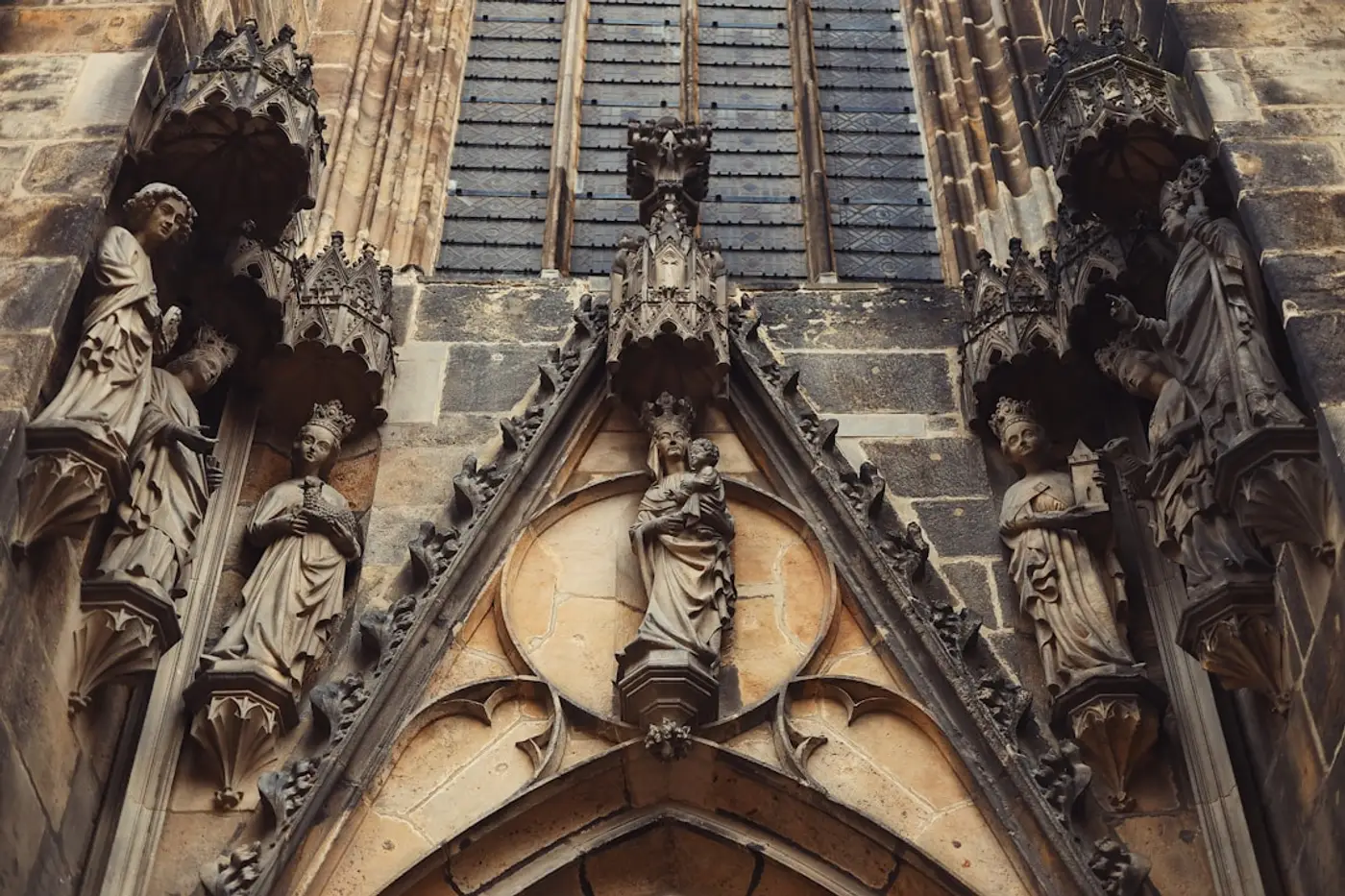
No thinker of the Middle Ages has been more frequently cited and less frequently understood than Thomas Aquinas. He is known as the theologian who formulated five proofs of God, as the man who reconciled Aristotle with Christianity, as Doctor of the Church and scholastic systematiser. None of this is wrong. But it misses what remains philosophically fruitful in Thomas: a participation ontology that belongs neither to rationalism nor to fideism and that found no home after the Cartesian split.
#Being Is Not Equal to Being
Thomas Aquinas (1225—1274) posed a question that no one before him had put with such precision: What does it mean that something is? Not what a thing is — its essence, its nature — but that it is: its existing, its actus essendi. This distinction between essence (essentia) and being (esse) forms the core of his metaphysics. In every finite being, essence and being fall apart. A tree is a tree — that is its essence. But that it is, it does not owe to itself. It receives its being.
Aristotle, on whom Thomas draws, had introduced the distinction between potency (potentia) and actuality (actus). Thomas radicalises it. Being itself is the highest actus, the deepest reality a thing can possess. Without this act, every essence remains a mere possibility, a form without actualisation. The oak in the seed is potentially an oak; that it becomes actual is an act that goes beyond the mere what. This figure of thought preserves what Aristotle initiated in his doctrine of entelechy: the inner directedness of a being toward its actualisation.
#Participation Rather Than Proof
The five ways (quinque viae) by which Thomas sought to demonstrate the existence of God appear in every philosophy encyclopaedia. Schelling subjected them to critique in his Munich Lectures (1827): from the cosmological argument, the progression from cause to cause, at best a final cause follows, but not its nature. Whether this cause acts freely or blindly remains open (cf. Schelling, 1827, On the History of Modern Philosophy). And the ontological argument, which Descartes later took up, had already been rejected by Thomas himself, who opposed Anselm of Canterbury.
More consequential philosophically than the proofs of God is Thomas’ doctrine of participatio. Every being has being but is not being itself. It participates in a being it did not bring forth. This participation ontology is not theological decoration. It formulates an order of being: the finite points to the infinite, not as a conclusion but as a structure of reality. Expressed in the language of hylomorphism: form inheres in the stuff, but the form itself does not receive its act of being from itself either. There is a depth-layer of being that precedes every form and every stuff.
Franz von Baader, in his Collected Works, refers to the Thomistic principle that knowledge occurs through the assimilation of the knower to the known (cf. Thomas, Summa Theologiae, I, q.12). Whoever knows God is, accordingly, in a certain sense transformed into God. For Thomas, knowing is not a neutral process of mirroring. It is an ontological process in which the knower assimilates to the known.
#What Modernity Lost
Thomas held together something that fell apart after Descartes: the unity of reason and the reality of the immaterial. In his metaphysics, reason is capable of reaching beyond the sensible toward being itself. The intellectus, as Thomas distinguished it from ratio, grasps first principles in a kind of immediate insight, while reason in the narrower sense thinks discursively, progressing from one thing to another.
Descartes shattered this unity. His distinction between res cogitans and res extensa made thought a bodiless substance and matter a mindless extension. What in Thomas was a graded, permeable order — matter, form, soul, intellect, being — became a rift that has occupied the whole of modern philosophy. The mind-body problem, which has since been considered one of the hardest problems in philosophy, simply did not exist for Thomas. The soul is for him, as for Aristotle, the form of the body — not an inhabitant who might one day move out.
Jochen Kirchhoff named the consequence of the Cartesian break in his Anti-History of Physics (1980): the petrification of official Church doctrine, which rested on Aristotle “seen through the lens of Thomas Aquinas,” made Galileo’s reaction inevitable. But Kirchhoff also emphasises the Mumfordian verdict that he shares: the form of that reaction was not merely an attack on Aristotle’s authority; it was “also indifferent to questions of biological behaviour and human experience, in which Aristotle, as an immediate observer, still showed more insight than those who equated science with mechanics and organisms with machines.”
That is the decisive point. Thomas’ reception of Aristotle became dogma and had to be criticised. But the critique threw out the baby with the bathwater: the Aristotelian insight that nature is living, form-bearing, and directed toward ends was lost along with the scholastic petrification. What natural philosophy has been trying to restore since Schelling was still intact in Thomas, in theological language: a reality in which the immaterial is no less real than the tangible.
#Reading Thomas Today
Whoever takes Thomas Aquinas seriously philosophically today must avoid two errors. The first consists in dismissing him as a pure theologian whose ontology claims validity only within the Christian faith. The second consists in co-opting him as a forerunner of rationalist theism that wants to prove God through arguments.
Thomas conceived an order of being in which being itself is more than the sum of the things that participate in it. This intuition precedes any confessional commitment. Mumford placed Thomas alongside Aristotle and Ibn Khaldun as one of those universal thinkers to whom “wide areas of human experience were necessarily closed” but who nevertheless managed to grasp fundamental patterns of reality.
For a philosophy that conceives the cosmos as a living whole, Thomas’ participation ontology is no relic. It formulates what Schelling’s natural philosophy and Kirchhoff’s cosmic anthropology also presuppose: that the individual has its ground not in itself but in a whole in which it participates and which it simultaneously expresses. The language is different; the thought runs in the same direction.
See also: Hylomorphism, Entelechy, Teleology
#Sources
Aristotle. De Anima (On the Soul).
Aristotle. Metaphysics.
Kirchhoff, J. (1991). Anti-Geschichte der Physik. Grundlagenkritik und Alternativen.
Schelling, F. W. J. (1827). Zur Geschichte der neueren Philosophie.
Thomas Aquinas (c. 1256). De Ente et Essentia (On Being and Essence).
Thomas Aquinas (1265-1274). Summa Theologiae.