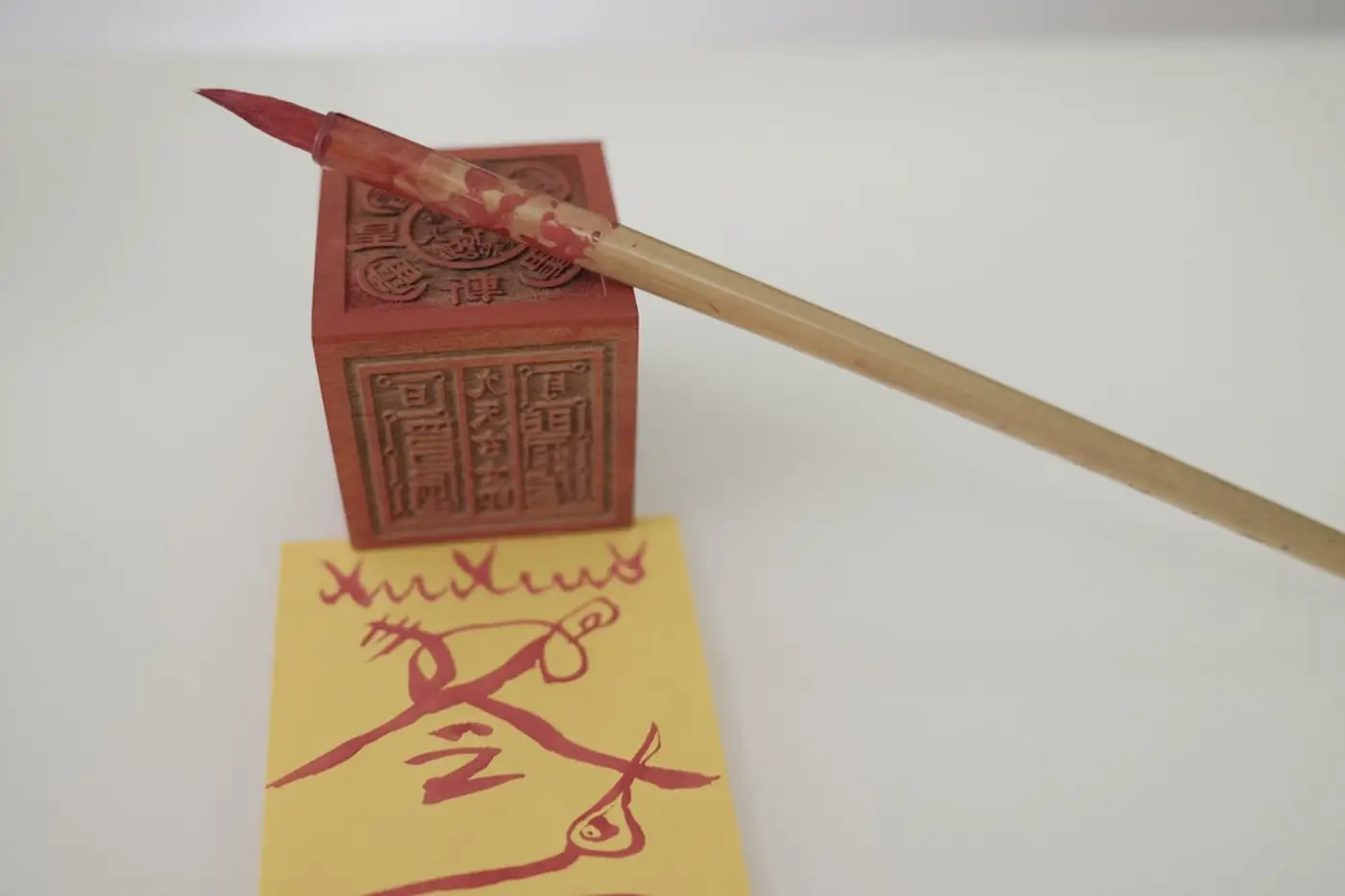
A decision is due. The arguments have been weighed, the facts are on the table. And yet something is missing. The mind has done its work, but the clarity it provides does not reach the question that actually burns: Is now the right moment? Should I act or wait? For precisely this boundary of analytical thinking, there has existed for over 3,000 years a book that does not give answers but cultivates the ability to read a situation in its movement: the I Ching, the Book of Changes.
#64 Images for 64 Situations in Transition
The I Ching is neither a guidebook nor a recipe collection. It is a compendium of 64 hexagrams — figures composed of six solid or broken lines, each describing a particular situation. Not a static condition, but a transition: the moment when a constellation shifts and passes into another. Each hexagram is formed from two trigrams representing elemental forces such as heaven, earth, water, fire, mountain, lake, thunder, and wind. Their combination produces an image of the situation that allows the questioner to recognize their own circumstances in their inner dynamic.
The solid line represents Yang: the bright, the firm, the moving. The broken line represents Yin: the dark, the yielding, the receptive. These two forces are neither opposites nor adversaries. They describe the tension inherent in every situation: the interplay of activity and stillness, of advancing and withdrawing. The I Ching thinks in transitions. It does not ask: What is the case? It asks: What is becoming of what presently is?
Richard Wilhelm, who translated the work into German between 1913 and 1923 under the guidance of the Chinese scholar Lao Nai-hsuan, describes this fundamental idea in his introduction: The judgements indicate whether an action will bring fortune or misfortune, remorse or humiliation. They thereby place the person in a position to decide freely — to potentially abandon a given direction that would arise from the situation of the time itself, if they can summon the strength to do so (Wilhelm, 1924/1950, p. 16).
#Oracle and Judgement: How the I Ching Is Read
The oracle technique of the I Ching — whether through the traditional sorting of yarrow stalks or the coin toss commonly used today — is not chance in the modern sense. It is a procedure that interrupts the questioner’s rational control for a moment, so that something else may come to expression. Wilhelm describes the process thus: Through this sorting, the unconscious in the person was given the opportunity to manifest (Wilhelm, 1924/1950, p. 19). What is required is an inner readiness, an ethical attitude of inquiry. Anyone who misuses the oracle to confirm a decision already made receives no useful answer.
What the I Ching cultivates is not clairvoyance but judgement: the ability to perceive a situation so precisely that the appropriate action arises from the perception itself. The 64 hexagrams offer a repertoire of situational images against which the questioner sharpens their own discernment. Those who consult the book over years develop a feel for the structure of transitions, regardless of whether they understand the oracle technique as a metaphysical process or a hermeneutic tool.
#The Noble One and the Art of Waiting
The central figure of the I Ching is the Noble One, in Chinese Junzi. In Confucianism, this term denotes the self-cultivated person who works through their being, not through imposition. The I Ching addresses the Noble One because it does not transmit a technique anyone could apply mechanically. It presupposes a person willing to see through their own impatience, their need for control, and their fear of waiting.
“Therefore the Noble One, in times of rest, contemplates these images and reflects upon the judgements,” reads the sixth paragraph of the Great Commentary (Wilhelm, 1924/1950, p. 315). “When he undertakes something, he contemplates the changes and reflects upon the oracle.” Here lies the practical core of the I Ching: the distinction between times for action and times for waiting. Wisdom in this tradition means being able to feel the difference between an impulse to act that arises from the matter itself and an anxious need for control disguised as a sense of responsibility. The I Ching is the instrument that trains this distinction.
This stance connects the I Ching with Daoism. Laozi formulates the principle in its most radical form in the Daodejing (Ch. 37): The Dao acts perpetually through non-action, and yet nothing remains undone (Laozi, Daodejing, Ch. 37; trans. Wilhelm, 1911). The I Ching makes this principle concrete. It shows that non-action is not passivity but a form of attention: the willingness to await the ripening of a situation rather than imposing one’s own sense of time upon it.
#From the Shang Dynasty to Richard Wilhelm
The oldest layers of the I Ching reach back to the Shang Dynasty (c. 1600—1046 BCE), when oracle bones and tortoise shells were used for divination. The 64 hexagrams with their judgements were likely composed between the 10th and 8th centuries BCE. During the Zhou Dynasty, the book served as a state oracle, and this standing in Chinese culture shapes its reception to this day. It was not a popular handbook but an instrument of leadership: a text consulted by those who bore responsibility for the whole.
Confucius (551—479 BCE) is said to have studied the I Ching so intensely that the leather bindings of his copy tore three times (Sima Qian, c. 94 BCE). Whether the anecdote is historically accurate matters less than what it reveals about the Confucian relationship with the text: not a single reading, but a repeated questioning in which the book becomes a counterpart. The so-called Ten Wings, the philosophical commentary layers of the I Ching, are attributed to Confucius and form the bridge between the archaic oracle book and the philosophical wisdom literature. They contain the Great Commentary (Da Zhuan), which elevates the I Ching from mere oracle technique to natural philosophy: a teaching of change as the fundamental principle of reality.
Richard Wilhelm’s translation, first published in 1924, made this text accessible to European thought (Wilhelm, 1924/1950). Wilhelm translated not merely words but conveyed the philosophical depth of a text that resists any purely philological rendering. Carl Gustav Jung, who wrote the foreword to the English edition, recognised in the I Ching an instrument that sets a synchronistic principle against Western causal thinking (Jung, 1950). Wilhelm’s work remains the definitive German edition and the foundation on which the I Ching has stayed alive in European philosophical practice.
#The I Ching in Philosophical Practice
In work with leaders and in philosophical consultation, the I Ching proves itself as an instrument for a particular capacity: timing. A leader faces a restructuring. The numbers say: act. But something in the situation says: not yet. The I Ching gives this perception a language. It is not about fortune-telling or magical thinking, but about trained attention to what a situation actually demands — and the courage to trust one’s own judgement, even when the rational mind delivers no clear-cut answer.
The question the I Ching poses is, at its core, the question of wisdom: How do you know when to act and when you are better off waiting? Neither analysis nor experience alone can answer this question. What answers it is a quality of perception that develops over time through engagement with the situational images of the I Ching — and that the philosophical tradition calls wisdom.
Confucianism and Daoism form the two intellectual traditions from which the I Ching draws its commentarial layers — the one emphasising ethical order, the other the effortless flowing-with. Wisdom names the quality the I Ching cultivates: not knowledge of the future, but a feel for the fitting moment. And judgement is the faculty that grows from this feel — the ability to decide in particular cases where no rule applies.
#Sources
- Jung, C. G. (1950). Foreword. In: R. Wilhelm (trans.), The I Ching or Book of Changes (English edition, C. F. Baynes, trans.). New York: Pantheon Books.
- Laozi (c. 4th century BCE). Daodejing. German edition: R. Wilhelm (trans.), Laotse: Tao Te King (1911). Jena: Diederichs.
- Sima Qian (c. 94 BCE). Shiji (Records of the Grand Historian). Biography of Confucius, Ch. 47.
- Wilhelm, R. (trans.) (1924). I Ging: Das Buch der Wandlungen. Jena: Diederichs. English edition: The I Ching or Book of Changes (C. F. Baynes, trans., 1950). New York: Pantheon Books.