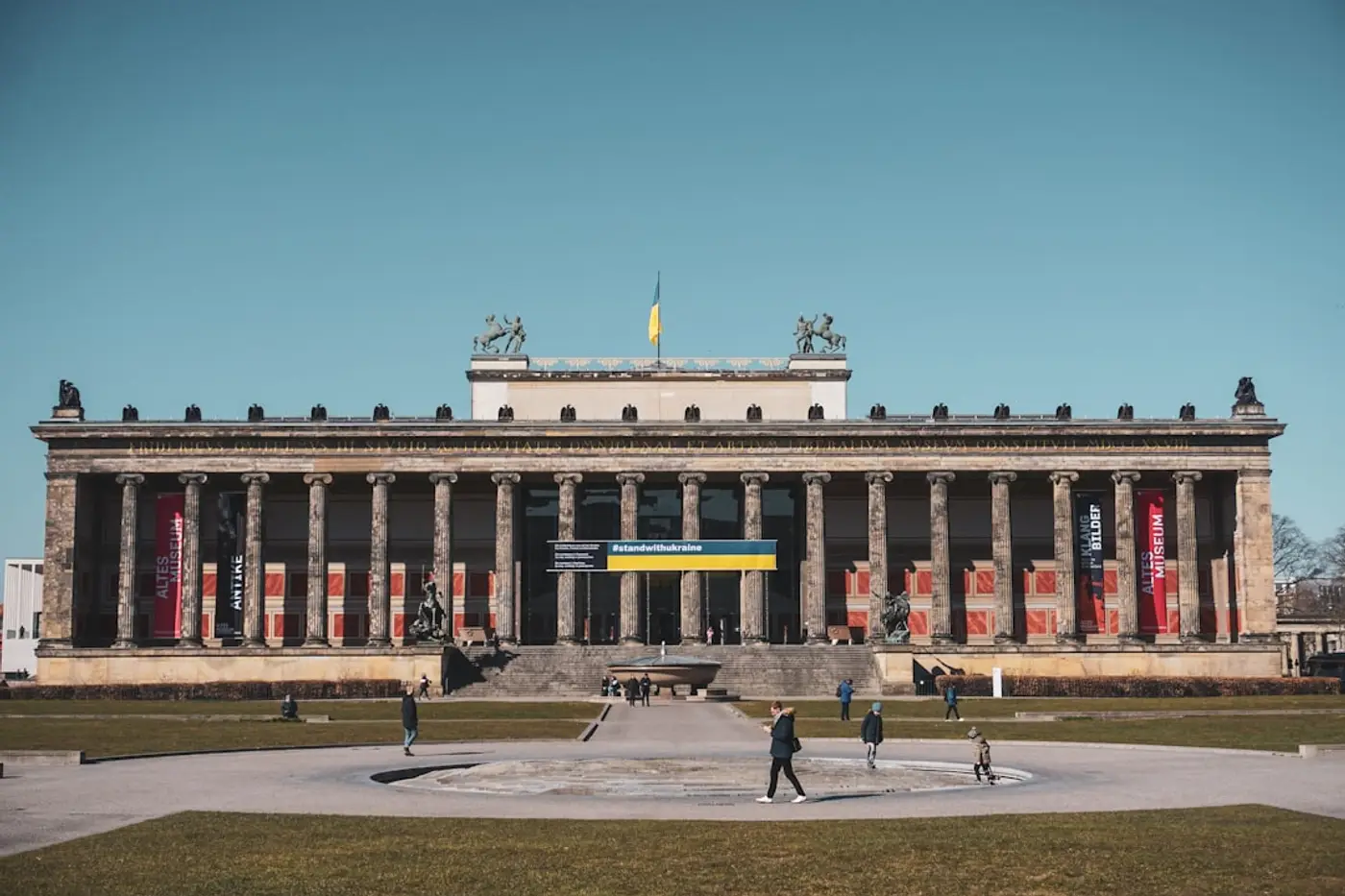
Gwendolin Kirchhoff offers philosophical counseling in Berlin-Prenzlauer Berg — in-person consultation as well as philosophical accompaniment online, in German and English.
Berlin is a city where inner searching need not hide. Therapy practices exist in every district, coaching services fill entire directories, and self-optimization courses advertise on every other billboard. The supply is vast, and precisely because of that, something can feel missing. Not because the existing formats are bad, but because what moves you needs neither a diagnosis nor a goal — it needs a space where thinking and feeling are allowed to come together. A place where the question itself carries weight before answers are sought. That is exactly what philosophical counseling is for (Achenbach, 1984).
#What is philosophical counseling, and what sets it apart?
Philosophical accompaniment is a form of intellectual work in which existential questions are not solved but taken seriously in their depth. The difference from therapy and coaching is not a dismissal of those formats. What therapy accomplishes — bringing the unconscious to the surface and enabling emotional processing — happens in philosophical work too. What coaching accomplishes — clarity about goals and structure in action — happens here as well. The path is different: not through a clinical category, not through standardized methods, but through a way of thinking oriented toward what is alive.
In practice, the philosopher brings four competencies to the conversation: Logic, which examines the inner coherence of your thoughts. An overview of tradition, which places your question within the horizon of 2,500 years of philosophical work — from Socrates through Confucius to Goethe and Schelling. Contextual disclosure, which makes visible the invisible assumptions that govern your thinking. And wisdom, which discerns when action is called for and when the wiser course lies in non-action.
#Philosophical counseling in Berlin-Prenzlauer Berg
Since July 2026, the practice has been located in Berlin-Prenzlauer Berg, on Kastanienallee in the Pankow district. If you live in Berlin, you can work here in person, in a space designed for philosophical conversation. Physical presence has a quality of its own in this work: the body speaks along, the atmosphere carries, and certain things reveal themselves when sitting face to face that are harder to grasp through a screen. Martin Buber, one of the great thinkers of encounter, knew: all real living is meeting (Buber, 1923). This holds true for the philosophical conversation as well.
A session lasts sixty minutes. The timeframe is set deliberately: focused enough to go deep, and open enough to let the conversation find its own rhythm. What happens can be described but not standardized: we enter your subject together. Not by giving advice or imposing models, but by listening for what is at work between the lines — logically, bodily, and in the voicing of what has so far only been circled around. Socrates called this method maieutics: insight is not delivered from the outside but brought to birth from what is already at work within you.
For family constellations (Familienaufstellung), physical presence is essential — they continue to take place at the practice room in Berlin-Schöneberg. Clients regularly travel from other cities because this work cannot be digitized. The bodily presence in the room, standing in a particular place, the somatic perception of order and entanglement — all of this requires the physical space.
#Philosophical accompaniment online: for those who do not live in Berlin
Regular philosophical consultations also take place online, in German and English. This format is especially suited for people who do not live in Berlin but seek the depth of philosophical work. The screen is not a compromise but a medium in its own right: the concentration on language and voice can lend the thinking process a particular sharpness.
What is possible online goes far beyond a counseling conversation. Thinking empathy — the simultaneous thinking and feeling that forms the core of this work — functions across distance as well. The decisive question is not whether a screen stands between us, but whether the willingness is there to truly expose yourself to your own thinking.
Many long-term accompaniments begin with an in-person session and then continue online. The ability to move between formats is part of this work’s flexibility. What remains constant is the standard: that every conversation opens a space in which something essential is allowed to come to language.
#Who is philosophical counseling in Berlin for?
The people who come to the practice bring no uniform set of concerns. Some face life decisions that cannot be captured in a list of pros and cons. Others carry a question that remained open after long therapy — not because the therapy failed, but because the question is philosophical in nature. Still others experience a crisis of meaning that cannot be resolved by setting new goals, but demands a deeper engagement with what meaning itself signifies. Leaders seek a space where they do not have to perform but are allowed to reflect: on the responsibility they carry and the question of where they are leading. And some come because they sense that their life follows an order they did not choose, and they want to find the courage to question that order.
You need no prior knowledge. Having studied philosophy is not a prerequisite for thinking philosophically. What counts is openness, curiosity, and the willingness to entrust yourself to a conversation with life. If it becomes clear in the initial conversation that a different path would be more fitting — whether therapy, counseling, or coaching — I say so openly. The ability to make this distinction belongs to the intellectual honesty that sustains this work.
The initial conversation is free and without obligation: thirty minutes in which we explore together whether and how this work can help you.
#The first step
Whether you live in Berlin, are willing to travel for a constellation session, or wish to work online: the path begins with a conversation. Not with a registration form, not with a questionnaire, but with the simple question of what moves you.
Book a free initial conversation
You can learn more about the process, duration, and costs in the essay Philosophical Consulting — Process, Duration, and What to Expect. If you have further questions, you can reach me through the contact page.
#Sources
- Achenbach, G. B. (1984). Philosophische Praxis. Cologne: Jürgen Dinter.
- Buber, M. (1923). Ich und Du. Leipzig: Insel.
- Heraclitus. Fragments. Trans. H. Diels. In: Fragmente der Vorsokratiker. Berlin: Weidmann.
- Novalis (1802). Die Lehrlinge zu Sais. In: Novalis Schriften. Berlin.